Musk under pressure after Starlink link to Russian ships
Story by August M
Musk under pressure after Starlink link to Russian ships
An investigation cited by TVP World found that vessels linked to Russia’s so-called “shadow fleet” are using Elon Musk’s Starlink system to communicate and coordinate operations.
According to the Kyiv Independent, which conducted the investigation, sailors working on these ships said they unknowingly became part of the covert network used to keep Russian oil exports flowing despite restrictions.
Hidden network
The shadow fleet refers to a group of aging tankers used to avoid Western sanctions on Russian oil exports.
Experts say these vessels often rely on opaque ownership structures and evasive tactics to continue operating
According to the Kyiv Independent, communication between ships and operators is maintained using Western tools, including satellite phones and Starlink terminals.
“It could be purchased through a proxy company. As far as I know, it is difficult to buy a Starlink in Ukraine now. Elsewhere in the world, you can simply order it and have it delivered by mail. It is not a weapon; everybody can buy it,” one sailor said.
Calls for action
Ukrainian officials have urged SpaceX to respond to the findings.
“Any activity by Russia’s shadow fleet effectively finances the war against Ukraine. If Starlink is being used to evade sanctions or bypass maritime safety rules, this is unacceptable,” said Vladyslav Vlasiuk, an adviser on sanctions policy, as quoted by the Kyiv Independent.
“We expect SpaceX to review this issue carefully and take steps to prevent the use of Starlink by shadow fleets of any country, including Russia, Venezuela or Iran.”
Wider concerns
The report adds to existing worries about unauthorized Russian access to Starlink technology.
According to previous reporting, Russian forces have attempted to use the system on the battlefield, prompting efforts to restrict access.
SpaceX has said it has taken steps to limit such use, including technical and contractual measures introduced in recent months.
The findings highlight ongoing challenges in enforcing sanctions and controlling the spread of dual-use technology during the conflict.
The Lebanese Red Cross is the largest humanitarian organization in Lebanon, with approximately 7,000 members/volunteers and 200 staff personnel. It operates over 250 ambulances and 46 first-aid centers across the country. Wikipedia redcross.org.lb
I received this email update:
I’m writing with another update on the evolving situation in Lebanon. Since I last emailed you, the situation in the south has deteriorated.
The scale of suffering people are now facing here is unprecedented, even for somewhere that has seen so much hardship over the years.
As conflict continues to escalate, evacuation orders are in place across roughly 20% of the country. One in five people are now registered as displaced and living in shelters, host communities, informal sites and public spaces.
People are having to make difficult choices: leave their homes for crowded shelters, or stay and risk being caught up in the fighting.
Amid this crisis, the Lebanese Red Cross remains a lifeline to people here, and we’re doing all we can to support their efforts. Local teams have been setting up shelters, and making sure those still in their homes have enough food and water to get by.
They’re also supporting those who are sick and injured. With 14 hospitals closed or damaged, and 54 health centres not operating, medical services are under severe strain. As I write this, Lebanese Red Cross ambulances are being dispatched to treat casualties, transfer blood units and transport patients.
The risks to humanitarian teams responding to the conflict in the Middle East are significant. Devastatingly, four Red Cross and Red Crescent colleagues have been killed, and many have been injured, while trying to save lives across the region.
These tragedies highlight how critical it is that every medic, every aid worker, every person carrying out life-saving humanitarian work is able to do it safely.
I want to end by reiterating something I’ve said before. Under international humanitarian law, humanitarian workers, including Red Cross and Red Crescent staff and volunteers, must be protected.
And that goes for other places, too. Around the world, Red Cross and Red Crescent teams are risking their lives amid conflict and crises to reach those who need help most – and your support is vital.
Just days ago:
……….claim were true, it would not justify broad attacks. Under international humanitarian law, an army must demonstrate that a specific object is being used for military purposes, for example, a particular ambulance in a particular location at a specific time. “You cannot simply declare that all ambulances are legitimate targets,” Bekerle said.
“What we’re seeing between Lebanon and Gaza is this big broadening of what constitutes an ‘acceptable’ target to the military,” she added. “The reality is that a civilian entity affiliated with a non-state armed group is not automatically targetable.”
Israel’s massive and unprecedented displacement orders in Lebanon have made the work of Lebanese first responders all the more dangerous.
Moussa Shaalan, a medic with the Lebanese Civil Defense in the coastal city of Sour, told Drop Site that the current war is the hardest he has experienced in more than three decades of service.
“The difference this time is that there are many more people in the villages,” Shaalan said. “They say they can’t afford the rent in other parts of the country…and that when they fled north, they were humiliated. They tell you they would rather die at home,” he added. “So the demand for emergency services under dangerous conditions is much higher.”
Most of the places being struck are still densely populated and full of children, Shaalan added. He fears the death toll will continue to rise, particularly since Israel has begun targeting civilian infrastructure such as bridges and roads that enable rescue teams to reach the wounded.
Karaki, the IHA spokesperson, said Israel’s attacks on first responders are part of a broader effort to force people from the region.
“The presence of a team of first responders offers a last remaining sense of security for people who have chosen to remain steadfast on their land,” he said. “That’s why the occupation targets healthcare workers who have nothing to do with what’s happening on the battlefield.”
Lylla Younes Investigative journalist and writer based in Beirut
Stablecoins are a type of cryptocurrency designed to maintain a stable value by pegging to fiat currencies, commodities, or financial instruments, aiming to offer a less volatile alternative to cryptocurrencies like Bitcoin.
There are four primary types of stablecoins: fiat-collateralized, commodity-backed, crypto-collateralized, and algorithmic. Each employs different mechanisms to maintain price stability; many can be found through top crypto exchanges.
Despite their potential benefits, investors should be cautious. Stablecoins involve third-party auditors for verification of reserves, which introduces risk in a system aiming to minimize third-party reliance.
Regulatory scrutiny of stablecoins is increasing worldwide due to their growing market impact, with various jurisdictions implementing measures to ensure they are backed by adequate reserves.
Tether (USDT) is the most widely used stablecoin, consistently ranking as one of the top cryptocurrencies by market capitalization, pegged to the U.S. dollar with a 1:1 backing.1
What Are Stablecoins?
Stablecoins, which can be found through top crypto exchanges, are designed to bridge the gap between the unpredictability of popular cryptocurrencies like Bitcoin (BTC) and the stability required for everyday financial transactions. By pegging their value to fiat currencies, commodities, or other financial instruments, stablecoins offer a crypto alternative with reduced volatility. As a result, they provide a more consistent medium of exchange capable of fulfilling daily transactional needs, unlike their more volatile cryptocurrency counterparts.
Stablecoins are an important part of the cryptocurrency market. Their value is designed to remain steady and they let people move money.Investopedia / Daniel Fishel
The Significance of Stablecoins in the Cryptocurrency Market
Bitcoin is the most popular cryptocurrency. On Oct. 6, 2025, it reached an all-time high of $126,198.07; however, it experiences significant price swings. For example, its price increased from around $6,000 in March 2020 to over $63,000 in April 2021, then dropped nearly 50% in the next two months. It often fluctuates over 10% in just a few hours.2
This volatility appeals to traders but makes everyday transactions risky for buyers and sellers. Investors holding cryptocurrencies for long-term appreciation don’t want to become famous for paying 10,000 Bitcoins for two pizzas. Similarly, most merchants don’t want to lose money if the price of a cryptocurrency plunges after they get paid in it.
For a currency that isn’t legal tender to work as a medium of exchange, it must stay relatively stable to ensure short-term purchasing power. In traditional fiat exchange, even 1% daily movements are rare.
As the name implies, stablecoins aim to address this problem by promising to hold the value of the cryptocurrency steady in a variety of ways.
Important
Investors should be cautious with stablecoins because they need an auditor to verify their reserves. While most auditors are trustworthy, auditing introduces another third party into a system meant to minimize third-party involvement.
Some argue that stablecoins are unnecessary because the U.S. dollar is widely accepted. Others believe digital currencies not controlled by central banks are the future. With that in mind, four types of stablecoins, based on the assets used to stabilize their value, have been created.
Tether (USDT) and TrueUSD (TUSD) are popular stablecoins backed by U.S. dollar reserves and denominated at parity to the dollar.34 As of December 2025, Tether (USDT) was the third-largest cryptocurrency by market capitalization, worth more than $184 billion.5
Posted: 5 February 2025, 11:00 CETUpdated: 25 June 2025, 10:55 CET5 min read
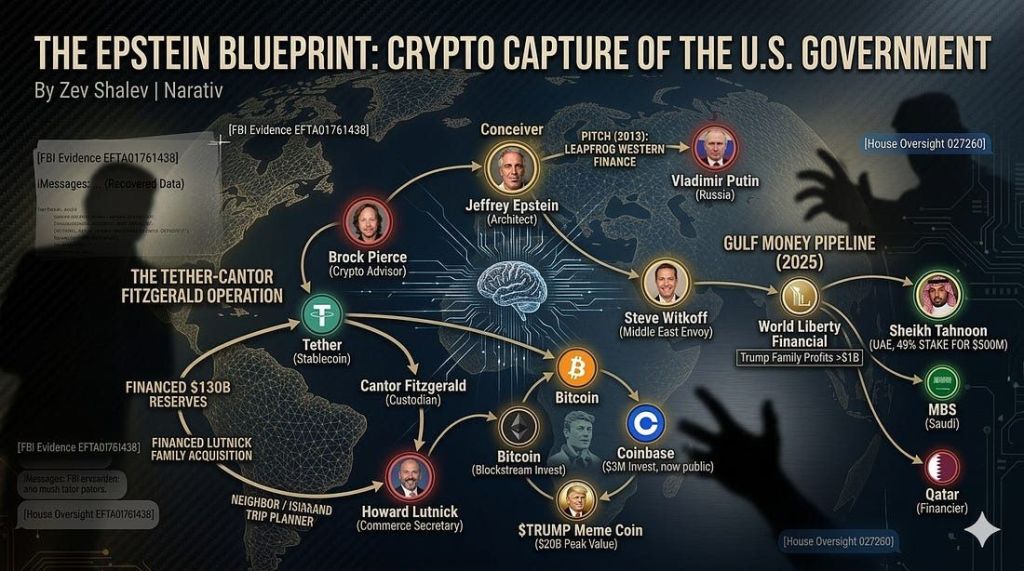
Giancarlo Devasini, a former plastic surgeon turned crypto billionaire, is one of Italy’s top 5 richest people. He’s the Chief Financial Officer of Bitfinex, a major crypto exchange, and Tether, the company behind the USDT stablecoin.
Devasini is the largest shareholder of Tether, with an estimated 47% stake, which, according to Forbes, is the source of his $9.2 billion fortune. This makes him the 3rd richest person in crypto, behind Binance founder Changpeng Zhao (CZ) and Coinbase’s Brian Armstrong.
Cantor Fitzgerald is Tether’s investment banker and has advised the stablecoin issuer with its push into the Bitcoin mining industry, Swan noted in the filing.
Nev Shalev found Epstein wrote emails ( located in The Files ) in 2013 to Thorbjørn Jagland in order he try and get Putin to utilise his plan to undermine the US dollar using the concept of stablecoin. This was a year before Putin invaded and occupied Crimea.
Already there were reported assertions about Thorbjørn Jagland (a month ago) and his relationship with Jeffrey Epstein, prior to Nev Shalev’s (see Narativ,Substack) finds:
And a trove of emails spanning years suggests that ThorbjørnJagland, a former prime minister, foreign minister, Nobel peace prize chair and secretary-general of the Council of Europe may have accepted luxury holidays to Epstein’s Palm Beach resort and his private Caribbean island, sought personal loans and engaged in sexual banter with Epstein. Police at Norway’s economic crimes unit are investigating Jagland on suspicion of aggravated corruption. Jagland has denied wrongdoing and through lawyers says he is “confident of the outcome” of the investigation.
Putin’s name appears more than 1,000 times in the released Epstein files, but the majority of those references come from news clippings and media digests Epstein received rather than his personal correspondence.
Epstein’s private emails, however, show repeated attempts in the 2010s to arrange a meeting with the Russian president, often through former Norwegian prime minister Thorbjørn Jagland. There is no evidence in the Justice Department files that such a meeting ever took place.
The Genius Act if July 2025 has now passed into law:
Tether’s situation is more complicated. USDT is the dominant stablecoin by market cap, but Tether is not a U.S.-based entity and has historically been less transparent about reserve composition. The GENIUS Act applies to any stablecoin used by U.S. persons, which means Tether either needs to comply or risk losing access to U.S. exchanges. How Tether navigates this over the next year will be one of the most consequential stories in crypto.
For smaller stablecoin projects, the compliance bar just got significantly higher. A startup issuing a dollar-pegged token from a DAO cannot meet monthly audited reserve requirements the way a regulated financial institution can. The law effectively consolidates the market around well-capitalized, compliant issuers.
Banks Are Coming, and the FDIC Already Made the First Move
On December 16, 2025, the FDIC approved a proposed rule that would let FDIC-supervised banks issue payment stablecoins through subsidiaries. The OCC followed with its own proposed rulemaking on February 25, 2026. Both agencies are working toward a July 18, 2026 deadline to finalize regulations, exactly one year after the law was signed.
This is the part that most crypto-native commentary underestimates. The GENIUS Act goes beyond restricting existing stablecoin issuers. It is an on-ramp for traditional banks to enter the stablecoin market. JPMorgan, Bank of America, and any FDIC-insured institution can now apply to issue their own dollar tokens. They bring existing deposit infrastructure, regulatory relationships, and distribution networks that dwarf anything in crypto today.
The practical effect over the next two to three years could be a stablecoin market that looks very different from the current USDT/USDC duopoly. Bank-issued stablecoins with FDIC-supervised reserve structures could capture significant market share, particularly for institutional use cases like settlement, payroll, and cross-border payments.
Mar 30 | America has assembled the largest naval and air concentration in the Persian Gulf since 2003. It has rarely had less ability to use it safely.
This photograph, taken from the southern city of Tyre, shows rockets fired from Lebanon towards Israel on March 24, 2026 | Kawant Haju
The ground invasion is grinding. The tankers are burning. The coalition is fracturing. And Iran still hasn’t fired its most consequential weapon.
Black smoke and flames rise from a burning compound following an Iranian missile strike. March 2026 | Fortune
Situation Snapshot — as of 23:59 GMT, March 30, 2026
The 82nd Airborne Division’s 1st Brigade Combat Team arrived in the Middle East on March 30, assessed as deploying to Kuwait’s Camp Arifjan, bringing total US military personnel in theater to more than 57,000 — the largest concentration since the 2003 invasion of Iraq, per Al Jazeera and Reuters.
Iran’s Strait of Hormuz toll mechanism was formalized this week. The GCC Secretary-General confirmed Iran is charging vessel passage fees settled in Chinese yuan. Iran’s parliament is moving to legislate the mechanism into permanent infrastructure, per Fortune and Lloyd’s List.
Spain closed its airspace to US military aircraft on March 30, per Air & Space Forces Magazine.
US CENTCOM has declared more than 9,000 targets struck since February 28. Reuters reported on March 27 that US intelligence can confirm destruction of approximately one-third of Iran’s total missile arsenal.
Day 32 is drawing closer to a moment that is going to define this conflict, the reality is that I will be writing many more of these updates — maximum US force in theater does not signal winding down, it does not signal no boots on the ground, it conflicts with every claim for diplomacy and claim of supremacy coming from Tel Aviv and Washington. The IDF is trapped in a ground campaign in Lebanon that is bleeding armored formations, Washington faces a degraded aerial logistics chain, and an adversary that still hasn’t used its most capable remaining weapon. There is far too much in the grey area to even comfortably declare that the US and Israel have effective regional supremacy.
1. Israel’s War Is Existential — and Lebanon Is Hezbollah’s Meat Grinder
Footage of a Hezbollah fiber-optic guided FPV drone tracking an armored vehicle — fiber-optic guidance renders standard electronic jamming ineffective. Hezbollah released the first confirmed footage of the weapon striking an Israeli Merkava tank in southern Lebanon on March 26, 2026. Southern Lebanon, March 26, 2026 | Times of Israel / CCD
Israel launched its ground operation into southern Lebanon on March 14. As of March 30, Israeli forces have not achieved a decisive advance to the Litani River, per Al-Ahram Weekly. Israel’s air campaign conducted 306 waves of airstrikes against Hezbollah targets between March 2 and March 15, with 63 percent concentrated south of the Litani River, per Alma Research Center.
Hezbollah claimed 96 operations against IDF forces on March 26 in a single day, including anti-armor attacks across the Taybeh-Qantara, Deer Syrian, Alcantara, Deb, and Alibaba axes in southern Lebanon, and missile strikes on the HaKirya IDF central command compound in Tel Aviv, per Al-Manar. Israel confirmed two soldiers killed and six wounded in the same period, per IDF spokesperson.
On March 26, Hezbollah released footage of the first confirmed fiber-optic FPV drone strike on an Israeli Merkava tank in Lebanon. Fiber-optic guidance renders electronic jamming ineffective. The Merkava in the footage carried no anti-drone cage armor, per Washington Examiner and FW-Mag. Hezbollah separately claimed destruction of a second Merkava via guided missile in Khyam, with crew casualties reported, per Al-Manar.
Israel is simultaneously absorbing ballistic missiles and drones from Iran, Hezbollah rockets and missiles reaching up to 120 kilometers inside Israeli territory, and Houthi ballistic and cruise missiles from Yemen, per ISW’s March 29 update.
Israel informed the United States it was running “critically low” on ballistic missile interceptors as of March 14, per Semafor citing US officials. Israel entered the current conflict already depleted — the June 2025 twelve-day war saw Iran launch approximately 550 ballistic missiles, during which the US expended more than 150 THAAD interceptors, approximately one quarter of total US inventory at the time, per CSIS. Arrow 3 interceptor production averages approximately 24 units per year, per the New York Times.
Israel is trapped, it started a war on the assumption that a decapitation strike and aggressive bombing campaign could crush Iran before it got started. They were wrong, Iran was ready, they saturated Tel Aviv’s defenses, they had Hezbollah batter down Israels door, Israel has been burning for weeks, its ground invasion is seeing the same attrition that Russian forces had in Ukraine. Armored Colums no longer work in a traditional military sense, Hezbollah is using fiber optic drones, this technology pioneered by Russia and Ukraine is devastating and proven. It’s use in Lebanon signals something that western militarys across the world must aknowledge, multi million dollar tanks are not the future of warfare, they are a liability. If a 500 dollar drone can destroy a 3.5 – 10 million dollar tank, technological dominance no longer is an effective deterrent. Israel cannot absorb the 70+ claimed Tank hits by Hezbollah. It can answer with more tanks, but those tanks will face the same problem. Israel is now being hit from three sides, Hezbollah, Iran, and the Houthis. Israels war is not longer about toppling Irans regime, it is about whether or not the Irans axis will stomp out what it views as a Zionist threat once and for all. Israel has killed hundreds of thousands and stolen land, carried out genocide, that is a fact. None of its neighbors are rushing to bail them out, Europe views them as the ugly cousin of America that no one likes, and America doesn’t seem like it can bail Israel out this time. Tel Aviv is in trouble and the odds are not in their favor.
2. Thousands of Troops — Nowhere Safe to Stage Them
US Marines kneel on a field beside an MV-22 Osprey as the Pentagon dispatches additional forces to the Middle East. March 2026 | New York Times
The 82nd Airborne Division’s 1st Brigade Combat Team — the Immediate Response Force, approximately 2,000 paratroopers — arrived in theater on March 30, assessed as deploying to Camp Arifjan, Kuwait, per Al Jazeera and NPR. The USS Tripoli Amphibious Ready Group, carrying approximately 2,200 Marines with F-35Bs embarked, entered CENTCOM’s area of operations this week, per Al Jazeera. The USS Boxer Amphibious Ready Group, carrying the 11th Marine Expeditionary Unit from Camp Pendleton, departed San Diego on March 19 and is not expected in theater until mid-April. Total US military personnel in theater now exceeds 57,000. An IISS senior fellow noted to Al Jazeera that the 2003 invasion of Iraq — a country significantly smaller than Iran — required approximately 300,000 troops.
Every major US installation in CENTCOM’s area of operations has sustained Iranian strikes during this campaign, per ISW and Air & Space Forces Magazine.
Prince Sultan Air Base was struck on March 27 by six ballistic missiles and twenty-nine drones. Four of six missiles penetrated Patriot coverage. Fifteen US personnel were wounded. One KC-135 tanker was destroyed and one E-3 Sentry AWACS was essentially destroyed — satellite imagery confirmed by The Aviationist via Sentinel-2 SWIR data showing fire on the apron. The Aviationist assessed the term “damaged,” used in initial reports, as “clearly an understatement.”
A US military request for blast barriers with a 72-hour delivery turnaround was reported within the current operational window, per reporting in the current campaign period.
The Iraqi government has not provided basing rights for offensive operations. Overland routes through Iraq into Iran’s operational periphery remain contested, per Al Jazeera.
The first 100 hours of Operation Epic Fury cost an estimated $3.7 billion — approximately $891 million per day — per CSIS.
The Pentagon is surging assets to the Middle East, whether it be destroyers, armored divisions, its premier airborne paratroopers, and its spear tip units Marine MEU’s, what matters more than sending troops is what you do with them. They need shelter, mess halls, uniforms, everything that most people take for granted. An army is only as good as it’s supply chain, the American force in the gulf has no lifeline. There is no resupply, units are being pulled from around the world not drawn up from calculated prepositioned reserves for this operation. If we were being generous and extended them a scenario where they had done all of those things… and in theory there was likely a large quantity of prepositioned assets. That does not change that US bases in the region were deemed largely uninhabitable, as they surge thousands of troops to the middle east where there are bases with no shelter, likely limited to no A/C. A successful campaign is not fought whilst– figuring it out. It is won with meticulous planning and a well supplied and healthy force. Washington can provide none of those things, it cannot even ensure the security of its most valuable command and control assets at the most hardened airbase in the region. This is room for major concern, they can send the troops, but what do they do with them when their basing apparatus is in ruins, when theyre early warning system and air cover capacity is degraded? The way the Pentagon is acting– it does not seem like they have any answers.
3. Tit for Tat — Making America’s Allies Think Twice
Burning vehicles amid debris and smoke following Iranian retaliatory strikes — Reuters confirmed the image as part of Iran’s March 30 wave. March 30, 2026 | Reuters
Iranian strikes on March 29 hit the Alba aluminium facility in Bahrain, injuring two employees, and the Emirates Global Aluminium plant in Abu Dhabi, causing what the company described as “substantial damage” and injuring six workers, per ISW’s March 29 Special Report. Iran simultaneously formalized its Hormuz toll system, with fees confirmed to be settled in Chinese yuan, per Fortune and Lloyd’s List, as Iran’s parliament moved to legislate the mechanism as permanent infrastructure.
India — Indian Foreign Minister Jaishankar engaged directly with Iranian Foreign Minister Araghchi. Two LPG carriers, the Pushpak and the Parimal, transited the Strait of Hormuz successfully on March 14. India is negotiating passage for at least 23 additional tankers, per the Wall Street Journal.
Pakistan — Pakistan brokered a 20-ship Hormuz transit arrangement, confirmed by Al Jazeera on March 29.
China — China sources approximately 45 percent of its oil through the Strait of Hormuz and entered direct negotiations with Tehran for crude oil and Qatari LNG passage from the conflict’s earliest days, per Reuters, citing three diplomatic officials. At least 30 vessels claimed Chinese ownership or crew on their AIS transponders in the conflict’s first weeks to secure transit, per Reuters.
Japan — Japan sources 90 to 93 percent of its crude oil through the Strait of Hormuz. Iranian Foreign Minister Araghchi communicated directly with Japanese Foreign Minister Motegi on March 21, committing to permitting the transit of Japanese-related vessels, per Al Jazeera and the Japan Times. Japan activated strategic petroleum reserve releases and emergency energy measures. Japan’s pacifist constitution prevents the deployment of warships to the strait, per Al Jazeera.
South Korea — South Korea implemented its first domestic fuel price cap since the 1997 financial crisis, per ABC Australia. North Korea launched ten ballistic missiles into the Sea of Japan on March 18, exploiting the redeployment of US assets from the Korean Peninsula, per ABC Australia.
Australia, the UK, and the Five Eyes — US asset redeployments from the Indo-Pacific are generating documented concern about reduced deterrence capacity against China across the region, per ABC Australia.
Spain — Closed airspace to US military aircraft on March 30, per Air & Space Forces Magazine.
Germany’s Foreign Minister stated, “Are we about to become actively involved in this conflict? No,” per PBS NewsHour.
France — Conditioned any escort mission support on hostilities diminishing first, per PBS NewsHour.
Ukraine — Providing intelligence and limited technical assistance to the coalition, per ISW.
This strategy is tactically the right move, the United States has historically had the pressure to leverage concessions out of European and Gulf “allies” however Iran is demonstrating a new strategy. Make that compliance more costly than removing themselves from the conflict. Every time the US or Israel hit a target in Iran, Iran strikes America’s allies, Israel hits steel, Iran hits Aluminium production in the UAE and Bahrain. It is not the US that gets punished for American and Israeli action, it is those states that host its forces and global trade. Iran is deliberately not escalating, their strikes are still also tailored to damage not destroy key facilities like De-Salination and Refineries. The message is not that we will destroy you, its that we can, so make the right choice. This presents them as giving Gulf monarchies an off ramp, stop allowing US strikes, we wont do billions of dollars in damage. For Gulf states, accepting this would be to accept that Iran has defacto control of gulf shipping. This alters the dynamic of the Horn of Africa and the middle east in a massive way.
4. The Room That Can’t Read the Map
US Defense Secretary Pete Hegseth addresses troops, as Reuters reported his directive to slash the senior-most ranks of the US military. At least 24 generals and admirals were fired or forced out in the twelve months before Operation Epic Fury began. March 2025 | Reuters
In the twelve months before Operation Epic Fury began, the United States fired or forced out at least 24 generals and admirals, according to Reuters and Foreign Policy. Among those removed: the CENTCOM commander who built the Iran operational architecture, the NSA director running signals intelligence collection against Iranian forces, and the Director of the Defense Intelligence Agency. The DIA Director was removed after his agency assessed that June 2025 strikes on Iranian nuclear sites had delayed Iran’s program by months rather than years — directly contradicting the president’s public claim that the sites had been “obliterated,” per Reuters and Foreign Policy.
The current CENTCOM commander, Admiral Brad Cooper, took command six months before the conflict began, inheriting an operational plan built by Army General Michael Kurilla, who spent more than three years developing institutional knowledge of Iran’s specific order of battle, underground infrastructure, and force posture, per Foreign Policy.
Lieutenant General Joe McGee — Joint Staff director of strategy and war plans, with 10 combat deployments — was forced out four months before the war began amid sustained tensions with Pentagon leadership, per Foreign Policy.
US CENTCOM has surpassed 6,000 combat sorties in Operation Epic Fury, per Army Recognition.
Reuters reported on March 27 that the US can confirm the destruction of approximately one-third of Iran’s missile arsenal despite more than 9,000 declared targets struck.
The degree of what I coin as leadership rot has becoming nearly undeniable at this point, the purge of high quality leadership across the pentagon is well documented. When Pete Hegseth took control of the Pentagon, a record number of generals and admirals were sent out the door. This operation is un coordinated, reactionary, and chaotic because no one has the operational knowledge and expertise to react to a peer level adversary when they expected a quick and easy regime change. The decisions being made lack tactical backing, because those decisions are being drawn from a book, not devised by a brain trust of military excellence. This may be the single scariest part of this for me, as what that means for possible outcomes, when facing a tactical adversary as advanced and well entrenched as Iran is a non-starter from Day 1. My observation is that the United States and Israel have not held the initiative, Iran has, that initiatve dictates the direction of a conflict, and it is absolutely being steered in a direction that no one in the Situation room is prepared for.
5. Bend It Until It Breaks — Running a War on Dinosaurs
Damaged US Air Force KC-135 Stratotanker refueling aircraft on the tarmac at Prince Sultan Air Base following an Iranian strike. Five KC-135s were damaged in the March 13 strike — a second strike on March 27 destroyed one more and damaged three additional airframes. Prince Sultan Air Base, Saudi Arabia, March 2026 | via Wall Street Journal
The KC-135 Stratotanker fleet sustaining Operation Epic Fury’s extended-range air campaign averages more than 60 years of age per airframe. The KC-46A Pegasus replacement program remains years behind schedule and numerically insufficient to cover the gap, per Breaking Defense. Veteran KC-135 base commanders described to The War Zone a fleet operating with no meaningful parts inventory in which every flight hour represents irreplaceable material degradation.
On March 12, a KC-135 crashed in western Iraq, killing all six crew members. A second tanker involved in the same incident was rendered non-operational, per CENTCOM, Al Jazeera, PBS NewsHour, Reuters, and Breaking Defense.
On March 27, the Prince Sultan Air Base strike destroyed one KC-135 and damaged three more, per Air & Space Forces Magazine. Satellite imagery published by The Aviationist, confirmed via Sentinel-2 SWIR data, showed fire on the apron consistent with multiple aircraft losses.
Five KC-135 tankers were damaged in an earlier strike on Prince Sultan Air Base on March 13, per the Wall Street Journal and Al Jazeera.
The E-3 Sentry AWACS essentially destroyed on March 27 was one of six based at Prince Sultan, per Air & Space Forces Magazine and The Aviationist.
A fire broke out in the laundry room dryer vent aboard the USS Gerald R. Ford and burned for more than 30 hours. More than 600 sailors were displaced from berths and reported sleeping on floors and tables. Three sailors were injured. The Navy and CENTCOM confirmed the ship remained fully operational and continued flight operations, per the New York Times, Navy Times, and Stars and Stripes.
Spain’s airspace closure on March 30 compresses the geographic options available for positioning tanker orbits supporting operations in theater, per Air & Space Forces Magazine.
Radar installations supporting Patriot and THAAD batteries have sustained confirmed damage across multiple strikes during the campaign, per ISW.
Iran is striking radars, it is hitting refueling tankers, and forcing the US to put thousands of flight hours on airframes that are on their last legs. At this point, the attrition delivered on US forces is visible, and constitutes a re-evaluation of the tactical picture. Iran keeps hitting key assets, Washington cant keep its bases from burning, the USS Gerald R. Ford the most advanced aircraft carrier in the world as forced to dock because of a laundry room fire that destroyed 4 berths, forced the US to liquidate its entire stock of black boots from European stockpiles and cost 10s of millions of dollars in damage. The United States does not appear collected, it appears to be fraying at the seams, as its military doctrine faces something created to pick at the fiber that holds US military supremacy and doctrine together. This fiber frays more and makes more key assets more vulnerable. This is a feedback loop, the US can send in more naval assets, but those assets require a different type of resupply, one that is vulnerable to the weapons that Iran has held conspicuously in reserve. Those bases were essential to US regional doctrine, they worked with US naval forces to create a situational awareness that was meant to counter Iranian missile threat. That doctrine has failed, the US is failing to adjust with the rapidity needed, and it is showing.
6. Kharg Island Is a Kill Box
Bloomberg annotated satellite map of Kharg Island showing oil terminals, storage, the airfield struck March 13, power plant, and port facilities. Kharg Island, Persian Gulf, Iran | Bloomberg
Kharg Island processes approximately 90 percent of Iran’s crude oil exports and sits approximately 25 kilometers off Iran’s southwestern coast, per standard geopolitical reference sources. The USS Tripoli Amphibious Ready Group — carrying approximately 2,200 Marines with F-35Bs embarked — is the assessed amphibious assault force for any Kharg operation, per Al Jazeera.
Reuters reported on March 27 that US intelligence can confirm destruction of approximately one-third of Iran’s missile arsenal. Independent OSINT analysts and satellite imagery have contradicted multiple IDF and CENTCOM claimed strike outcomes throughout the campaign.
No US minesweeper assets have been confirmed in theater, per ISW. Iran retains one of the world’s largest naval mine inventories — including moored contact mines, bottom influence mines, and rocket-propelled mines deployable by submarine, surface vessel, or aircraft — per CSIS.
Iran retains coastal TEL-launched anti-ship ballistic missiles capable of targeting surface combatants throughout the Persian Gulf. No confirmed systematic destruction of coastal TEL infrastructure has been independently verified in open source, per ISW and Reuters.
Iran’s IRGC Navy fast attack craft fleet remains largely intact. No confirmed naval engagement at scale has occurred in this campaign, per ISW.
Houthi forces demonstrated sea drone capability against commercial shipping during the 2024 Red Sea campaign. That capability has not been deployed against US naval assets in the current conflict, per ISW.
No hospital ships have been confirmed in theater, per ISW. Gulf Cooperation Council partners face documented Iranian threats against any medical facility treating US casualties, per ISW.
Kharg Island is the only point of leverage that a desperate Washington can see, Hormuz is closed, and they cannot force it open. India, Pakistan, and China are showing that there is another way. If the United States cannot open the strait, it runs the risk of losing its soft power over its key allies. Japan, Europe, Australia, and others. Kharg Island is what they view as that last ditch chance to get Iran to change direction. Iran knows it, Hormuz is a kill box, the United States intends to sail 2,200 marines into it. Those ships run the risk of entrapment, there are no minesweepers, Iran has not used an antiship ballistic missiles, the Houthis have not deployed sea drones, hundreds of TELS are unaccounted for despite claims from the IDF and CENTCOM, which have been proven by real satellite imagery and OSINT analysts to be largely fabricated. What Iran wants is the prize, a symbolic victory, and American sailors in the water, marines stranded and dying on Kharg Island, and the symbol of US power projection, a ship bearing a presidents name aflame or sinking to the bottom of a shallow strait. This is what Iran is setting up, and it appears to be what the United States is sailing into. A desperate enemy is the easiest to defeat, and Washington and Tel Aviv are desperate, and that has big consequences.
U.S. Air Force airmen prepare for aerial refueling on a KC-135 Stratotanker aircraft during Operation Epic Fury over the U.S. Central Command area of responsibility, March 20, 2026. | (U.S. Air Force photo) U.S. Central Command Public Affairs
By Day 32, Operation Epic Fury has surpassed 9,000 declared targets struck, 6,000 combat sorties flown, and 57,000 US personnel deployed — the largest US military concentration in the Persian Gulf since 2003, per CENTCOM, Army Recognition, Al Jazeera, and Reuters. US intelligence assesses confirmed destruction of approximately one-third of Iran’s missile arsenal, per Reuters. Patriot battery capacity across the theater is assessed at approximately 40 to 50 percent, per ISW and JINSA. The aerial refueling architecture sustaining extended-range strike operations has absorbed the confirmed loss or destruction of at least three KC-135 airframes and damage to several more across two separate strikes on Prince Sultan Air Base and one crash in Iraq. Spain’s airspace closure on March 30 further compresses tanker orbit options. Iran has not yet deployed anti-ship ballistic missiles against naval assets, sea drones, or activated its naval mine inventory. The selective Hormuz passage system has produced bilateral transit arrangements with India, Pakistan, China, and Japan — each negotiated independently of the US-led coalition, per Al Jazeera, Reuters, Wall Street Journal, and Japan Times. Germany declined participation, France conditioned support on hostilities diminishing, and Spain closed its airspace on the same day the 82nd Airborne arrived in theater, per PBS NewsHour and Air & Space Forces Magazine.
The United States is at peak physical presence and declining operational freedom simultaneously. Iran is at peak strategic patience and advancing terminal strike positioning simultaneously. Everything visible in the open-source record is consistent with an adversary that has engineered a specific terminal outcome and is waiting for the conditions to ripen. The question for Day 33 is not whether Iran’s strategy is working. It is whether anyone in the room managing this war is capable of reading the map before the shot opens, and even if they are, is leaving hundreds of sailors and marines stranded on Kharg Island an acceptable decision, or do they surge Americas most symbolic assets into a kill box. I have never been more unsure.
— I will continue to keep you updated.
Note: I am committed to providing you with the best available information regarding the wider world. This work is hard, exhausting, and it does not pay. Any support you can provide is now more important than ever. Thank you.
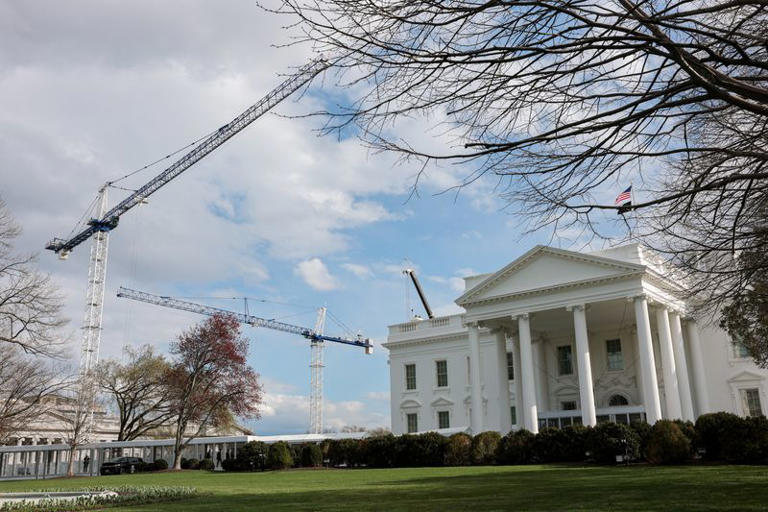
WASHINGTON, March 31 (Reuters) – A U.S. judge said on Tuesday that President Donald Trump cannot construct his planned $400 million ballroom on the site of the White House’s demolished East Wing without approval from Congress, halting for now one of the Republican president’s most visible efforts to reshape the seat of American power.
Pope Leo has said God ignores the prayers of leaders who wage war and have “hands full of blood”, in an apparent rebuke to the Trump administration.
The pontiff made the comments on Sunday as thousands of US troops arrived in the Middle East and days after the US defence secretary, Pete Hegseth, prayed for violence against enemies who deserved “no mercy”.
During a Palm Sunday mass in St Peter’s Square, the pope said the conflict between Iran, Israel and the US was “atrocious” and that Jesus could not be used to justify war.
“This is our God: Jesus, king of peace, who rejects war, whom no one can use to justify war,” he told tens of thousands of worshippers. “He does not listen to the prayers of those who wage war, but rejects them.”
Quoting a Bible passage, Leo added: “‘Even though you make many prayers, I will not listen: your hands are full of blood.’”
Israel killed three journalists in south Lebanon on Saturday, their TV channels and authorities said, prompting condemnation from the Lebanese government who called the killings a “blatant war crime”.
Ali Shoeib, from the Hezbollah-owned al-Manar television station, Fatima Ftouni and her brother and cameraman Mohammed Ftouni from the pro-Hezbollah outlet al-Mayadeen, were killed in the strike targeting their car.
Israel claimed the attack shortly afterwards, saying the target was Shoeib, whom it accused of being a Hezbollah “terrorist” in an intelligence unit who had reported on the locations of Israeli soldiers in southern Lebanon. The Israeli military provided no further evidence to support the claim and made no comment on the killing of the other journalists.
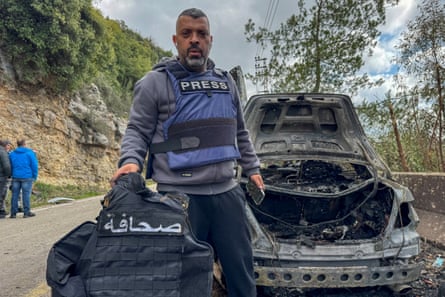
Jamal al-Ghurabi, a journalist for al-Mayadeen, holds up press vests removed from the car. Photograph: Ali Hankir/Reuters
Shoeib was a well known war correspondent in Lebanon, where he reported for al-Manar for nearly three decades. His death was met with a wave of condolences from audiences and journalists in Lebanon, many of whom said he was considered a mentor figure in Lebanese journalism.
Ftouni had also been reporting from the frontlines of the Israel-Hezbollah war in recent days, filming in front of battles in the town of Taybeh, south Lebanon. Her own family had been killed in Israeli strikes weeks earlier.
Eighteen months earlier, she and her colleagues were struck by an Israeli bomb while they were sleeping in a hotel in south Lebanon; Ftouni survived but two of her colleagues did not. Commenting on the deaths of her colleagues at the time, Ftouni said that “it is the silence of the international community that let this happen”.
The three journalists were struck as they were driving in Jezzine, a district in south Lebanon far from the frontlines. Local television showed at least four missiles were shot at the car and footage appeared to show a missile being fired between the journalists’ car and bystanders as the latter tried to approach and help. Video of the aftermath showed singed press jackets and helmets, as well as tripods and microphones that had been pulled from the car.
West Bank: IDF launches investigation after CNN footage shows soldiers confronting crew at gunpoint
During filming at an outpost near Tayasir, a CNN crew said a soldiers pointed weapons at them while making remarks about the future of the outpost and the West Bank
i24NEWS
3 min read
March 29, 2026 at 05:11 AMlatest revision March 29, 2026 at 05:12 AMFile photo of clashes involving Israelis and Palestinian in the West Bank village of Qusra, October 29, 2024. Flash90
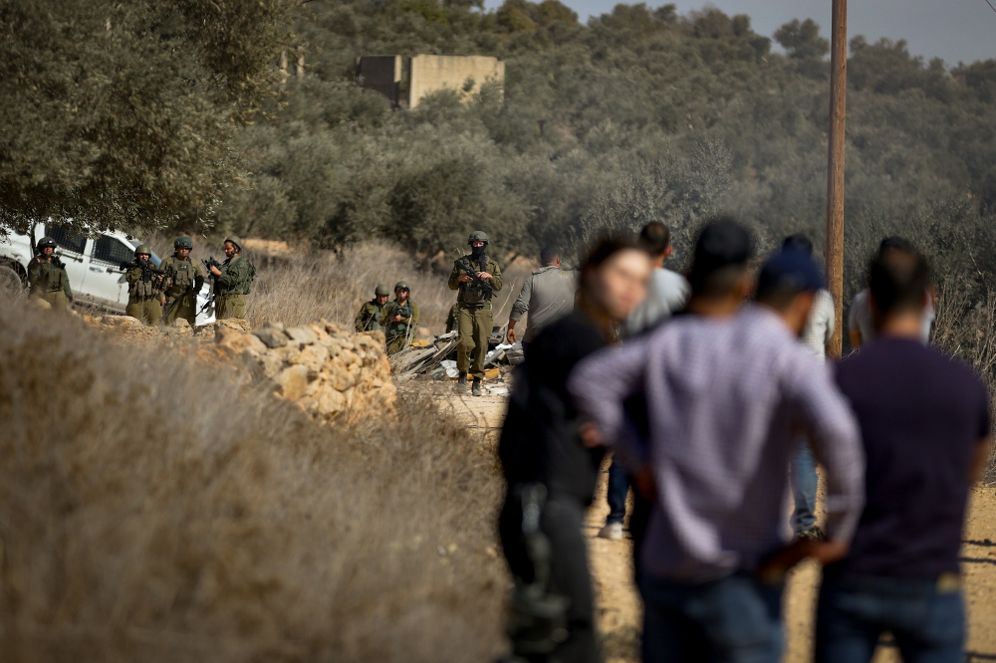
Footage aired by CNN from a report on rising tensions in the West Bank has sparked international controversy after documenting a confrontation between Israel Defense Forces soldiers and a film crew.
The incident took place in the northern West Bank, where CNN correspondent Jeremy Diamond and his team had arrived to cover an outpost established in memory of Yehuda Sherman, who was killed in a prior attack near Homesh.
According to the footage, IDF soldiers approached the crew during filming, pointed their weapons at them, and ordered them to sit on the ground.
Ben Delo is a 42 year old billionaire and co-founder of the BitMex cryptocurrency trading platform.
He is autistic and has managed to flourish academically after he found educational support as a child in the British education system.
He has donated to many charities and science research endeavours. He has made a £25 million donation to the Sheila Coates Foundation, a charity he founded in 2020 to support young people with autism.
In 2019, he signed the Giving Pledge created by Bill Gates, his then-wife Melinda French Gates and Warren Buffett, which has led to hundreds of the world’s wealthiest people promising to give away at least half of their fortunes during their lifetimes.
Trump pardoned him in 2025, when he had been accused of money laundering in the US:
The co-founders, Arthur Hayes, Benjamin Delo and Samuel Reed previously pled guilty to violating the Bank Secrecy Act, for failing to maintain anti-money laundering and know-your-customer programs, as did former business development chief Gregory Dwyer.
Prosecutors accused the men of effectively operating BitMEX as a “money laundering platform” and that its purported withdrawal from the U.S. market was “a sham.”
Once someone has been pardoned by Trump they seem to return the favour by encouraging social change which seems to fit with extremist Project 25 type ambitions to break democracies, in this case the British democracy.
This recent article in The Guardian drew my attention:
Revealed: a crypto billionaire’s political base hosting ‘anti-woke’ and rightwing activists in Westminster
Pardoned by Trump after violating US banking law, Ben Delo provides funding, networking, and podcasting space for a range of groups, including those with hardline views on migration and abortion
A British billionaire convicted in the US for failing to implement adequate money-laundering controls on his cryptocurrency business is funding a political base in the heart of Westminster used by “anti-woke” and rightwing activists.
Ben Delo, 42, who was pardoned by Donald Trump last year, has given support in kind to Rupert Lowe, the anti-migration MP challenging Nigel Farage from the right – while also connecting with mainstream figures including the Conservative leader Kemi Badenoch and former cabinet minister Michael Gove.
Delo, an Oxford graduate who moved to Hong Kong in 2012 and appears to still be based there, says he is a champion of “free speech” and has vowed to tackle the “nuisance” of political correctness. He supports more than 50 organisations ranging across the political spectrum and public life, as well as non-affiliated groups and individuals.
Now a joint investigation by the Guardian and Hope Not Hate reveals some of the people and projects that have benefited from Delo’s largesse.
Among them are those who have expressed hardline positions on immigration, nationalism and abortion.
Delo, who says he has poured more than £100m into philanthropy, is providing funding, networking opportunities and help in kind via a suite of rooms in a building overlooking Westminster Abbey, known as the Sanctuary. Those given access can use the facility free of charge for events, office space and podcasting.
Restore Britain, the party founded by Lowe, a former Reform UK MP who now sits as an independent, launched its campaign for the mass deportation of millions of migrants from a room at the Sanctuary last year.
The pardon marks the latest example of the abrupt U-turn Washington has taken on digital assets since Trump’s inauguration.
President Donald Trump has granted a pardon to Binance founder Changpeng Zhao, the White House confirmed Thursday. | Jason Redmond/AFP via Getty Images
By Declan Harty10/23/2025 12:20 PM EDTUpdated: 10/23/2025 01:34 PM EDT
Zhao’s case was a major victory for the Biden administration, coming just weeks after a jury found Sam Bankman-Fried guilty of multiple counts of fraud and conspiracy in connection with the collapse of his company, FTX, a onetime rival to Binance. (Bankman-Fried, who was sentenced to 25 years in a federal prison, is also angling for a pardon, according to the New York Times.)
At that time, prosecutors and financial regulators had an icy stance toward crypto that the industry has long painted as hostile — a fact that helped galvanize crypto advocates to support Trump, who embraced them (and their very wealthy donors) during his re-election campaign.
Trump, once a skeptic of digital assets, is now a full-fledged crypto mogul. Having amassed more than $5 billion in paper gains through his own and his family’s various crypto projects, Trump’s digital asset portfolio now eclipses his real estate holdings.
But Trump’s success in crypto is thanks in no small part to connections he and his eldest sons have forged with industry bigwigs, including Zhao, whose own net worth is estimated at more than $85 billion.
The Trump family’s crypto platform, World Liberty Financial, is hosted by Binance, and the exchange has been a key driver in the growth of World Liberty’s dollar-pegged token, USD1. Earlier this year, as Zhao was activelyh seeking a pardon, Binance accepted a $2 billion investment from an Emirati-backed investment firm using USD1 — a boon for World Liberty Financial, which effectively received a $2 billion bank deposit
And charges dropped against Justin Sun, crypto billionaire:
Sun, who was born in China but now a citizen of Saint Kitts and Nevis, is facing civil charges in the United States for fraud and market manipulation, but his SEC lawsuit was paused earlier this year when the Trump administration dropped virtually all of its lawsuits and investigations against alleged crypto violators.
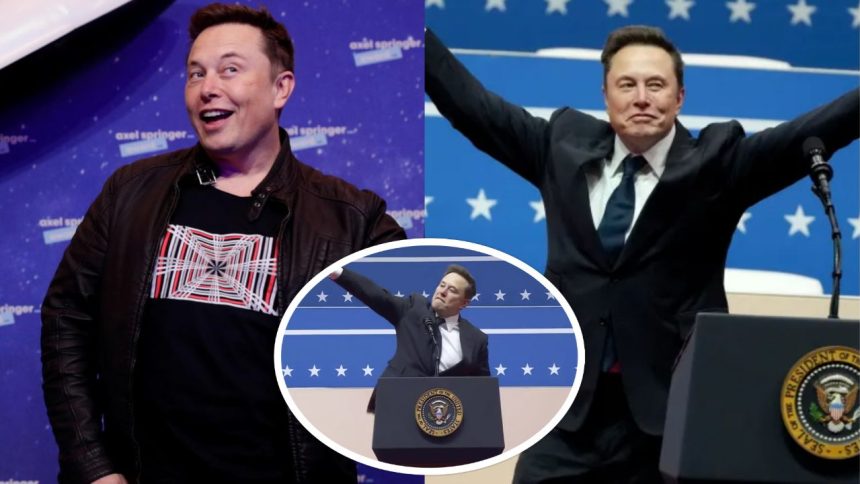
Elon Musk, the enigmatic billionaire and tech mogul behind Tesla and SpaceX, has always been a subject of fascination, controversy, and endless speculation. Whether he’s launching rockets into space, shaking up social media with provocative posts, or casually revealing personal details about himself, Musk keeps people talking.
Margaret Ryan, the top enforcement official at the Securities and Exchange Commission — the agency tasked with investigating insider trading and other illegal activities in financial markets — abruptly resigned last week, after just six months on the job.
Reportedly, Ryan wanted to be more aggressive in pursuing charges of fraud and other misconduct, including against Trump’s inner circle. But the SEC’s chairman, Paul Atkins, and other Republican appointees to the commission wouldn’t let her.
When Trump appointed Atkins chair of the SEC, he was co-chair of the Token Alliance, a cryptocurrency advocacy group, and he owned $6 million worth of holdings in crypto-related businesses.
During Atkins’s time at the SEC, the commission has dropped or settled numerous lawsuits with cryptocurrency companies and adopted a lax regulatory approach to fraud.
It’s also avoided politically sensitive cases — such as, let me hazard a guess, insider trading by Trump’s family and cronies.
Why do I mention insider trading by Trump’s family and cronies?
Because on Monday, March 23, at 7:05 a.m. ET, Trump posted on his Truth Social platform that Washington had held “VERY GOOD AND PRODUCTIVE CONVERSATIONS” with Tehran over a “COMPLETE AND TOTAL RESOLUTION” to hostilities.
Immediately, the stock market roared to life. The S&P 500 futures soared more than 2.5 percent before the opening bell. And oil futures (bets on the future prices of oil) plummeted, dropping 14 percent in a matter of minutes.
But something very peculiar happened 15 minutes before Trump’s post.
I apologize in advance for giving you a bunch of charts, but it’s important that you see exactly what happened at 6:50 Eastern Time Monday morning.
At 6:49 a.m. ET, traders placed 734 bets on crude oil contracts on the New York Mercantile Exchange. One minute later, at 6:50 a.m., that number had jumped to 2,168 — equivalent to about $170 million.
At the same time — 15 minutes before Trump’s announcement — West Texas Intermediate futures also saw a huge spike in trading activity.
The same pattern was seen in contracts for Brent crude, the other major oil benchmark. Between 6:48 a.m. and 6:50 a.m. ET, the volume of trades rose from 20 to more than 1,650. That’s about $150 million in contracts.
A similar spike in trades occurred between 6:49 a.m. and 6:50 a.m. ET in futures contracts for the Standard & Poor 500 stock index, the Euro Stoxx 50, and other stock markets.
At 6:50 AM ET, $1.5 billion in notional value of S&P 500 futures contracts were bought.
In other words, 15 minutes before Trump announced that the U.S. would postpone strikes against Iran’s energy infrastructure, the volume of stock market trades mysteriously spiked and the price of oil just as mysteriously plunged.
Yet at that time — 15 minutes before Trump’s announcement — there were no public indications that any serious talks had been taking place between the U.S. and Iran.
So this huge spike in stock market trades and drop in oil futures must have been made by someone, or some people, who had prior knowledge of Trump’s announcement.
This person or these people made a boatload of money off this inside information.
But who was the inside trader, or traders, who placed such huge bets on Trump doing exactly what he did?
Could it be, say, Jared Kushner, Trump’s son-in-law, who is one of the people representing the United States in negotiations with Iran, and is also operating a private-equity firm with over $6 billion in investments, heavily funded by Middle Eastern sovereign wealth funds, especially Saudi Arabia’s Public Investment Fund?
Or Steve Witkoff, who’s also representing the U.S. in these negotiations and who also has his own investment firm?
Or Howard Lutnick?
Or Melania?
Or all of them?
Who knows?
The Securities and Exchange Commission is in charge of policing against such insider trading. On the basis of the trading I mention above, ordinarily the SEC by now would have opened an investigation.
But so far, nothing.
This isn’t the first time spikes in betting have occurred just before Trump did something unexpected.
In January, wagers surged on Polymarket, a crypto-powered predictions platform, as bets were made on Venezuela’s president Nicolás Maduro being out of power by the end of the month. Hours later, he was seized by American forces. (One account made more than $436,000 from a $32,537 bet.)
Why should we worry about people with insider information profiting in the stock market, futures markets, or even crypto-powered predictions markets?
For one thing, it’s unfair. It hurts average investors while increasing the wealth of certain people who know, for example, what Trump is about to do (including Trump and members of his family).
For another, such rigging erodes public confidence in market fairness, which ultimately destroys markets. Put simply, if the public believes the market is rigged in favor of privileged individuals, they may withdraw their investments.
This is why the Securities and Exchange Commission is supposed to police the market against insider trading.
And why we should all be concerned that the top enforcement officer at the SEC abruptly resigned last week because the SEC’s chairman and other Republican appointees wouldn’t allow her to be more aggressive in pursuing charges of fraud and other misconduct against Trump’s inner circle.
And why what occurred Monday morning, 15 minutes before Trump’s public announcement, is so damned troubling.
Friends, there’s a word for this. It’s called corruption.
Several accounts on the online platform Polymarket laid bets on a US-Iran ceasefire over the weekend that appeared to show signs of insider knowledge, according to experts.
Eight accounts, all newly created around 21 March, bet a total of nearly $70,000 (£52,000) on there being a ceasefire. They stand to make nearly $820,000 if such a deal is reached before 31 March.
………..past few days, from 6% on 21 March to 24% by Monday. More than $21m is currently being wagered on this outcome.
Online prediction markets such as Polymarket and Kalshi are rapidly becoming a feature of modern warfare.
Timely bets laid this year suggest insiders may be using them to profit from secret information, such as Trump’s plans to kidnap the Venezuelan leader, Nicolás Maduro, or the timing of US-Israel attacks on Iran.
Polymarket, whose investors include a venture capital firm owned by Donald Trump Jr, has faced criticism and regulatory scrutiny over potentially
facilitating war profiteering and insider trading.
A New York Times story recently found that while the company described itself as “News 2.0” – a parallel source of information harnessing the power of prediction markets – its own social media feeds are full of falsehoods.
On several Discord channels devoted to Polymarket, users and automated bots on Monday traded tips on how to monetise the war – including arbitrage between different platforms, and following users with a history of good bets.
One post suggested users wager “YES” on “US x Iran ceasefire by March 31” because three historically profitable traders on the platform had bet “yes”, and a historically unprofitable trader had bet “no”.
Insider knowledge may not be enough to win this particular bet on Polymarket, as it requires both the US and Iran to agree that a ceasefire has been reached.
Venezuela’s Delcy Rodríguez Allegedly Hired Former US Lawmaker in $50M Bid to Influence Trump White House
The accusation came to light amid the trial of David Rivera, a former GOP Florida Rep who allegedly pushed officials to ease pressure on Maduro’s government during Trump’s first term
By Pedro Camacho Published 03/23/26 AT 5:27 PM EDT
Prosecutors allege that Venezuela‘s interim President Delcy Rodríguez authorized a $50 million contract to hire former U.S. congressman David Rivera to lobby the Trump administration as a federal trial examining the alleged influence campaign began Monday in Miami.
The case centers on claims that Rivera, a Republican who once represented Florida, used his political connections to push U.S. officials to ease pressure on Nicolás Maduro‘s regime during Trump’s first term.
Prosecutors say Rodríguez, then Venezuela’s foreign minister, directed a subsidiary of state oil company PDVSA to sign the consulting agreement with Rivera’s firm as part of the effort. “This case is about two things: greed and betrayal,” prosecutor Roger Cruz said in his opening statement reported by The Associated Press, adding that the evidence would show the defendants “made a pact to secretly lobby for Nicolás Maduro… and his second in command Delcy Rodríguez.”
According to the indictment, Rivera sought to arrange meetings with U.S. officials and business leaders, including efforts to connect Rodríguez with then-Rep. Pete Sessions and facilitate outreach to Exxon Mobil. Prosecutors allege the lobbying campaign aimed to improve relations with Washington and potentially ease sanctions on Venezuela. Rivera was ultimately paid about $20 million, according to court filings cited by Reuters.
The trial is also expected to examine Rodríguez’s role in coordinating the outreach. Prosecutors say she relied on Rivera to organize meetings in cities including Washington, New York and Dallas as part of a broader attempt to build support within U.S. political and business circles.
Rivera and his co-defendant, political consultant Esther Nuhfer, have pleaded not guilty to charges including failing to register as foreign agents and conspiracy to commit money laundering. Defense attorneys argue that Rivera’s work was commercial in nature and tied to efforts to attract investment to Venezuela’s energy sector, which they say would not require registration under the Foreign Agents Registration Act.
“This is like a murder case without a murder,” Rivera’s attorney Ed Shohat told jurors. “Nothing happened… Not one single policy of the U.S. was impacted by this case.”
The proceedings are expected to feature testimony from Secretary of State Marco Rubio, a former political ally of Rivera. Prosecutors say Rivera viewed Rubio as a key contact in his outreach to the White House.


:max_bytes(150000):strip_icc():format(webp)/terms_s_stablecoin_FINAL-89e1671b1f24486b84b74cebe6836573.jpg)








 borderslynn
You must be logged in to post a comment.