A humanitarian nightmare is occurring within the borders of the United States.
ICE is ramping up — from 20,000 to 30,000 agents — and adding many more detention camps. It’s tearing up families, uprooting communities, taking our neighbors.
Over 70 percent of those now being detained have no criminal records. Many have been hardworking members of their communities for decades.
ICE is now detaining at least 60,000 people. That’s almost 45 percent above the capacity provided for by Congress. Detainees in at least seven states are complaining of overcrowding, food shortages, and hunger.
Many camps are run by private contractors who evidently don’t care about conditions in the camps. Recent job cuts to an independent watchdog within the Department of Homeland Security means even fewer means of complaining about inhumane conditions.
One of my favorite poets, Alison Luterman, sent me this, to pass on to you.
**
Los Vicinos
Teresa, our Mexican neighbor,
climbs our porch steps on arthritic legs,
carrying a plate of fresh tamales,
still warm, wrapped in cloth,
because they’re having a cook-out in their yard
with all the tias and grandbabies,
and we’re included in the golden circle
of familia, through no virtue
of our own, yet here she is again at our door
with a plate of something delicious, or a big plastic bag
filled with nopales from the edible pads
of the giant cactus in their yard
which she has skinned and cubed and boiled
in salted water. They’re slippery as okra
and tart as lemons and she swears they will cure
a long list of ailments, including
but not limited to cancer, high blood pressure,
diabetes…standing on our porch, leaning
against the railing, she enumerates
the benefits while I smile and nod, “Si, si, gracias…”
My friend who lives in a rich neighborhood
says she’s seen ICE patrolling, looking for gardeners
and maids escaping over the back fences of Marin.
They’re tearing apart families like clumps
of seedlings, uprooting whole delicate
ecosystems, but what they don’t
understand is the mycelian nature
of kinship, how love is a weed
that travels across borders in a bird’s belly
and pops up waving its arms, no matter the law.
Our block resounds with spangled mariachi tunes
all summer long, and I’d be lying if I said
I wasn’t jealous some evenings,
lying awake while parties go on all around us,
because this land is their land, and this devotion
is tough and wild and joyous and Teresa can’t read
the red card that says Know Your Rights
in English and Spanish that I give her, nor understand
how I make a living, but she knows
what to do with the leaves of the guava tree
growing along our driveway, whose leaves
are medicinal in dozens of ways–whose leaves,
like the Bible says, are given for the healing of the nations.
The New York Times reported in July that two senior L Brands executives learned in the mid-1990s that Mr. Epstein was trying to pitch himself as a recruiter for Victoria’s Secret models and that Mr. Wexner was alerted to the inappropriate behavior. Around the same time, a model said, Mr. Epstein lured her to his hotel room under the pretense of being a Victoria’s Secret talent scout and then attacked her.
The executives, who spoke on the condition of anonymity, citing nondisclosure agreements, said they had not been contacted as part of the investigation, which is being conducted by Davis Polk & Wardwell, a prominent law firm with deep connections to L Brands. Mr. Wexner’s wife, Abigail, once worked there as an associate, and his financial adviser is a former partner.
Mr. Wexner bought Victoria’s Secret for $1 million in 1982. He transformed it into a global powerhouse that defined many Americans’ perceptions of female sexiness.
For years, Victoria’s Secret and its catalogs sought to convey a high-minded British sensibility. The “English heritage of the brand” was “totally made-up but effective,” said Ms. Fedus-Fields, who oversaw the growth of the direct business to almost $1 billion in annual revenue.
The brand’s guiding light in those days was a fictional woman named Victoria who had been raised in England by a successful London businessman and a French mother. She was well educated and married to a barrister. Company decisions were often made by asking, “Would Victoria do this?” By the time Ms. Fedus-Fields left in 2000, she said, the English aesthetic was fading and the brand was becoming “much more blatantly sexy.”
The Victoria’s Secret catalog in 1991 and 1992.Credit…Victoria’s Secret
Young girls fantasised about becoming models like these, just as starlets flocked to Hollywood dreaming of becoming a famed beauty on the screen.
Victoria’s Secret Fashion show in New York in 2005. Picture: Victorias Secret.
But the lure was like a moth trap, the innocent fluttered their wings and were caught by predators who eagerly welcomed them in. And they were destroyed.
First Epstein, Now This: Widespread Sexual Harassment of Victoria’s Secret Models Alleged in Exposé
Feb 1st, 2020
For decades, top executives at Victoria’s Secret engendered and participated in creating a culture of rampant misogyny, bullying, sexual harassment, and retaliation, according to a Saturday New York Times exposé.
As previously reported by Law&Crime, Epstein, who was charged with sex-trafficking last year before officially dying by suicide, mysteriously maintained sweeping control over Wexner’s fortune for decades before the two cut business ties approximately 12 years ago.
Razek, who resigned in August as the brand struggled to reinvent itself, was perceived within the company as “Wexner’s proxy,” which reportedly allowed him to operate with impunity despite myriad complaints regarding inappropriate behavior that included: groping models, trying to kiss them, asking them to sit on his lap, and grabbing one’s crotch without consent prior to the brand’s televised 2018 fashion show. Several witnesses also alleged instances in which Razek publicly demeaned and shamed women, and retaliated professionally against those who dared file complaints about his conduct with human resources.
Harvey Weinstein was another predator on the innocent:
Before their comeuppances, the mention of Weinstein conjured images of respected films and actors, while Epstein — albeit less in the public eye — had ties to rich and powerful figures like Bill Clinton, Donald Trump, and Prince Andrew, as well as institutions like Harvard University (via The Washington Post). The pair amassed wealth and connections as they committed disturbing acts of sexual assault behind the facade that they worked years to create. They were also friends who appeared to use their connections and status to help each other commit their crimes — at least, for a time.
….bid for New York Magazine
As reported by New York Magazine, both Harvey Weinstein and Jeffrey Epstein were part of a group of investors that was looking to purchase the outlet in 2003. Among the other people in the group were billionaire Nelson Peltz, businessman Donny Deutsch, and U.S. News & World Report owner Mortimer Zuckerman (via The New York Times). Ultimately, the group bid $44 million for the publication to Primedia Inc. but was outbid by investment banker Bruce Wasserstein.
Why get into media? According to The New York Times, the group was motivated by “ego, power, and cachet.” While Weinstein had enough Hollywood influence at the time, Business Insider said Epstein “tried to establish himself as a media mogul.” The outlet noted that after the failed New York Magazine bid, he and Zuckerman invested $25 million into Radar Magazine. The outlet was ultimately sold to American Media Inc. in 2008 when it stopped publishing in print amid struggles to stay afloat.
Their exact motivations are unclear. Nevertheless, the media disintegration of figures like Prince Andrew — who settled a sexual abuse lawsuit with Virginia Giuffre, one of Epstein’s victims who Andrew was accused of raping — shows what such charges can do to the carefully crafted public images of influential people.
Investigative journalism has created an online trail for anyone to follow:
In his book “Relentless Pursuit,” Bradley Edwards, one of the lawyers who helped put Jeffrey Epstein behind bars, described a disturbing story about Weinstein and Epstein’s reported sexual abuse (via The Sun). Edwards pointed to a conversation with Jean-Luc Brunel, an Epstein associate accused of helping him run an underage sex trafficking ring (per the Daily Beast). Brunel reportedly described a scene where Weinstein was receiving a massage from one of Epstein’s “girls.”
“He attempted to aggressively convert the massage into something sexual,” Edwards said. “The girl rejected his advances. As the story goes, Harvey then verbally abused her for rejecting him. Little did Harvey know, this was one of Epstein’s favorite girls at the time and Jeffrey viewed the aggressive mistreatment as disrespectful to him.”
Epstein allegedly kicked Weinstein out of the house, “delivering the message that he was never to come back.” That was apparently the end of their relationship.
Donald Trump was forced to sell the Miss Universe Organization – which also includes sister scholarship programs Miss USA and Miss Teen USA – in 2015 after his incendiary comments about Mexicans drove away broadcasters NBC and Univision. But Trump owned the pageant for nearly two decades, during which time he would have had the opportunity to come into contact with nearly 4,000 beauty queens.
From walking into a teen dressing room to joking about his obligation to sleep with contestants, Trump’s a storied pageant creep
Brown did not heed his warning. She flung herself at the investigation and eventually persuaded Reiter to go on record. Her resulting, award-winning three-part series last November exposed a vast operation in which 80 potential victims were identified, some as young as 13 and 14 at the time of the alleged abuse. She persuaded eight to tell their stories.
Brown also exposed a government cover-up in which Epstein got away with an exceptionally light sentence that saw him serve only 13 months in jail. She discovered that a “non-prosecution agreement” had been negotiated secretly in 2008 by the then top federal prosecutor in Miami, Alexander Acosta, that gave Epstein and his co-conspirators immunity from federal prosecution.
In 2017, Acosta was appointed by Donald Trump as labor secretary, a post that ironically is responsible for combating sex trafficking.
The FBI revealed in an unsigned memo released last week that Federal investigators have confirmed that “Epstein harmed over 1,000 victims,” each one suffering “unique trauma.”
There is so much evidence, such as that in Craig Ungar’s book, American Kompramat, which contradicts Trump’s denial of his involvement with women procured by Jeffrey Epstein:
Anna Malova wasn’t the only woman who spent time with both Trump and Epstein. In 1997, Trump, who had just separated from Marla Maples, was photographed with Ghislaine at Ford Models’ fiftieth-anniversary party, where he ogled models throughout the evening.25 At another event that year, according to the New Yorker, Trump, then fifty, seemed to fall for a friend of Ghislaine’s, twenty-year-old London model Anouska De Georgiou, and flew her and Ghislaine to Mar-a-Lago for the weekend, after which he installed Anouska in an apartment in Trump Tower.26
July 15, 2025
Terry Moran, on Substack
But the scandal of Epstein’s crimes was never about politics. It was about class. Rich men got away with it. There are princes and presidents, corporate chieftains and celebrity lawyers, oil sheikhs and Hollywood icons and scions of famous families—so many rich men flying on the devil’s jet, dining with him, partying with him, visiting his island of terror for so many girls and women. These men, they are so familiar to us in so many areas of our politics, our economy, and our culture: the rich men who seem to glide through life beyond and above our systems of accountability.
Trump denied he was ever on Epstein’s plane:
the flight logs indicated he flew on Epstein’s plane at least seven times. There is no suggestion that Mr Trump was flown to the island.
The logs indicate that on one of the trips between New York and Florida he was accompanied by his then-wife Marla Maples and their daughter, Tiffany, and another listed his son Eric as a passenger.
In 2015, author and journalist, Nick Bryant found publisher Gawker to put ‘the little black book’ in print, which created a major stir.
In 2015, finally, Gawker published the Little Black Book and accompanying articles. I found it ironic that Gawker, considered to be the mean kids in the media, had the fortitude to publish a story about children whose lives have been disfigured with impunity, whereas media outlets ostensibly immersed in integrity had rejected the story.
So much garbage surfacing, but it has to be corrected:
Bill O’Reilly reluctantly had to admit Monday night that his outlandish claims about the Biden administration and former Attorney General Merrick Garland “convicting” Jeffrey Epstein were false, muttering a truculent “yeah, so” when NewsNation anchor Leland Vittert corrected him.
The Mint Press published an article in 2019 about Lex Wexner. Epstein and the MEGA (not MAGA) group, here is an extract:
The Mega Group’s role in the Epstein case has garnered some attention, as Epstein’s main financial patron for decades, billionaire Leslie Wexner, was a co-founder of the group that unites several well-known businessmen with a penchant for pro-Israel and ethno-philanthropy (i.e., philanthropy benefiting a single ethnic or ethno-religious group). However, as this report will show, another uniting factor among Mega Group members is deep ties to organized crime, specifically the organized crime network discussed in Part I of this series, which was largely led by notorious American mobster Meyer Lansky.
Back in the 1930s, a Canadian named Samuel Bronfman, exploited legal loopholes to sell liquor during the Canadian, then the American Prohibition Era:
Most of Bronfman’s mob associates during Prohibition were members of what became known as the National Crime Syndicate, which a 1950s Senate investigative body known as the Kefauver Committee described as a confederation dominated by Italian-American and Jewish-American mobs. During that investigation, some of the biggest names in the American Mafia named Bronfman as a central figure in their bootlegging operations. The widow of notorious American mob boss Meyer Lansky even recounted how Bronfman had thrown lavish dinner parties for her husband.
Years later, Samuel Bronfman’s children and grandchildren, their family’s ties to the criminal underworld intact, would go on to associate closely with Leslie Wexner, allegedly the source of much of Epstein’s mysterious wealth, and other mob-linked “philanthropists,” and some would even manage their own sexual blackmail operations, including the recently busted blackmail-based “sex cult” NXIVM. The later generations of the Bronfman family, particularly Samuel Bronfman’s sons Edgar and Charles, will be discussed in greater detail in Part II of this report.
Maurene Comey, a federal prosecutor in Manhattan, was fired recently. She was known for her work on high-profile cases, including those involving Jeffrey Epstein and Sean “Diddy” Combs. Political Wire Axios
NEW YORK, NY – JUNE 07: Les Wexner speaks onstage at the 2016 Fragrance Foundation Awards presented by Hearst Magazines – Show on June 7, 2016 in New York City.
The CEO of L Brands, which owns Victoria’s Secret, compared Donald Trump and Hillary Clinton to two of Rome’s most notorious emperors, faulting their divisive campaign for distracting shoppers.
“We have Nero and Caligula arguing about the future of Rome, and like fools we’re listening to it,” Ohio billionaire Les Wexner said Tuesday during the company’s investor day.
Wexner, in remarks reported by Bloomberg, said the presidential election had distracted consumers.
“We’ve got this peculiar election,” said Wexner, who has donated to Republican candidates in the past. “On the one hand, you can choose somebody who’s absolutely nuts or somebody who’s probably very selfish and dishonest.”
He didn’t clarify which candidate had earned a comparison to which emperor. Caligula was murdered by his advisers after a short, tumultuous reign as emperor. Nero, his nephew, was a tyrant known for debauchery who fled the city during a revolt against him.
Jeffrey Epstein held Power of Attorney for Lex Wexner. How he managed to end up doing that after his brief and unsuccessful career in teaching, can be learned if you check out facts at Snopes and other sites:
Epstein was fired at the end of the 1975-76 school year. Peter Branch, interim headmaster after Barr’s departure, told The Miami Herald that Epstein “had not adequately grown as a new teacher to the standard of the school.”
But more on Les Wexner:
July/August 2021 Issue
The Mogul and the Monster: Inside Jeffrey Epstein’s Decades-Long Relationship With His Biggest Client
Of the many mysteries that still surround the life and crimes of the notorious financier, the source of his wealth, and thus his power, might be the greatest. His long-standing business ties with his most prominent client, billionaire retail magnate Leslie Wexner, hold the key.
Les Wexner knew Donald Trump and Hillary Clinton very well, so he was in a strong position to make comments about them. But what about the qualities in this Ohio based billionaire, Les Wexner? Answers are easily found on the Internet, if you can be bothered to look. He obviously has been of interest to investigative journalists during his long life. So I just picked out a few quotes and links.
So starting with how revered Mr Wexner was:
Jew of the Week: Les Wexner
Les Wexner
Leslie H. Wexner (b. 1937) was born in Ohio to Russian-Jewish immigrants. He dropped out of law school to help his parents, who opened a small clothing shop after struggling for many years in low-level jobs in the garment industry. At 26, he loaned $5000 and opened his own sportswear store for young women, called ‘The Limited’. The store was a hit, pulling in $160,000 in sales in its first year. Just 6 years later, the company went public. Wexner has been its CEO since then, making him the all time longest-serving CEO of a Fortune 500 company. Over that time, he has taken his company to new heights, starting a number of new businesses, and acquiring others, including Victoria’s Secret, La Senza, Pink, Bath & Body Works, and Abercrombie & Fitch. He now oversees 3000 locations around the world, and his net worth is estimated at around $6 billion. A sizable portion of this wealth goes to charitable causes. Wexner has donated millions to the United Way, Hillel, Birthright, and Ohio State University. He has given over $160 million to the Columbus Foundation, and pledged $100 million for medical and cancer research. His own Wexner Foundation provides funding for Jewish leadership programs, master’s degrees in rabbinics and Jewish studies, Jewish day schools in the US and universities in Israel, as well as sponsoring Israelis studying at Harvard. For his extensive philanthropic work and business acumen, Wexner has won numerous awards and honourary degrees.
From the above 2021 article by Gabriel Sherman we can read how Wexner first employed Harold Levin as his money manager in 1982. Levin was a happy man to gain such employment, but was eventually replaced by Jeffrey Epstein.
Wexner entrusted Levin with increasingly ambitious projects. Starting in the mid-1980s, Levin purchased thousands of acres of farmland in New Albany (population 414) on the outskirts of Columbus, where Wexner planned to build his very own town modeled on an 18th-century Georgian village. “Les sent me to Richmond, Virginia, to look at architecture he wanted to copy,” Levin said.
On one of Levin’s trips to New York in 1989, Wexner asked him to meet a brilliant young financier who wanted to pitch an investment opportunity.
Levin had never heard of the man, Jeffrey Epstein, which was odd. After working for Wexner for seven years, Levin knew virtually every player on Wall Street (a few months earlier, Levin says, he met with arbitrageur Ivan Boesky). Levin’s skepticism was confirmed as soon as he arrived at Epstein’s Madison Avenue office. There were no visible signs of a trading operation; just Epstein sitting behind a desk that didn’t even have a computer. “Epstein was trying to explain a currency trade he wanted to do. I have an MBA from Ohio State, and I didn’t understand a word the man said,” Levin recalled. Levin went back to Columbus and reported that Epstein was a fraud. “I told Les, ‘Stay away from him,’ ” Levin remembered. Wexner agreed not to do the trade.
But despite warnings, such was the Epstein charm that Wexner dismissed Levin and made Epstein not only his financial adviser, but eventually gave him Power of Attorney.
Sherman goes on:
Wexner paid Epstein’s predecessor about $600,000 a year in today’s dollars. Epstein, a former high school math teacher from Coney Island, Brooklyn, was worth a reported $559 million. His estate included a 51,000-square-foot Manhattan town house (bought from Wexner); a private jet (formerly owned by The Limited) and a helicopter; a Caribbean island; a Paris apartment; a Palm Beach mansion; and a 10,000-acre New Mexico ranch. (Epstein’s brother’s real estate company also had majority ownership of a Manhattan condo building on East 66th Street where Epstein allegedly housed girls. The building was formerly owned by Wexner.) Prosecutors say that Epstein built his vast sex-trafficking ring throughout the ’90s and early aughts. In other words, Epstein became Epstein during his long association with Wexner.
And after Epstein’s arrest, Wexner stated:
Wexner said during a speech in September 2019. In a letter to his charitable foundation around this time, Wexner claimed Epstein had “misappropriated vast sums of money from me and my family.” Epstein had reportedly transferred back nearly $47 million to a Wexner-controlled charity fund in 2008.
But Wexner’s belated attempts to explain himself only raised more questions. Why, for instance, did Wexner not report Epstein’s alleged $47 million theft to the FBI? Or how could Wexner claim to be blindsided by Epstein’s duplicitousness? “I told Les, ‘I wouldn’t trust Epstein to cross the street—why are you trusting him with your money?’ ” recalled Jerry Merritt, a former Ohio state highway patrolman who served as The Limited’s security chief for more than 25 years.
In reporting this article, I spoke to more than 30 people who had firsthand encounters with Epstein or Wexner. (Wexner, who announced he was stepping down from the board of his company in March, declined numerous interview requests.) The story that emerged is a deeply strange one. Sources say Epstein occupied different roles in Wexner’s life depending on the audience. “Jeffrey compartmentalized. He told you what you wanted to hear,” Epstein’s former lawyer Alan Dershowitz told me. Epstein sometimes portrayed himself as a surrogate son to a lonely billionaire. He told some people he was Wexner’s fixer. Dershowitz said that when he became Epstein’s criminal lawyer in 2007, Epstein boasted that Wexner would not testify against him. Whatever the nature of their relationship, Epstein’s long-standing connection to one of America’s richest men inarguably aided his public profile, adding to his air of legitimacy and thus his power.
Further on Sherman relates he talked to Robert Meister, who had introduced Epstein to Wexner:
Wexner met Epstein sometime around 1986. They were introduced by Wexner’s close friend the insurance mogul Robert Meister, whose firm handled insurance for The Limited. I spoke with Meister in April, and he opened up for the first time about the origins of Wexner and Epstein’s relationship. It was history that Meister, 79, found difficult to revisit. “I walked away from Epstein a long time ago, and I’ve been trying to erase him from my mind ever since,” he said. Epstein struck up a conversation with Meister on a commercial flight to Palm Beach. Meister remembered being impressed with the young banker. In reality, Epstein lived in a one-bedroom apartment and ran a fledgling investment firm. (Epstein had been forced to leave Bear Stearns in 1981. He told Securities and Exchange Commission investigators he had been penalized after letting a friend borrow money to buy stock, that there were irregularities with his expense account, and that there were rumors at the firm about his relationship with a secretary.) “He was a great bullshit artist,” Meister said.
The PFAS class incorporates a vast but unknown number of different chemicals – estimates vary from around 5,000 to 6.5 million. TFA is just one of many PFAS.
Get your news from actual experts, straight to your inbox.Sign up to our daily newsletter to receive all The Conversation UK’s latest coverage of news and research, from politics and business to the arts and sciences.
TFA enters the environment from different sources. It’s used to make blowing agents (used to make things like expanded foams and plastics such as packaging materials), pesticides and pharmaceuticals. So it is intentionally used for some useful applications.
But it can also be produced unintentionally as a by-product from various processes that involve “pre-cursor” PFAS chemicals. The biggest environmental source of TFA is as a by-product from manufacturing “F-gases” or flourinated greenhouse gases – these are used as refrigerants instead of CFCs (chlorofluorocarbons) and HCFCs (hydrochlorofluorocarbons) which are known to cause ozone depletion.
While F-gases may not deplete ozone, they are greenhouse gases with extremely high global warming potential with some several thousand times more potent then CO₂. An F-gas called fluoroform has a global warming potential of 14,800. This means that when fluoroform is released into the atmosphere, it will trap 14,800 times more heat for an equivalent amount of CO₂.
TFA is highly persistent so it resists most forms of physical, chemical and biological degradation. TFA is also highly mobile so it can enter waterways and move around them easily, while remaining in the environment for hundreds of years. This is why it’s now accumulating and cropping up in our environment more often, contaminating our rivers, food and even our wine.
Scientists have analysed levels of a particular forever chemical in 32 UK rivers. Inessa Boo/Shutterstock
TFA has been found in rivers across the globe including the US, China, Germany and Switzerland. These findings have triggered joint research between environmental charity Fidra and scientists at the University of York to sample water from and analyse the TFA levels in 32 UK rivers, streams and lakes. They found TFA present in 31 of the 32 sites investigated, including an exceptionally high level in the River Kelvin, Glasgow (the second highest recorded globally to date). This is approaching levels where TFA has been previously observed to start having adverse effects on aquatic organisms.
The trouble with TFA
Apart from its major source being as a breakdown product from the production of greenhouse gases (and knock on climate change effects), the presence of TFA in our environment represents a genuine threat to human and environmental health.
Currently there is no guidance for safe levels of TFA in drinking water, and it is not something that is measured. However, if it is present in our rivers and lakes, then there is a potential pathway for it to enter our drinking water. This needs to be addressed so that our levels of exposure, and the level of threat that TFA poses, can be assessed by scientists, industries and regulators.
While evidence is limited on human toxicity of TFA, studies dating back more than 25 years have highlighted its potential effects on aquatic organisms, including effects on development of zebrafish, as well as various algaes, which act as important food sources in aquatic ecosystems. Studies on mammals have that continuous TFA exposure could lead to shown increased liver sizes (suggesting the possibility of a significant underlying, unknown medical condition) and potential disruption to reproductive hormones, causing fertility and foetal development issues.
The EU’s chemical regulator, the European Chemicals Agency is responsible for ensuring chemical safety in Europe. They suggest TFA poses a low threat if exposure is short term. However, longer-term exposure effects remain unknown. With other PFAS, recommended weekly maximum intakes have been substantially reduced as knowledge has advanced.
While TFA pollution continues unabated, levels in the environment beyond those 32 rivers – and in our food and drink – remain difficult to quantify. It is also hard to confidently suggest methods to reduce personal TFA exposure. However, work by myself and colleagues has shown that exposure to many PFAS can be reduced by filtering tap water with activated carbon or charcoal filters. Other researchers have suggested that this could be an effective way to remove TFA from drinking water, as long as filters are changed regularly.
The upgrades to the drones were part of a larger technological push in the IDF, which in the late 1980s invested significant resources to acquire and develop precision ordnance—“smart bombs” that could hit their targets more accurately, making them more effective and less likely to inflict collateral damage. This process was accelerated when technology buff Ehud Barak, who wanted to build “a small, smart army,” became chief of staff in 1991, in effect shaping the Israeli war machine for the coming decades. Under his direction, the IAF’s Apache attack helicopters were equipped with laser-guided Hellfire missiles. At the same time, a meeting between the heads of the IAF operations department and Arieh Weisbrot, commander of the first IAF drone unit, Squadron 200, came up with the revolutionary idea of combining all of these technological advances into a single five-step process, to create a new and particularly deadly method of targeted killing. First, a drone would track a moving target, either a person or a vehicle. Second, the drone would transmit an image of the target directly to the operational command, providing a real-time connection with the decision-makers, right up until the order to fire. Third, the drone would designate the target with a laser beam that could be picked up by an Apache helicopter’s laser detector—a stage known as “passing the baton,” from the intelligence-gathering cycle to the operational cycle. Fourth, the Apache’s own laser would mark the target, which a Hellfire missile could then lock on to. Fifth, the Apache pilot would fire the missile and destroy the target. Combining and synchronizing both systems—intelligence and operations—was a major breakthrough. Drones already had proven themselves invaluable in gathering information. But now they’d evolved from a support role into a direct combat tool. Squadron 200 began training with the Apache pilots of Squadron 113, the “Wasp” squadron, in late 1991. There were skeptics in the IAF, especially among pilots who’d been trained in, and had long practiced, specific combat tactics. The idea that flying robots could be effective in war seemed, to some, preposterous. But in December 1991, they tried a number of “dry runs,” using vehicles on Israel’s roads as targets. Three or four drones were launched, and a vehicle selected at random for them to track with their cameras, transmitting everything to the control caravan. Then the vehicle was “lit up” with a laser beam, and after a few miles the chase was joined by two Apaches, and the whole team would practice “passing the baton” as the Apaches’ sensors would lock on to the drone’s laser beam. At the moment the Apache indicated that the target was locked, the exercise ended. But simulating missile fire onto cars on a friendly road was one thing. Killing a live target in hostile territory was something else altogether.
From book, ‘Rise and Kill First,’ Ronen Bergman
From Mint Press:
During the 1980s, as MintPresspreviously reported, Epstein claimed to have been an intelligence operative and so-called “bounty hunter” in the world of shadow finance. During this time, he was known to have developed close relationships with several British arms dealers, particularly Sir Douglas Leese. Thus, Epstein appeared to frequently be traveling between the Middle East and London, which is also supported by Epstein’s now-infamous Austrian passport which he was believed to have carried during this period of time.
Ben-Menashe told MintPress that he had not only met Epstein after Epstein had been recently recruited by Israeli military intelligence, but had seen him on several occasions thereafter as Epstein “used to be in [Robert Maxwell’s] office [in London] quite often” and would arrive there between trips to and from Israel.
Camp David, Clinton and Barak:
The 2000 Camp David Summit was a summit meeting at Camp David between United States president Bill Clinton, Israeli prime minister Ehud Barak and Palestinian Authority chairman Yasser Arafat. The summit took place between 11 and 25 July 2000 and was an effort to end the Israeli–Palestinian conflict. Wikipedia
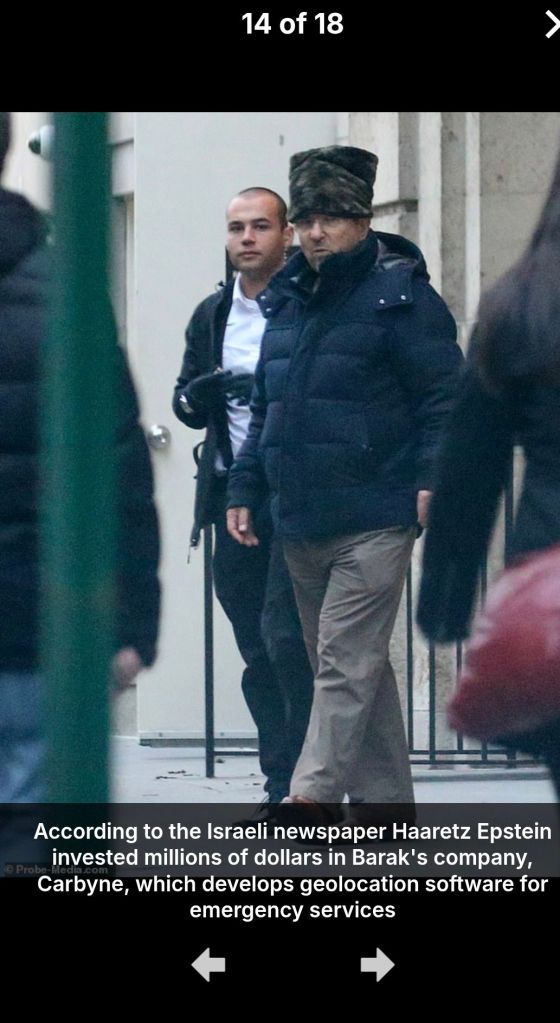
Ehud Barak, and his start up company, Carbyne:
Even more funds for Carbyne from Peter Thiel:
Peter Thiel’s venture capital firm Founders Fund has joined a $15 million Series B funding round in an emergency response startup Carbyne, backed by former Israeli prime minister Ehud Barak. The company announced the round led Elsted Capital Partners Tuesday.
Listed as Reporty Homeland Security Ltd., Carbyne develops a technology designed to enhance first response services, reducing the time it takes first responders to assess, prioritize, and act in crisis situations. Carbyne’s digitized 911 system helps first responders better process incoming emergency calls using information sources including live video streaming, voice over IP, and location detection. The company reports a 65% reduction in time to dispatch.
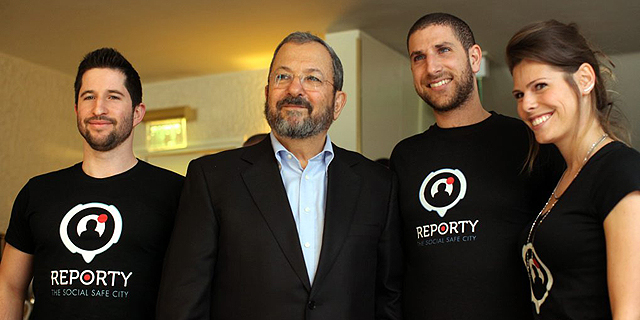
.Ehud Barak with the founders of Reporty, which was rebranded as Carbyne. Photo: Amit Sha’alCarbyne was founded in 2014 and is based in Tel Aviv, with an additional office in New York. The company reports clients in the U.S., Latin America, Europe, the Middle East, and Asia. In 2016, Carbyne raised $5.15 million in an angel funding round led by Barak, who serves as Carbyne’s chairman of the board.
Ehud Barak’s relationship with Jeffrey Epstein detailed in new book
According to a new book by journalist Michael Wolff, former Israeli prime minister Barak said he and Epstein have “nothing to worry about. The secrets are safe.”
Ehud Barak and Jeffrey Epstein(photo credit: CORINNA KERN/REUTERS)ByJERUSALEM POST STAFFOCTOBER 17, 2021 20:53
Former prime minister Ehud Barak was a “frequent guest, almost a fixture” at convicted sex offender Jeffrey Epstein’s mansion in New York before Epstein’s death in 2019, according to a new book by journalist Michael Wolff.
Too Famous: The Rich, The Powerful, The Wishful, The Damned, The Notorious – Twenty Years of Columns, Essays and Reporting, to be released on Tuesday, features Barak’s relationship with Epstein in great detail.
And now the sale of Paragon software from the Carbyne stable:
The deal will significantly benefit Paragon’s founders, including former Prime Minister Ehud Barak, company chairman Ehud Schneorson (a former commander of IDF Intelligence Unit 8200), CEO Idan Nurick, Igor Bogdalov and Liad Avraham. The founders are expected to collectively receive about 30% of the initial payment, or approximately $150 million. Barak, holding a small equity share, is estimated to receive around $15 million. Employees will also benefit, collectively receiving about $100 million through the company’s generous stock option policy. The remaining funds will go to the company’s investors.
A strategic partnership with global implications
Paragon, one of Israel’s two leading offensive cyber companies alongside NSO, specializes in technologies classified as weapons, requiring export approval from the Ministry of Defense. Unlike NSO, which faced international backlash for selling spyware to authoritarian regimes and which was blacklisted by the U.S. government, Paragon was founded under a mandate to operate exclusively in democratic nations. This ethical approach paved the way for the current deal.
According to a source familiar with the transaction, the acquisition aims to establish Paragon as a global leader in cyber technologies.
Famous as “the girl who kissed Putin,” Masha Drokova also worked for Jeffrey Epstein before she penetrated the Silicon Valley tech sector. Big question: Is Masha another Red Sparrow?
Epstein, replicating the pretensions and vacuity of the characters who were parodied in the “Dinner with Trimalchio” chapter of Satyricon, organized elaborate dinner gatherings for his billionaire friends, including Elon Musk, Salar Kamangar and Jeff Bezos. He dreamed up bizarre schemes of social engineering, including a plan to seed the human species with his own DNA by creating a baby compound at his sprawling ranch in New Mexico.
“Epstein was also obsessed with cryonics, the transhumanist philosophy whose followers believe that people can be replicated or brought back to life after they are frozen,” Brown writes. “Epstein apparently told some of the members of his scientific circle that he wanted to inseminate women with his sperm for them to give birth to his babies, and that he wanted his head and his penis frozen.”
Musk can be found all over YouTube and other sites spouting his interest in cryonics, for example on Reddit:
“In an AMA, Elon Musk on cryonics: “Assuming that the brain is frozen quickly after death, then I think you probably could extract quite a lot of information from it in the future. And you might be able to create something approximating that person. I mean there’s gonna be a few issues obviously.”
And Kara Swisher, in her book, cites a particular conversation she had with Musk:
So, what did Musk think of Trump’s invitation? The meeting had no stated agenda, which made it clear to me that it had nothing to do with policy and everything to do with a photo op. “You shouldn’t go,” I warned him. “Trump’s going to screw you.” Musk disagreed. He told me he would attend, adding that he had already joined a business council for the newly elected president, too. When I brought up Trump’s constant divisive fearmongering and campaign promises to unravel progress on issues ranging from immigration to gay rights, Musk dismissed the threats. I can convince him, he assured me. I can influence him, he told me. Apparently, Musk thought that his very presence would turn the fetid water into fine wine, since he had long considered himself more than just a man, but an icon and, on some days, a god. Good luck with that, I thought to myself as we hung up.
Note from Brittanica on Cryonics:
The concept of cryonic preservation was popularized in The Prospect of Immortality, a book by Robert Ettinger that was initially released in 1962 and formally published in 1964. Ettinger subsequently became known as the father of cryonics. His body was cryonically preserved upon his death in 2011 and was stored at the Cryonics Institute in Clinton Township, Michigan. The first human to be cryonically preserved was James Bedford. On January 12, 1967, Bedford died from liver cancer that had metastasized to his lungs. Bedford died before all the arrangements for his cryonic preservation could be completed. As a result, his body was injected with cryoprotective agents without first draining his blood, and his body was then packed in dry ice. Bedford’s body was later immersed in liquid nitrogen and transferred from one facility to another, finally ending up at the Alcor Life Extension Foundation in Scottsdale, Arizona.
America once promoted its ‘melting pot’ of well integrated Americans, drawn from across the world. Now we have the “Big Beautiful Bill” which heralds a windfall for ICE (not the UK’s Institute of Civil Engineers, but America’s masked gangs of Immigration and Customs Enforcement). They will be able to increase their numbers and detention centres. Naturally, this raises concerns for people. Especially exiled Russians:
Hiring 10,000 new officers, as the OBBBA envisions, would put the ratio of ICE agents to undocumented migrants at around 1:400. That’s within striking distance of the Stasi’s one secret policeman to every 166 East Germans and far ahead of the Gestapo’s 1:2,000.
No doubt, as the overt entertainment of opening new facilities grows to the thrill of psychopaths and the horror of balanced minds, the list will grow over the next few months.
Topping the bill just now is southern Florida’s “Alligator Alcatraz’ following the previously publicized El Salvador CECOT (Terrorism Confinement Centre) prison complex (see earlier blog).
Videos and photos posted on social media give a glimpse into the new facility, which is mostly composed of tents and trailers and is located at the Dade-Collier Training and Transition Airport, surrounded by wetlands that are home to gators, pythons and other wildlife.
Inside the detention center are rows of two-tier bunk beds inside large cells that are surrounded by chain-link fencing.
Receiving staff at the centres are knowingly untrained and unable to carry out even the simplest First Aid if necessary:
A WIRED investigation into 911 calls from 10 of the nation’s largest immigration detention centers found that serious medical incidents are rising at many of the sites. The data, obtained through public records requests, show that at least 60 percent of the centers analyzed had reported serious pregnancy complications, suicide attempts, or sexual assault allegations. Since January, these 10 facilities have collectively placed nearly 400 emergency calls. Nearly 50 of those have involved potential cardiac episodes, 26 referenced seizures, and 17 reported head injuries. Seven calls described suicide attempts or self-harm, including overdoses and hangings. Six others involved allegations of sexual abuse—including at least one case logged as “staff on detainee.”
WIRED spoke with immigration attorneys, local migrant advocates, national policy experts, and individuals who have been recently detained or have family currently in ICE custody. Their accounts echoed the data: a system overwhelmed, and at times, seemingly indifferent to medical crises.
A group of Democrats visited the south Florida newly opened site:
As lawmakers, we have both the legal right and moral responsibility to inspect this site, demand answers, and expose this abuse before it becomes the national blueprint,” the legislators said in a joint statement ahead of the visit.
Federal agencies signaled their opposition Thursday to a lawsuit brought by environmental groups seeking to halt operations at the detention center. Though Trump applauded the center during an official tour earlier this week, the filing on behalf of the Department of Homeland Security seemed to try to distance his administration from the facility, and said no federal money to date has been spent on it.
“DHS has not implemented, authorized, directed, or funded Florida’s temporary detention center. Florida is constructing and operating the facility using state funds on state lands under state emergency authority and a preexisting general delegation of federal authority to implement immigration functions,” the U.S. filing says.
Human rights advocates and Native American tribes have also protested against the center, contending it is a threat to the fragile Everglades system, would be cruel to detainees because of heat and mosquitoes, and is on land the tribes consider sacred.
It’s also located at a place prone to frequent heavy rains, which caused some flooding in the tents Tuesday during a visit by President Donald Trump to mark its opening. State officials say the complex can withstand a Category 2 hurricane, which packs winds of between 96 and 110 mph (154 and 177 kph), and that contractors worked overnight to shore up areas where flooding occurred.
This move marks Eswatini as the latest country to accept third-country deportees from the US. Authorities in Eswatini state the men are being held in correctional facilities pending their eventual repatriation to their native countries………
The country was previously known as Swaziland but changed to Eswatini in 2018 after the king announced it should revert to its traditional name in the Swazi language. It was Swaziland when it was under British colonial rule, which ended in 1968.
Using Africa as a dumping ground for ICE deportees, this from CNN:
Ken Opalo, an associate professor at Georgetown University’s School of Foreign Service inWashington, DC, said African nations are being pushed by the Trump administration “into doing egregious things such as accepting migrants from random countries or giving them (the US) their mineral wealth in ambiguous deals that don’t make much sense.”
Someone on Substack said the other day that he had been visiting the site of Auschwitz in Poland. A person showed him a copy of a planning permission document for the building ahead of them. It was a waste water treatment plant. It had been the last thing to be built, although the Jews and other herded German prisoners had already arrived in this miserable place. The gas chambers awaited them, but their end was delayed as bureaucrats had not got around to the planning permission stage for the processing of their bodies. Once the plant was built, the German SS carried out their horrific processing.
What happened to ‘Never Again?’
ICE Lawyers Are Hiding Their Names in Immigration Court
ICE attorneys fighting to deport immigrants are able to obscure their identities — no masks required.
1979 A Workers Compensation Act was created by the UK Parliament.
It was a recognition of all the illnesses caused since the various environmental hazards through employment were understood and classified.
Silicosis:
Silicosis is a long-term lung disease caused by inhaling large amounts of crystalline silica dust, usually over many years.
Silica is a substance naturally found in certain types of stone, rock, sand and clay. Working with these materials can create a very fine dust that can be easily inhaled.
Once inside the lungs, it causes swelling (inflammation) and gradually leads to areas of hardened and scarred lung tissue (fibrosis). Lung tissue that’s scarred in this way doesn’t function properly.
People who work in the following industries are particularly at risk:
stone masonry and stone cutting – especially with sandstone
construction and demolition – as a result of exposure to concrete and paving materials
Pneumoconiosis refers to a range of diseases that are caused by the inhalation of a range of organic and non-organic dusts which are then retained in the lungs. The main types of pneumoconiosis are –
Asbestosis
Berylliosis
Byssinosis
Coal Worker’s Pneumoconiosis (also known as “black lung”)
Records of those involved employed in the extraction of coal. Modern coalmining began from the early 18th century with coal miners frequently changing places of work.
After WWII, the coal industry was nationalised with the establishment of the National Coal Board in 1946. In 1987, it was renamed as the British Coal Corporation and later its assets were privatised. In 1994, the newly established Coal Authority assumed control over the management and licensing of coal mines and other management issues.
Coalminers had few employment rights and therefore coalmine owners had little need to keep records of those in their employ in the 19th century. The frequent movement of the miners between pits has resulted in very few extant employment records. As coalmining evolved into a more permanent means of earning a living, the personnel records increased in the quality and coverage. If the name of the colliery is known, the local record office should hold employment records. If the colliery is not known, then the records of the surrounding collieries will have to be consulted. The Durham Mining Museum has a useful finding aid on its web site …..
Mines were nationalised after the war, and remained so until Mrs Thatcher’s Conservative government, 1980:
Between 1945 and 1951, Clement Attlee’s Labour government nationalised numerous major industries, including coal, electricity, railway transportation, and telecommunications. Broadly, such industries were nationalised to further the public interest; accordingly, the Coal Industry Nationalisation Act 1946 reads, “There shall be a National Coal Board… charged with the duties of:
a) working and getting the coal in Great Britain, to the exclusion (save as in this Act provided) of any other person.
b) securing the efficient development of the coal-mining industry.
c) making supplies of coal available, of such qualities and sizes, in such quantities and at such prices, as may seem to them best calculated to further the public interest in all respects, including the avoidance of any undue or unreasonable preference or advantage.”
History of delays in gaining compensation for coal miners:
1999: Record compensation for miners
Ex-miners suffering from lung diseases have won the biggest industrial injuries case in British legal history with a compensation deal worth £2 billion.
Up to 100,000 ex-miners could be eligible for compensation under the deal which ends 14 months of negotiations between their lawyers and the Department of Trade and Industry.
Negotiations ended just before the deal was unveiled at the High Court in Cardiff.
“These miners worked in some of the worst conditions in the world.” Energy Minister John Battle
Already 65,000 ex-miners, including 15,000 widows of those who died after developing work-related illnesses, have already registered claims but there are expected to be thousands more applications.
But many miners have not received compensation, 25 years after the 1999 announcement of the right to receive it.
Pneumoconiosis – which blackens the lungs due to dust inhalation – on average yields between £30,000 and £50,000 varying on its severity, according to industry experts.
However, families have contacted both Stephanie and Dan – who represent Barnsley East and Barnsley Central respectively – to complain about the government’s handling of claims.
The NUM have also reported that its members have found it difficult to access the funding that they are eligible for following assessment of their conditions.
Stephanie said: “I was pleased to meet with the Yorkshire branch of the NUM alongside other former coalfield MPs from the region.
Asbestosis is a rare but serious lung condition that affects people exposed to asbestos(a building material usedfrom the 1950s to the 1990s).It cannot be cured, buttreatment may improve the symptoms.
You may be able to claim compensation if you get asbestosis.
Symptoms of asbestosis
Symptoms of asbestosis include:
shortness of breath
persistent cough
wheezing
extreme tiredness (fatigue)
pain in your chest or shoulder
in more advanced cases, clubbed (swollen) fingertips
It can take 20 to 30 years after being exposed to asbestos before symptoms appear.
There are sometimes no symptoms.
Causes of asbestosis
Asbestosis is caused by exposure to asbestos.
You may have been exposed to asbestos if you worked in an industry such as building or construction, particularly from the 1950s to the 1990s.
You could be exposed to asbestos today if your job involves working in certain roles in old buildings.
Examples include:
heating and ventilation engineers
demolition workers
plumbers
construction workers
electricians
There are many ways asbestos can harm you. We all probably know someone who developed an illness and died from it. My cousin, a science teacher, died from mesothelioma, a cancer caused by breathing in the dust of asbestos whilst in employment. Someone else I knew, a neighbour when I lived in North East England. Also conracted mesothelioma from breathing in asbestos whilst in his lifelong career working in a power station. He could prove the link. My cousin was unable to. It is a horrible way to die.
People continue to die from exposure to asbestos dust today.
Hundreds of thousands of miles of pipes, across the UK, are made from asbestos cement delivering drinking water to people around the world, but are reaching the end of their lifespan and starting to degrade. Scientists are now debating whether this could pose a risk to human health. How long will that debate go on, or will it be the proverbial ‘can kicked down the road’ as who will pay for the repacement of pipes?
Asbestos cement has been used extensively to make corrugated and flat sheets, as well as other moulded products such as flower planters, coal stores, low-pressure and high-pressure flues and pipework, as well as junction boxes, heat resistant mats and flash guards.
It is when it ages and degrades that it has become a problem.
Compensation for a personal injury following exposure to asbestos is available to individuals who have gone on to develop and be diagnosed with an asbestos-related disease that is causing a disability.
These diseases include:
Mesothelioma
Asbestosis
Asbestos-related diffuse pleural thickening
Asbestos-related lung cancer
In order to claim compensation, an individual needs to be able to say how they were exposed to asbestos.
It is also possible for a family member to claim on behalf of a loved one if they have passed away from an asbestos-related disease, or they do not have the capacity to bring a claim forward themselves.
If someone is diagnosed with an asbestos-related disease, they have three years from the date of their reasonable knowledge of their diagnosis to start the claims process (known as the limitation period – this is standard for all personal injury claims). If an individual was diagnosed with an asbestos-related disease more than 3 years ago (outside of the limitation period), this would mean they have run out of time to make a claim.
Asbestos contamination is a threat to many populations in the world. Here is an article by an American consultant, albeit he is making his money through offering a service to locate its existence:
The Presence of Asbestos in the Environment
The previous section set the stage for exploring the next topic. The presence of asbestos in the environment shows clear evidence of long-standing risk. The US Bureau of Mines recognised asbestos dangers in 1932.
Swift Creek in Everson, Washington, recorded asbestos levels up to 43% in some dried samples. The Environmental Protection Agency confirmed asbestos contamination in studies from 2006.
Asbestos is found in both rural and urban areas, especially in drinking water with ranges from nondetectable levels to 1 million fibres per litre.
I experienced a similar concern during fieldwork that revealed distinct asbestos exposures. Hundreds of millions have faced asbestos exposure every year worldwide. Local samples show asbestos concentrations outdoors remain below 0.0001 fibres/ml in rural areas.
Urban readings also stay low, yet variable. I noted firsthand the environmental contamination that persists in places such as Swift Creek. The presence of asbestos in the environment continues to pose health risks that warrant careful monitoring and proper management.
The application of asbestos in building construction have happened over decades as it seemed a good idea at the time:
Why is asbestos dangerous?
Asbestos still kills around 5000 workers each year, this is more than the number of people killed on the road.
Around 20 tradesman die each week as a result of past exposure
However, asbestos is not just a problem of the past. It can be present today in any building built or refurbished before the year 2000.
When materials that contain asbestos are disturbed or damaged, fibres are released into the air. When these fibres are inhaled they can cause serious diseases. These diseases will not affect you immediately; they often take a long time to develop, but once diagnosed, it is often too late to do anything. This is why it is important that you protect yourself now.
Asbestos can cause the following fatal and serious diseases
The accumulated knowledge base on preventable employment-related hideos illnesses should see us all in a safe environment by now, but deregulation pressures and avoidance of responsibility by those making their wealth through construction work ensures these diseases will be with us for many years to come.
Compensation to those afflicted, and their families, will also be a long time coming.
This does not need to be the case. It took centuries to arrive at the Workers Compensation Act in the UK.
But mostly it is the lawyers who are the “ambulance chasers” who have benefited the most.
It was kings, barons, lords and knights who always took the profits off the labour of the poor. Now they have been replaced by oligarchs and corporates, who also exploit the middle class who used to be their buffer to the working class. The plan seems to be that only the elite will remain, but who will serve them then?










 borderslynn

You must be logged in to post a comment.