Uranium is obtained by in-situ drilling, usually into aquifers where uranium is found.
The type of mine in question uses in situ leach technology (ISL), also known as in situ reach (ISR), the most common form of uranium extraction. It involves drilling holes into the earth to reach the mineral deposit. A chemical solution is pumped underground, often into the aquifer, to dissolve the uranium deposit. This solution is then pumped back to the surface with the mineral in tow for processing.
I have written in earlier blogs about there being a scarcity of freshwater in the whole world. It is therefore highly precious and supply is not expanding.
Namibia and Kazakhstan, the world’s top producer.2 Most uranium mining in Kazakhstan, and many other places, is now done through “in situ recovery”: instead of removing ore from the ground and treating it, miners use a chemical solution to dissolve the uranium-containing material and transport it to the surface in liquid form, where the uranium-containing minerals can be recovered. “It reduces hazards associated with digging and mining, but groundwater contamination is a concern,” Wainwright says.
The last thing we need is drills going down into vital aquifers to grab uranium. It is suicidal for all living things to do so. We already have many human activities contaminating the aquifers.
Of all environmental ills, contaminated drinking water the most devastating in its consequences. Each year 10 million deaths are directly attributable to waterborne intestinal diseases. One-third of humanity labours in a perpetual state of illness or debility as a result of impure water; another third is threatened by the release into water of chemical substances whose long-term effects are unknown.
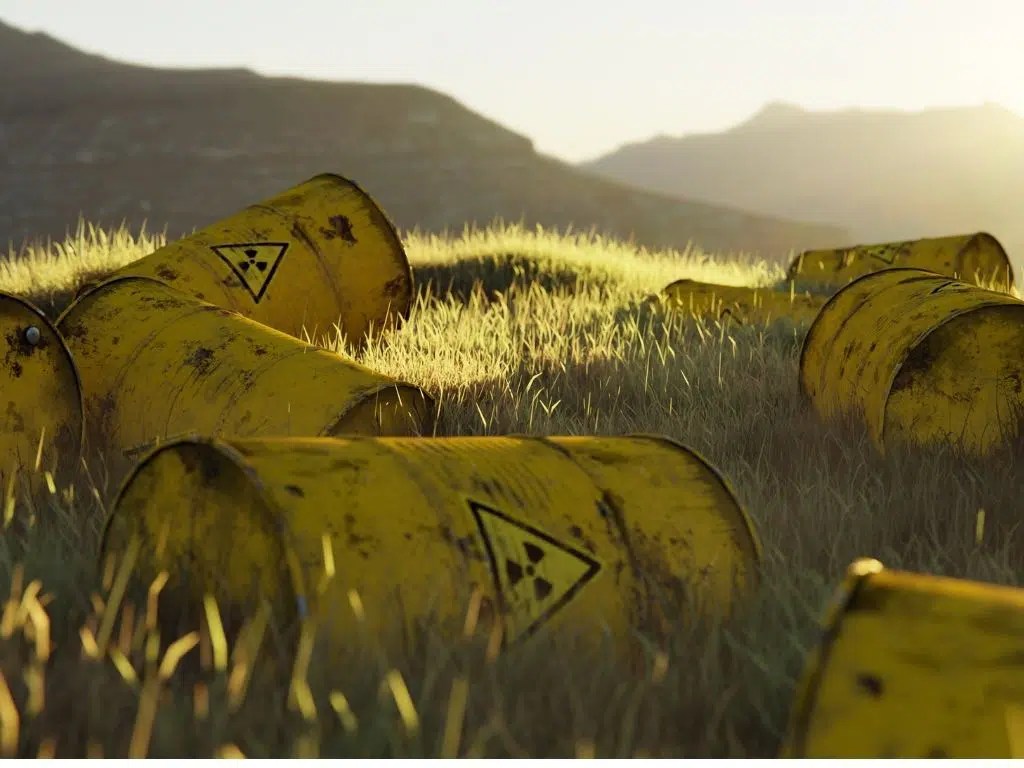
Regardless of the source, this hazardous waste contains highly poisonous chemicals like plutonium and uranium pellets. These extremely toxic materials remain highly radioactive for tens of thousands of years, posing a threat to agricultural land, fishing waters, freshwater sources, and humans.
Since the 1950s, when early commercial nuclear power stations started operating, more than 250,000 tonnes of highly toxic nuclear waste have been accumulated and spread across 14 countries worldwide. In most cases, the highly radioactive material is collected and stored in inactive nuclear power plants.
quantity of untreated nuclear waste on the planet is currently stored in the Sellafield plant in the UK. Yet, the maintenance of these sites can be extremely costly and it requires a large amount of manpower. Despite having shut down in 2003, more than 100,000 employees are involved in ongoing cleanup and nuclear-decommissioning activities at Sellafield that are expected to last more than a century and will cost the government a staggering USD$118 billion.
It has taken until 2023 for Finland to be at the final stages of a revolutionary new method of radioactive waste disposal, but that cannot be retrospectively applied to British power plants.
Now, Finland is close to completing the world’s first long-term nuclear waste disposal site, which is expected to be operational in 2023.
On April 25 and 26, 1986, the worst nuclear accident in history unfolded in what is now northern Ukraine as a reactor at a nuclear power plant exploded and burned. Shrouded in secrecy, the incident was a watershed moment in both the Cold War and the history of nuclear power. More than 30 years on, scientists estimate the zone around the former plant will not be habitable for up to 20,000 years.
And then March 2011, when around 18,000 people died as a result of the Fukushima Daiichi Power Plant disaster after it was hit by an offshore earthquake and tsunami.
One might question whether an earthquake region should have ever considered nuclear power and, due to sea levels rising, should even any new Reactor be built by any seashore?
All plants being decommissioned in the UK are on the coast, with coastal erosion common nowadays too.
Scotland has been decommissioning several plants and learning the skills needed to carry it out since Dounreay, built in 1955 as a fast breeder reactor.
Dounreay is again at the forefront of science and engineering – this time in the skills and innovation needed to dismantle one of the most complex and hazardous legacies of the 20th century. Dounreay today is a site of major construction, demolition and waste management. The experimental facilities are being cleaned out and knocked down, and the environment is being made safe for future generations.
The six giant heads were lowered onto the seabed of the Bristol Channel – which has the 2nd highest tidal range in the world! They weigh 5,000 tonnes each and were installed using floating cranes (the size of football pitches). The heads enable the flow of water in and out of the power station.
The German-Dutch-US Unenco group also have a UK based industrial complex:
Guess who is helping fund and provide the construction design and build for countries with no previous experience?
State-owned nuclear companies in Russia and China have taken the lead in offering nuclear power plants to emerging countries, usually with finance and fuel services. The following table charts the main influence in countries with various agreements but not yet any plants under construction (see also the relevant tables in the information pages on China and Russia):
And worldwide, this is the only plan humans have arrived at in order to cut dependence on fossil fuels. We have dithered until it is too late for any other plan it would seem:
And then there is War – As the song goes “what is it good for? Absolutely nothing”
Abrams Tanks with depleted-uranium rounds. The United Nations Environment Programme (UNEP) warns such ammunition is “chemically and radiologically toxic heavy metal.” The Harvard International Review reports “Depleted uranium may pose a risk to both soldiers and local civilian populations. When ammunition made from depleted uranium strikes a target, the uranium turns into dust that is inhaled by soldiers near the explosion site. The wind then carries dust to surrounding areas, polluting local water and agriculture.”
BHP is one of the largest mining companies in the world, and is based in SW Australia. Their website tells of the over supplied world market of uranium:
Prices began to fall when anti-nuclear reactor sentiment was on the rise. Countries like Germany closed their reactors and built wind farms and used other technologies to generate electricity.
The global uranium (U308) market was around 73Kt in 2016.1 More than half that demand came from the Americas and eastern and western Europe combined. China was next with around one-seventh of global demand. The average age of the 129 reactor units in the Americas fleet is 37 years; western Europe’s 134 units are slightly younger (e.g. France 31 years, UK 33 years); and eastern Europe’s 52 units are slightly younger again at 28 years.2 China’s 33 units, by contrast, are 7 years old on average, while India’s 22 units are a more mature 21 years.
The fleet ages above indicate the traditional consumers of uranium are likely to face ‘extend or decommission’ decisions in scale within the next decade.
…… economics look quite competitive in China, however, and that is where we estimate the most notable growth in nuclear capacity emerging. Nuclear is in middle of the LCOE pack in India right now, but it could be eclipsed by solar and then wind over the course of the 2020s, and it never catches coal.
The clear inference is that the challenge of greening the world’s energy appetite and moving towards a more favourable long run climate outcome cannot exclude how we generate the planet’s electricity. Nuclear generation is a well-established technology that can provide affordable life-of-asset base load power in a carbon conscious fashion. That is not to say that EVs and uranium are intrinsically linked: merely that from a climatic perspective, a prima facie carbon saving (moving to EVs) is only realised if the power they use is greener than the internal combustion method being displaced
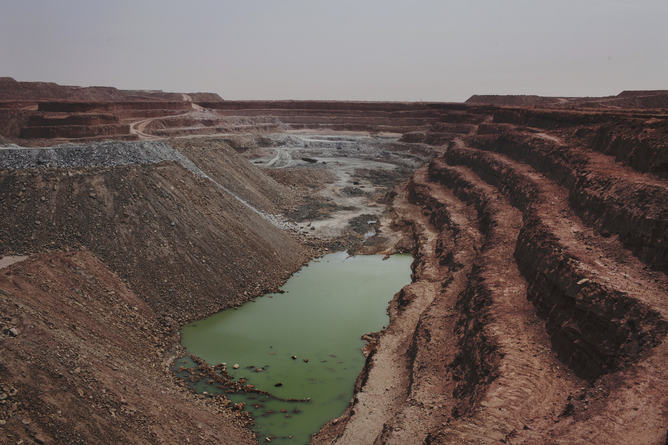
Niger, Africa, is the 7th largest uranium mining area, uranium found in the Tamgak mountain.
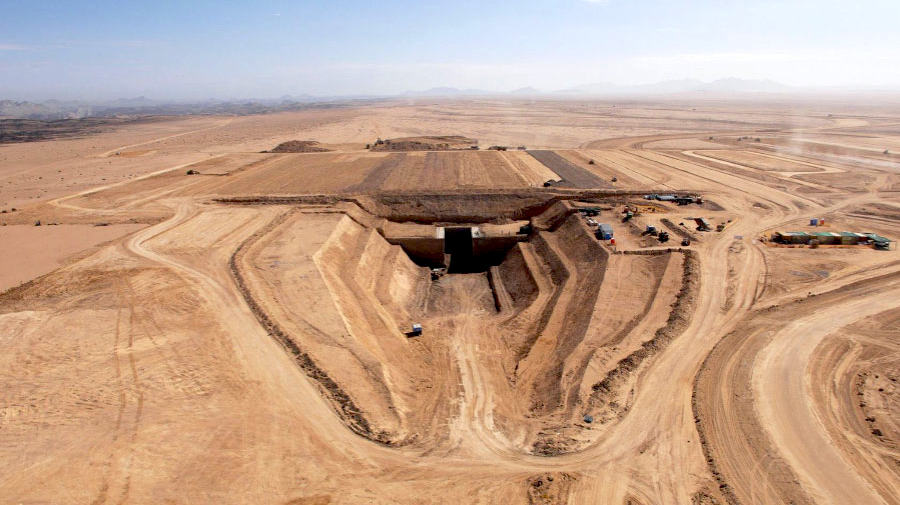
The $2-billion Husab project, a joint venture between China General Nuclear Power Holding Corp (CGNPC) and local miner Swakop Uranium, is expected to produce up to 15-million pounds of uranium a year.
Russia is gradually acquiring sources of uranium as it leads the world in conversion and enrichment to create rods for nuclear reactors.
Tanzania, Africa has a uranium mine run by Uranium1 (TENEX Group of Rosatom State Corporation).
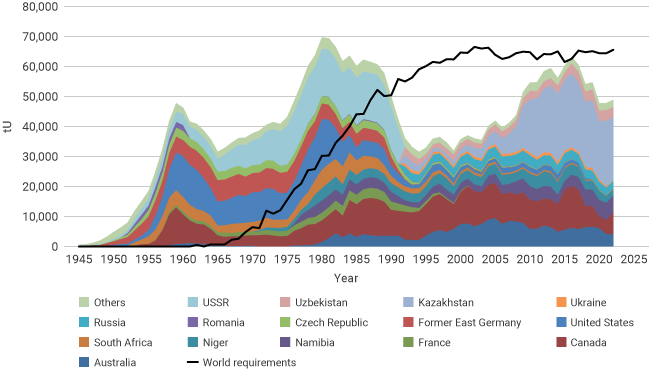
About two-thirds of the world’s production of uranium from mines is from Kazakhstan, Canada and Australia.
An increasing amount of uranium, now over 55%, is produced by in situ leaching.
In 2022 Kazakhstan produced the largest share of uranium from mines (43% of world supply), followed by Canada (15%) and Namibia (11%).
Charts can be viewed by clicking on the above link.
* Data from the World Nuclear Association. NB: the figures in this table are liable to change as new data becomes available. Totals may not sum exactly due to rounding.
Mining methods have been changing. In 1990, 55% of world production came from underground mines, but this shrunk dramatically to 1999, with 33% then. From 2000 the new Canadian mines increased it again. In 2022 in situ leach (ISL, also called in situ recovery, ISR) mining accounted for over 55% of production:Methodtonnes U%In situ leach (ISL)27,30756%Underground & open pit (except Olympic Dam)18,56938%By-product30136%
Conventional mines have a mill where the ore is crushed, ground and then leached with sulfuric acid to dissolve the uranium oxides. At the mill of a conventional mine, or the treatment plant of an ISL operation, the uranium then separated by ion exchange before being dried and packed, usually as U3O8. Some mills and ISL operations (especially in the USA) use carbonate leaching instead of sulfuric acid, depending on the orebody. Where uranium is recovered as a by-product, e.g. of copper or phosphate, the treatment process is likely to be more complex.
During the 1990s the uranium production industry was consolidated by takeovers, mergers and closures, but this has diversified again with Kazakhstan’s multinational ownership structure. Over half of uranium mine production is from state-owned mining companies, some of which prioritise secure supply over market considerations. In 2021, the top 10 companies by production contributed about 90% of the world’s uranium production:
See charts by clicking on above link.
Note 1: SMCC, a joint venture between Kazatomprom and Uranium One, reported combined production of 2321 tU in 2021 at its two mines, South Inkai 4 and Akdala. Note 2: KATCO, a joint venture between Kazatomprom and Orano, reported combined production of 2840 tU in 2021 across its two mines, Moinkum and Tortkuduk.
World uranium production and reactor requirements (tonnes U)
Sources: OECD-NEA/IAEA, World Nuclear Association
Uranium resources by country in 2021
See charts by clicking on above link.
Identified resources recoverable (reasonably assured resources plus inferred resources), to $130/kg U, 1/1/21, from OECD NEA & IAEA, Uranium 2022: Resources, Production and Demand (‘Red Book’). The total recoverable identified resources to $260/kg U is 7.918 million tonnes U.
Another reproduced source, from which I start with a quote:
Indeed, Wainwright says it may be impossible to get accurate data on uranium mining safety in all parts of the world. “Mining has been often a hidden component from consumers, often disproportionately impacting rural regions and vulnerable populations,” she says. “It is important to develop mechanisms and regulations to protect workers’ health as well as the environment.”
What are the health and environmental impacts of mining and enriching uranium?Listen with Speechify
Exposure to more than trace amounts of uranium can cause cancer and other diseases, which is why uranium mining has some of the world’s strictest regulations.
July 10, 2023
Advocates of nuclear power argue it can play a key role in society’s transition away from climate-warming fossil fuels, since nuclear fuels like uranium do not emit climate pollution like coal, oil, and gas do. But nuclear fuels are dangerous substances, and proper precautions are needed to scale up their use without causing harm to the environment or to the workers mining the material.
Health risks related to mining uranium have been known for nearly a century, says Haruko Wainwright, MIT assistant professor of nuclear science and engineering and of civil and environmental engineering. In the 1930s, for example, after increased rates of lung cancer were found in miners (including children), mining companies put in early safety systems such as proper ventilation.
The atomic age boom in uranium came in the 1950s, when it was mined throughout the Southwestern U.S. to power the nation’s growing arsenal of nuclear weapons and its earliest nuclear power plants. However, Wainwright says, workers often did not know the risks of mining uranium, especially the rise in lung cancer risk via inhalation of uranium and its byproducts, and safety precautions such as ventilation were not always installed. This was especially true at mines where Native Americans worked, says Wainwright. Throughout the 1960s and 70s, members of tribes such as the Navajo mined uranium for the U.S. government in environments with slow and incomplete adoption of safety measures.
In the environment, the risk of uranium exposure is highest for communities near uranium mines or sites where it is milled into a usable form or enriched in preparation for use. Uranium exists naturally in the soil, rocks, and ocean, which means all of us are naturally exposed to a small amount of it, but large exposures are associated with cancers and kidney damage. To protect Americans, the EPA has instituted rules that set a safe limit for uranium in drinking water, mandate cleanups of accidental uranium waste releases, and regulate how abandoned uranium processing sites are dealt with.1
The situation at American uranium mines has improved over the decades. Mines today are regulated by the Nuclear Regulatory Commission and Environmental Protection Agency. To protect the environment, they mandate, for example, that places storing uranium waste are constructed with a 1,000-year compliance period, meaning they are built to last without leakages for at least that long.
The vast majority of uranium mining today, however, is done outside the U.S. The top producers include both wealthy countries like Canada and Australia, and developing countries such as Namibia and Kazakhstan, the world’s top producer.2 Most uranium mining in Kazakhstan, and many other places, is now done through “in situ recovery”: instead of removing ore from the ground and treating it, miners use a chemical solution to dissolve the uranium-containing material and transport it to the surface in liquid form, where the uranium-containing minerals can be recovered. “It reduces hazards associated with digging and mining, but groundwater contamination is a concern,” Wainwright says.
While groundwater is heavily monitored in the United States, less is known about the effects in other countries. Some studies have indicated that areas of Kazakhstan around uranium mines have seen water contamination3 and plausibly related health impacts.4,5
Given the well-known health hazards, uranium mines tend to have the strictest regulations among mines. The World Nuclear Organization says that Canadian and Australian mines in particular are run in accordance with regulations to prevent workers from unsafe exposure. It also notes that although “most uranium mined is done so in countries with full adoption of international recommendations, this is not the case in all parts of the world.”6
Indeed, Wainwright says it may be impossible to get accurate data on uranium mining safety in all parts of the world. “Mining has been often a hidden component from consumers, often disproportionately impacting rural regions and vulnerable populations,” she says. “It is important to develop mechanisms and regulations to protect workers’ health as well as the environment.”
Thank you to Julie Chapman of Portland, Oregon, for the question. You can submit your own question to Ask MIT Climate here.
















You must be logged in to post a comment.