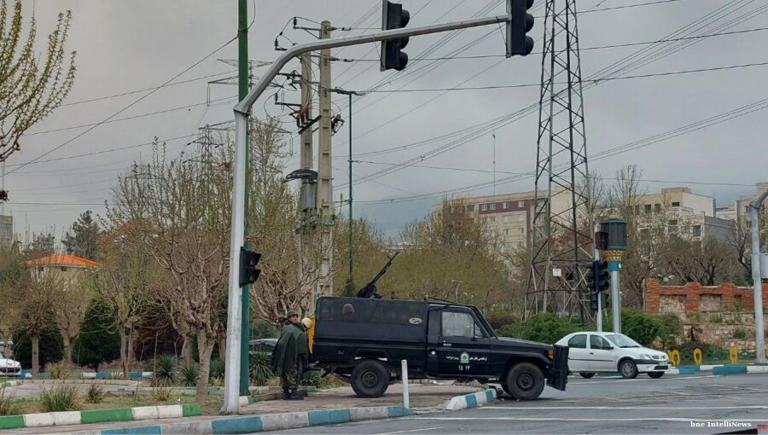
Iran’s Islamic Revolutionary Guard Corps claimed on April 1 that 37 US military officers were killed in an attack on a covert gathering point in the UAE, as part of five naval operations launched since dawn, according to an IRGC statement.
The U.S. Navy has evacuated the Bahrain-based Naval Support Activity (NSA) Manama, the headquarters of the U.S. 5th Fleet, after the facility was subjected to multiple strikes. The Pentagon confirmed that 1,500 sailors, their families, and pets were relocated from NSA Bahrain to the Naval Station Norfolk in Virginia.
Why it matters
The evacuation of the U.S. 5th Fleet headquarters in Bahrain is a significant development, as it marks the first time the U.S. has been forced to abandon a major naval command center since World War II when the Philippines were invaded by Japan. This move highlights the escalating tensions and security challenges in the region.
The details
Satellite images confirmed that at least seven buildings, including communication infrastructure and warehouses, were destroyed at NSA Manama in the first week of the attacks. American sailors arrived in Norfolk with only what they could carry in their backpacks, and local community organizations are being mobilized to provide basic necessities.
On February 28, the first day of Operation Epic Gloom, NSA Manama was subjected to the initial strikes.
In the first week, at least seven buildings were destroyed at the facility.
Two HC-130J Combat King II aircraft were stranded in Iran during a rescue operation for a downed F-15E crew member. To prevent their capture by Iranian forces, U.S. forces destroyed these aircraft. turkiyetoday.com defencesecurityasia.com
These sophisticated aircraft cost a billion dollars each.
It has become clear the F15E was unable to detect a heat seeking missile heading for it:
Explained: How Passive Infrared May Have Helped Iran Down US F-15E
Emerging reports say Iran may have used passive infrared detection system to down the US F-15E Strike Eagle. Here’s how it works – and why it challenges American air superiority.
Reports are emerging that Iran may have used passive infrared detection systems to down the US F-15 jet. Pictured above: A US F-15 Strike Eagle jet
The reported downing of a US F-15E fighter jet over Iran has triggered a deeper strategic debate. At the centre of this debate is a striking claim: that Iran may have used passive infrared detection systems – a method fundamentally different from conventional radar – to track and engage one of America’s most battle-tested aircraft. While details remain contested, the implications are significant.
As per an ABC News report, Iran may have used passive infrared detection system to down the US F-15E Strike Eagle, with one crew member rescued and another still missing. The incident marks the first confirmed instance during this war when a US piloted aircraft was downed by Iran, immediately raising questions about American air superiority. The situation is further complicated by reports that additional US aircraft – including an A-10 – were also hit during the same operational window.
A tweet shared online by security intelligence analyst Brian Allen said, “Passive infrared detection does not emit radar signals. It cannot be detected or jammed by American electronic warfare systems. It is invisible to the technology America has spent trillions building its air superiority around.”
Retired, living in the Scottish Borders after living most of my life in cities in England. I can now indulge my interest in all aspects of living close to nature in a wild landscape. I live on what was once the Iapetus Ocean which took millions of years to travel from the Southern Hemisphere to here in the Northern Hemisphere. That set me thinking and questioning and seeking answers.
In 1998 I co-wrote Millennium Countdown (US)/ A Business Guide to the Year 2000 (UK) see https://www.abebooks.co.uk/products/isbn/9780749427917