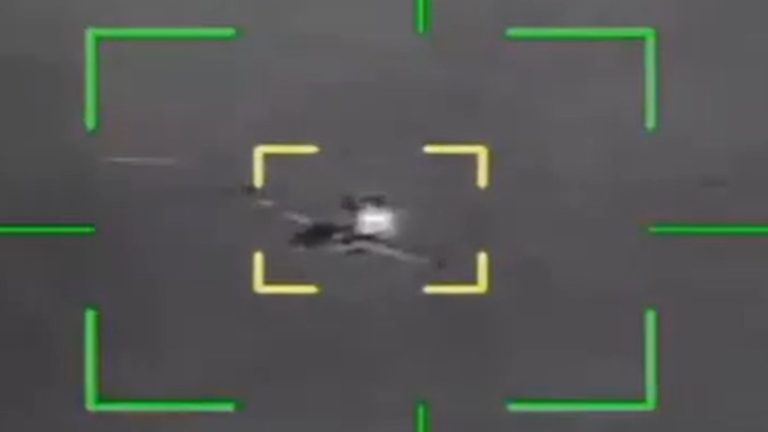
Iran’s military said Friday that it had downed a second US jet in the Gulf, following earlier reports of an F-15 fighter going down in the country’s southwest.
After F15 was shot down over Iran, so far one pilot has been recovered, the other is being sought.
The missing airman, a weapon systems officer, was aboard a US F-15 fighter jet that was downed in southern Iran, CBS reports
It’s not known what has happened to the missing crew member – a pilot who was also on board has been rescued
Iranian security forces are searching the region for the airman – officials in the country are urging citizens to find the crew member “alive” and are offering rewards for their capture, state media says
Iran says it has shot down a second US warplane over the Gulf – US media reports an A-10 Warthog was shot at during a search-and-rescue mission for the first downed aircraft
The pilot of the Warthog reportedly ejected over the Gulf and has been rescued
Elsewhere, Israel says it has carried out a new series of attacks on “key infrastructure” in Tehran. In Israel, emergency services say one person is injured from shrapnel after a missile attack from Iran was intercepted
According to Military Machine, The A-10 Thunderbolt II costs about $18.8 million per aircraft. This makes it one of the more affordable combat aircraft in the US Air Force, especially given its role in close air support missions.
The cost has changed over time. In the 1970s, the original flyaway cost was about $9.8 million per aircraft. When adjusted for inflation, that comes to around $18.8 million today. The total program cost per aircraft was about $13 million in 1994 dollars, including development.
The F-15E Strike Eagle serves as the primary tactical bomber for the US Air Force. The F-15E Strike Eagle historically cost $31.1 million, adjusting to over $65 million today. Costing $19,000 per flight hour, this Mach 2.5 jet carries a massive 10,400-kilogramme payload.
Reports say two US helicopters were hit during recovery operations linked to a downed aircraft in Iran. All crew members are safe, though some injuries have been reported.
US reportedly fired over 850 Tomahawk missiles in four weeks of war with Iran. Heavy usage raised concerns over supply and rising costs inside the Pentagon. Each missile costs over $2 million, making large-scale use expensive.
Back in March 2025 this extract from an article on asymmetric warfare seems to have not impacted the Pentagon strategy:
Throwing Money at the Problem
In January 2025, the U.S. Navy disclosed that it has fired more than 200 missiles to repel Houthi attacks on civilian shipping in the Red Sea since November 2023, at a cost of hundreds of millions of dollars.
This includes 120 SM-2 missiles priced at around $2.1 million each, eighty SM-6 missiles at $3.9 million apiece, and twenty Evolved Sea Sparrow and SM-3 missiles estimated to cost between $9.6 million and $27.9 million each, as well as 160 rounds from 5-inch naval guns.
Of course, the comparison is not as simple as measuring a million-dollar interceptor against a thousand-dollar drone.
When a NATO destroyer engages a drone or missile in the Red Sea, it does so to prevent it from hitting a military target, thus killing sailors and damaging equipment worth hundreds of millions of dollars, or striking an unprotected civilian ship, creating the risk of environmental disaster if an oil spill occurs.
Houthi disruption in the Red Sea has already cost the global economy and financial markets hundreds of billions of dollars, so mitigating this threat with a few missile interceptors can represent a good return on investment.
Militaries are therefore seeking ways to tip the economic calculus back in the defender’s favor. The U.S. and British navies, for example, are exploring the possibility of re-arming missile tubes at sea, a first-time endeavor, to reduce the time, money, and fuel required for ships to return to port after expending their munitions.
They are also racing to expand electronic warfare capabilities to jam, spoof, blind, or confuse incoming drones and munitions.
Perhaps most ambitiously, they are experimenting with high-powered lasers and microwave weapons. These directed-energy systems, once the stuff of science fiction, offer the prospect of a low-cost way to destroy targets within the weapon’s line of sight. Following a recent test of its DragonFire laser system, the UK Ministry of Defense claimed that it cost just twelve dollars USD per shot to down aerial targets such as small drones and mortar rounds, despite the $120 million spent on development.
Beyond active defenses, militaries are pursuing more passive measures to reduce the threat and expense of hostile air, missile, and drone strikes. Examples include dispersing forces, employing camouflage and decoys, and investing in fortifications or backup systems to minimize the impact of attacks.
Alongside punitive retaliation, these tactics aim to deter and disincentivize attackers, shifting the cost-benefit calculation in the defenders’ favor.
In addition to the many ways of dealing with threats “right of launch,” when enemy drones or missiles are airborne, there is renewed interest in addressing them “left of launch,” before they can be enacted.
President Donald Trump’s fiscal year 2027 budget request asks Congress to deliver the largest military outlay in American history while directing hundreds of millions of dollars towards White House renovations, funded in part by cutting billions from health research, education, housing and climate grants
Retired, living in the Scottish Borders after living most of my life in cities in England. I can now indulge my interest in all aspects of living close to nature in a wild landscape. I live on what was once the Iapetus Ocean which took millions of years to travel from the Southern Hemisphere to here in the Northern Hemisphere. That set me thinking and questioning and seeking answers.
In 1998 I co-wrote Millennium Countdown (US)/ A Business Guide to the Year 2000 (UK) see https://www.abebooks.co.uk/products/isbn/9780749427917