On February 15, 2026, Taliban spokesman Zabihullah Mujahid told Radio Iran’s Pashto service that Kabul would be prepared to cooperate with the Islamic Republic in the event of a U.S. military attack — if Tehran formally requested assistance. He added that Iran had emerged victorious from its June 2025 war with Israel and would prevail again against Washington. The statement was extraordinary on its face: the world’s most prominent Sunni jihadist movement publicly offering military solidarity to a Shia theocracy it once nearly went to war with. Yet the declaration was less a rupture than a culmination — the latest expression of a pragmatic alignment that has been deepening for over a decade, driven not by ideological convergence but by shared adversaries, mutual dependence, and the strategic logic of survival under pressure.
Iran’s engagement with the Taliban has evolved from tactical coordination during the insurgency to a pragmatic working relationship since the group’s return to power in August 2021. Despite deep ideological differences and a history of confrontation, Tehran has prioritized strategic interests over sectarian or doctrinal considerations. This relationship has yielded tangible benefits for both sides, while remaining transactional, asymmetric, and subject to significant constraints.
In response to the 9/11 terrorist attacks, a US-led coalition invaded Afghanistan in October 2001. The allies quickly deposed the repressive Taliban regime and installed a western-backed government.
But by the time that Trump came to office in 2017, the war was at a stalemate. To make matters worse for the president, the US was spending US$27 billion (£21.3 billion) annually on military expenditure. Given this, Trump’s reflex was to withdraw from Afghanistan as quickly as possible.
However, the president’s national security team – largely comprised of former and current military generals who did not owe personal loyalty to Trump – persuaded him to increase the US’s commitment to Afghanistan. The new strategy also set the conditions for a negotiated settlement with the Taliban.
The following year, angered by the lack of progress, Trump argued that the US should “get out” of Afghanistan as the strategy had been a “total failure”.
By this time, the US had talked directly to the Taliban, without the Afghan government in the room – a key Taliban demand. While the talks were designed to lead to intra-Afghan negotiations, it resulted in the Afghan republic being sidelined from the process.
Throughout these talks, Trump frequently threatened to withdraw from Afghanistan. US officials referred to this constant threat as the “Tweet of Damocles” – meaning at any point, the president would announce on Twitter that the US was departing Afghanistan.
The secretary of state at the time, Mike Pompeo – a diehard Trump loyalist – knew the president could pull the plug on the talks at any time. He therefore instructed lead US negotiator, Zalmay Khalilzad, to secure a deal at all costs.
As a former senior Pentagon official who was present at the talks told me, it became clear Pompeo and Khalilzad had “no red lines” as both believed that “any deal was better than no deal”.
Khalilzad abandoned the original Afghan-led process and worked to secure an agreement with the Taliban, which inevitably caused dismay within the sidelined Afghan government. Trump also largely refused to consult the Afghan president, Ashraf Ghani, about his plans.
Compounding matters, the US president made several public statements about his desire to withdraw US forces from Afghanistan. This weakened Khalilzad’s position and encouraged the Taliban to remain resolute in negotiations.
The US-Taliban agreement, which was signed in Doha in February 2020, favoured the insurgents and damaged the Afghan government. Khalilzad had conceded to the Taliban’s key demand: the withdrawal of all US and coalition troops from the country, which was scheduled over 14 months.
In return, the Taliban promised to prevent terrorist groups from basing themselves in Afghanistan and agreed to hold talks with the Afghan government. If the Taliban did not adhere to these conditions, the US would – in theory – halt reducing its troop numbers.
“This was a terrible deal. It was deeply injurious to US interests, let alone ruinous to Afghan interests,” the former Pentagon official told me.
In the end, the Taliban failed to honour its counterterrorism commitments, and only half-heartedly pursued intra-Afghan talks.
The deal set the conditions for the insurgents to retake Kabul by force, although the disastrous withdrawal overseen by the administration of Trump’s successor, Joe Biden, in 2021 proved fatal for the Afghan government.
Trump’s Taliban deal excluded the US’s ally, conceded too much to an adversary, and was partly motivated by the perception of wasting American dollars in a far-off land. Unfortunately, these hallmarks are all too evident in the president’s stance on Ukraine.
The early signs of Trump’s approach to talks with Russia do not augur well for Ukraine or the western alliance. If Trump does secure a peace deal with Russia that mirrors the accord struck with the Taliban, not only will Ukraine lose out, but Russia may be emboldened to again pursue its expansionist agenda
And women continually suffer brutality from family members:
The Taliban does not collect any data on how many Afghan women are killed each year. The attorney general’s office, which used to collate this information, was abolished in 2023.
To measure what the state will not, reporters for Zan times, a collective of journalists who work under cover in Afghanistan, collected cases of women killed in 10 of Afghanistan’s 34 provinces since the Taliban came to power in August 2021, drawing on 174 instances reported by local media, as well as 57 cases documented directly by the journalists but previously unreported. The investigation found women across Afghanistan are being killed at home by husbands, fathers, brothers, in a system that all but guarantees impunity for the crime. Many cases are never entered into official records.
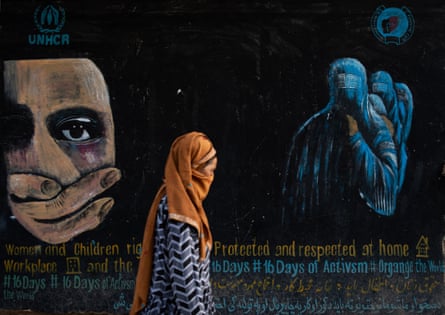
A mural calling for women and children’s rights in Afghanistan in August 2022 in Bamian, west of Kabul, a year after the Taliban takeover. Photograph: Nava Jamshidi/Getty Images
The team documented 231 cases, of which 53 were declared suicide. The provinces with the highest recorded tolls were Jawzjan (36), Herat (32), Badakhshan (28) and Ghazni (26). The age of victims ranged from girls as young as five to women of 65. Seven out of 10 victims – 165 of 231 – were housewives with no independent income or institutional standing to pursue a domestic violence case. Most of the cases occurred in the victim’s home. Across the dataset, only 58 arrests were recorded. More than one in five were officially declared suicide, even when there was significant evidence of foul play. Only one in four of the 231 killings resulted in any arrest, but even in these cases, the suspect was often released – sometimes just one day after being detained.
The reporters found a number of deaths that according to family or witnesses had resulted from domestic violence, but were being officially recorded as suicides.
Freshta Emady, whose family and friends believe she was killed by her husband
A healthcare worker in Jawzjan said that many of the dead women that came to hospital and were labelled suicides had clearly been beaten, their bodies covered in wounds and bruises.
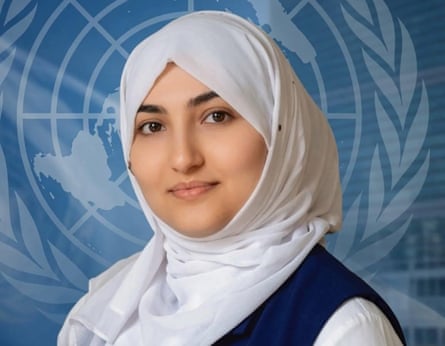
Freshta Emady, 33, a UN agency employee in Kabul, was found dead in her home on 31 May. Her husband reportedly told Taliban police she had killed herself, citing a psychiatric condition.
Her family and friends, however, believe she was killed by her husband. Five people who knew her said Freshta, who had been married off at 17, had spent 15 years being beaten, choked and controlled. A colleague said Freshta had described her husband repeatedly strangling her and telling her, “I’ll cut your throat.”
Retired, living in the Scottish Borders after living most of my life in cities in England. I can now indulge my interest in all aspects of living close to nature in a wild landscape. I live on what was once the Iapetus Ocean which took millions of years to travel from the Southern Hemisphere to here in the Northern Hemisphere. That set me thinking and questioning and seeking answers.
In 1998 I co-wrote Millennium Countdown (US)/ A Business Guide to the Year 2000 (UK) see https://www.abebooks.co.uk/products/isbn/9780749427917