
Horrifying images caught by CCTV before transmission cut out:
The catastrophic debris flow that struck Nepal and Tibet today was triggered by the collapse of a glacier high in the mountains.
Why did this mountain collapse:
Glacier melt is primarily driven by rising global temperatures caused by human activities such as burning fossil fuels, deforestation, and industrial emissions that increase greenhouse gases. Since 2000, glaciers worldwide have been losing an average of 273 billion tonnes of ice per year, accelerating freshwater loss and contributing to sea-level rise. European Space Agency iberdrola.com
Thousands will have perished, including tourists:
Footage broadcast on TV channels shows collapsed houses being swept away by the floodwaters, cars adrift and a massive metal bridge over the Trishuli River swept away by the flood. According to some witnesses quoted by Reuters, entire villages have reportedly been submerged by the floodwaters. Others claim to have seen the current sweep away ‘eight or nine lorries, along with houses and people’.
“There could be many casualties or significant material damage,” said Nepalese district administrator Narendra Pariyar, urging villagers living on the banks of the Bhote Koshi river to move to higher ground.
“There is devastation wherever we look,” explains Tula Bahadur BK, a healthcare worker from Rasuwa. “The settlements near the river have been completely swept away. Five of my relatives are missing.” According to the Nepalese army spokesperson Raja Ram Basnet, rescue helicopters will not be able to land in the affected areas until the waters recede.
Chinese President Xi Jinping
Chinese President Xi Jinping has called for every possible effort to be made to search for and rescue missing persons, to evacuate and rehouse residents threatened by the disaster, and to speed up treatment for the injured, with the aim of minimising the number of casualties. He also ordered that monitoring and early warning systems be strengthened, that rescue operations be conducted in accordance with scientific principles, and that the occurrence of secondary disasters be prevented.
Chinese Premier Li Qiang has, in turn, asked the Ministry of Foreign Affairs to strengthen communication and coordination with the countries concerned and to share information promptly in order to jointly manage the rescue operations. On the instructions of Xi and Li, Deputy Prime Minister Zhang Guoqing travelled to the scene with the heads of the relevant departments to lead the rescue and emergency management operations. The Tibetan authorities have mobilised forces for search and rescue operations at the disaster site.
Our planet is self destructing thanks to human harmful actions.
It was only recently the famous Nepalese mountaineer died under an avalanche. The danger signs were there, but still he continued to climb.
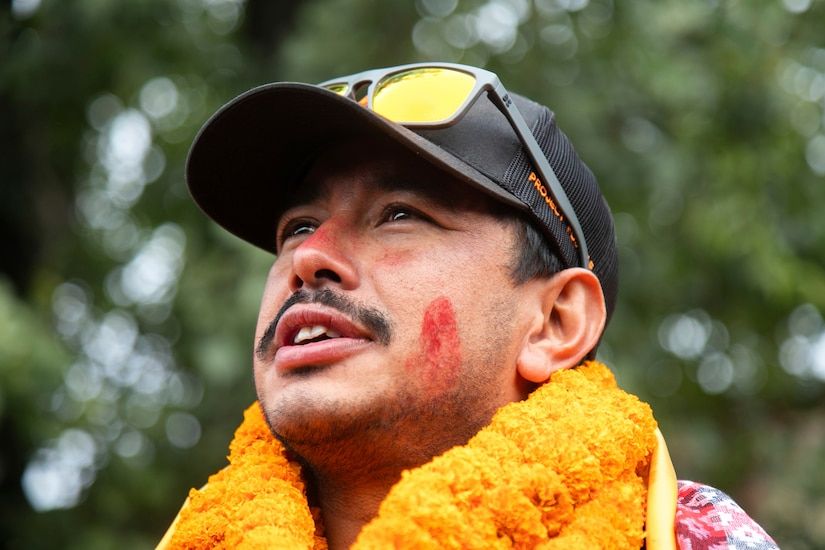
Prabin Ranabhat, Pacific Press, Sipa USA, AP Images
How Nims Purja’s Broad Peak climb ended in deadly disaster
The mountaineering star and nine other climbers perished in an avalanche in Pakistan’s Karakoram. Other expeditions had already left the mountain over concerns about a recent heavy snowfall.
Before the avalanche, Nirmal “Nims” Purja, a climbing sensation, posted on Instagram that the world’s twelfth highest mountain…Read More
Prabin Ranabhat, Pacific Press, Sipa USA, AP Images
ByAnna Callaghan and Grayson Schaffer
Last updated August 2, 2026
David Klein and Ian Overton did not like what they were seeing. By the last week of July the two men had been living under Pakistan’s 26,414-foot Broad Peak for a month, and the mountain in front of them had dramatically changed its mood. They had come to climb it without bottled oxygen and no porters. Klein, a Hungarian who led the country’s first ascent attempt on Broad Peak in 2000, and Overton, an American ER nurse, tried Nanga Parbat together in winter 2012. This year, they decided to give Broad Peak, the world’s twelfth highest peak, a go.
In mid-July, Klein told ExplorersWeb that conditions on the mountain were relatively good and that “avalanche danger is low.” Most of what could slide, he said then, had already slid. On July 19, he followed a Pakistani rope-fixing team up the west side for 19 hours and turned around somewhere between 50 and 70 vertical meters below the summit. Klein was climbing without bottled oxygen. Overton, affected by the altitude, had already returned to base camp.
Klein weighed the idea of making another attempt, but was dissuaded by heavy snowfall that began around July 22. “After lots of snowfall you don’t only want good weather,” says Klein. “You want a few days of good weather in which there is no snowfall, but you are not moving because the snow has to do one of two things. It has to stick to the mountain or it has to slide down.”
Most of the teams at base camp had already gone home. On July 25, Klein and Overton packed up and walked out as well. Yet a few teams with summit hopes remained, including that of Nirmal “Nims” Purja, who rose to fame in 2019 after summiting all 14 of the world’s 8,000-meter peaks in record time, and his team from Elite Exped, who were staged at a nearby base camp.
Why they decided to stay is still opaque, but the consequences were deadly. At around 9 a.m. local time on Thursday, July 30, an avalanche swept ten climbers down the mountain’s main west-facing gulley, up to a vertical mile, and a rescue and recovery mission was immediately initiated. At first, rescuers hoped to find survivors. But the Alpine Club of Pakistan confirmed on Friday that the bodies of two climbers, Nadhira Al-Harthy of Oman and Pur Bahadur Gurung “Yukta” of Nepal, had been recovered. And on Saturday, Elite Exped posted that Purja and another climber and guide, Nima Sherpa, were among the dead. “Today, it is with profound sadness and immense heartbreak that we confirm that Nirmal ‘Nimsdai’ Purja tragically lost his life following the avalanche on Broad Peak. We have also received confirmation that other members of the expedition sadly did not survive.”
https://www.nationalgeographic.com/adventure/article/nims-purja-avalanche-broad-peak-himalayas
All the signs are around us. We know we have tipped our planet into a momentum of disaster due to our human activities, yet we have intensified the harm and reduced the attempts to Save the Planet.
See Nepal history:
Health and welfare
The Ministry of Health is responsible for the support and administration of public health services, including hospitals and health clinics. Although the government has taken steps to improve existing health centers and to establish new ones, health care remains inadequate. Malaria, tuberculosis, cholera, and typhoid are prevalent in spite of government projects to control or eradicate them. Ayurvedic medicine, the traditional Hindu system of medicine, is popular in Nepal.
https://www.britannica.com/place/Nepal/Government-and-society


You must be logged in to post a comment.