Yemen is one of the world’s worst humanitarian crises. It is a result of the bitter civil war, starvation, and a failing economy. Over 18 million people are in need of assistance, that’s more than 55% of the population.
Together with our partner BCHR (Benevolence Coalition for Humanitarian Relief), we are supporting vulnerable communities.
Read more about the crisis in Yemen, how it affects people, and get some crucial facts and figures.
Yemen is facing one of the world’s worst humanitarian crises. Years of conflict, poverty, and climate shocks have forced millions from their homes.
Since 2014, civil war between Yemen’s government and the Houthi movement has devastated the country. Over 18 million people – more than half the population – need support, including 4.5 million people who have been displaced.
Many families have been forced to move again and again, relying on aid just to survive.
A brief truce in 2022 brought hope, but it only lasted six months. Fighting now continues, making it impossible for many to return home.
Yemen remains divided, people are still being displaced, and delivering help is increasingly difficult. On average, displaced families have been without stable homes for eight years – some children have only known war.
The crisis is made worse by extreme poverty, and repeated climate shocks like droughts, storms, heavy rains, and locust swarms. Recent attacks on key trade routes and ongoing airstrikes have deepened the crisis.
Where is Yemen?
Yemen is a country in West Asia, found in the southwestern part of the Arabian Peninsula. The land is mostly made up of mountains and dry areas.
Why is there a war in Yemen?
Since 2004, The Houthi movement has been leading an insurgency against the military in Yemen. The movement is known officially as Ansar Allah. In 2014, tensions between Houthis and government forces escalated into outright civil war.
Protests around the 2011 Arab Spring had pressured Yemen’s President Saleh to hand power to his deputy, Abdrabbuh Mansour Hadi. The transition was not smooth.
As security forces withdrew from outlying provinces, the Houthi rebels took advantage and captured territory in the north. They also had growing support from Yemenis tired of Saleh’s decades-long regime.
By the end of 2014, Houthi forces had occupied Yemen’s capital city, Sanaa. In early 2015, President Hadi fled Yemen.
After Hadi appealed to the international community, Saudi Arabia led a coalition of Arab states to try and restore full power to the Yemen Government. Relentless airstrikes and ground offensives killed thousands of civilians
18,500 Displaced in 72 Hours as Fighting Flares Across Yemen West Coast
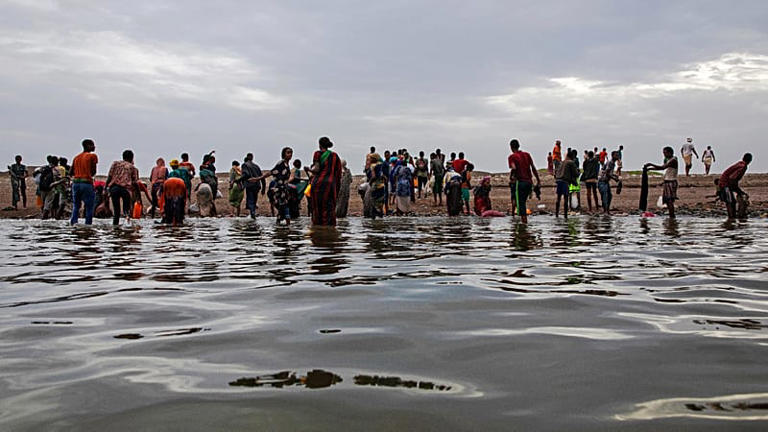
Over 2,000 families have been displaced in a flareup of fighting in Yemen. Photo: IOM 2026/Yemen
Aden/Geneva, 7 September 2026 — Renewed hostilities along Yemen’s western coast and in parts of Taiz and Al-Hodeidah have forced thousands of people from their homes, with civilians reportedly among those killed and injured as clashes intensify.
Approximately 18,500 people have been displaced in the governorates of Taiz and Al-Hodeidah since hostilities escalated rapidly on September 3, according to the International Organization for Migration’s (IOM) Displacement Tracking Matrix, government and partners. The number is increasing by the hour as families continue to arrive in host communities and displacement sites.
“Families are arriving with nothing: no shelter, no food, no way to know if it’s safe to go back,” said Abdusattor Esoev, IOM Yemen’s Chief of Mission. “Many of these are people who have already been displaced once, twice, even four times before. Every time fighting flares up, they lose whatever little they had managed to rebuild. We are particularly concerned by reports that some families may be unable to leave frontline areas safely because of continuing hostilities and insecurity along access routes.”
Reports indicate significant displacement from affected communities in Maqbanah, Al Ma’afer and Jabal Habashi, including Al-Hajab, Al-Rajehi, Hajjat Gabeh and Al Kadaha. Renewed fighting has also reportedly caused secondary displacement among families previously living in displacement sites in Hays.
Urban centres and host communities across South Taiz and the West Coast, including Al Mokha, Hays, Mawza, Al Ma’afer and Jabal Habashi, are experiencing significant pressure due to the continued influx of newly displaced families fleeing ongoing hostilities. With displacement figures continuing to rise, and local capacities overstretched, authorities have issued urgent appeals to humanitarian partners and UN agencies for additional support to address growing needs.
Challenges in road access due to ongoing clashes and disruption of telecommunications networks in the affected districts are slowing efforts to reach, register and verify newly displaced families, complicating an already difficult response. Emergency stocks, particularly food assistance, shelter and household items are severely depleted following recent flood and West Coast responses, leaving humanitarian partners with little to distribute to families arriving at reception sites.
Displaced families are urgently in need of cash assistance, emergency shelter, essential household items and food assistance. At reception sites and throughout host communities, access to safe drinking water and hygiene support remains problematic. In addition, affected populations urgently require emergency healthcare and referral pathways for the injured.
“At the same time, we recognize the presence of migrants using the Eastern Route who may also become trapped or stranded in these areas as a result of the deteriorating security situation and restrictions on movement. Their limited access to assistance, information, safe shelter, voluntary humanitarian return, and essential services may further increase their vulnerabilities and exposure to protection risks,” noted Esoev.
IOM is working alongside Yemen’s Executive Units for Internally Displaced People and humanitarian partners to track, verify and consolidate displacement figures, identify people in urgent need, and mobilize resources for a rapid response. Already, 663 households have been reached with vital household items across Taiz and Hodeidah governorates, while further supplies are on the way.
IOM calls on all parties to the conflict to protect civilians, allow safe passage for families trying to flee, and ensure unimpeded humanitarian access to those still trapped by the fighting.
The Organization is urging donors to urgently replenish emergency stocks and fund the response, as the scale of need continues to outpace available resources.
Houthi attacks on Saudi Arabia ignite fires at oil facilities and wound 73 people
The attacks come after weeks of escalating clashes between the important U.S. ally and the Iranian-backed rebels in Yemen, which shattered a four-year truce in the country’s civil war.
Sept. 8, 2026, 7:47 AM GMT+1 / Updated Sept. 8, 2026, 9:29 AM GMT+1/ Source: The Associated Press
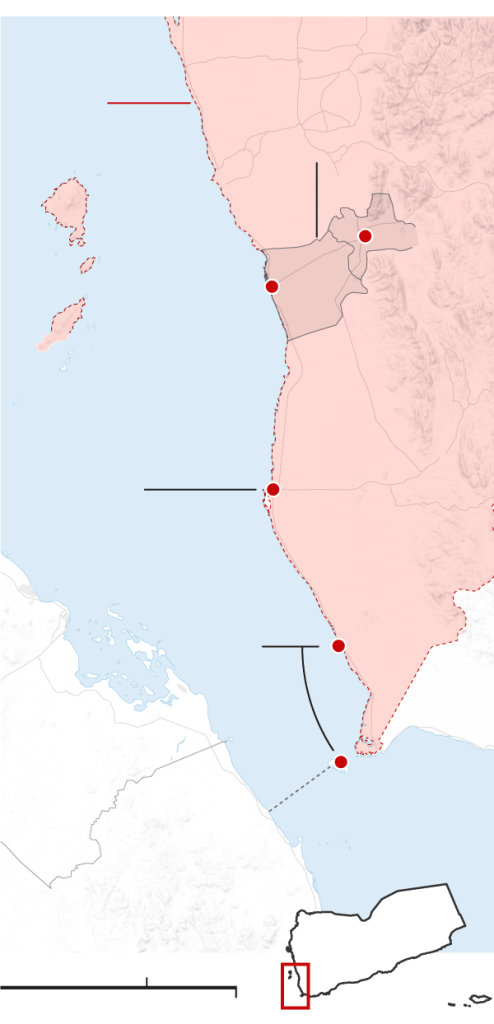
On Thursday and Friday, a rapid Houthi advance southwards along Yemen’s western coast resulted in the capture of the port city of Mocha and then the strategic island of Perim in the the Bab al-Mandab strait. Pending a counter-offensive from government forces, the group is now in a position to control shipping through the strait.
…………
The Red Sea, via Bab al-Mandab, has become a vital lifeline for Saudi Arabia to export its oil. If the Houthis gained full control over the strait, the group would be able to virtually close shipping through the waterway, or charge tolls. It would give Iran and its allies control over two key shipping lanes in the region.
Retired, living in the Scottish Borders after living most of my life in cities in England. I can now indulge my interest in all aspects of living close to nature in a wild landscape. I live on what was once the Iapetus Ocean which took millions of years to travel from the Southern Hemisphere to here in the Northern Hemisphere. That set me thinking and questioning and seeking answers.
In 1998 I co-wrote Millennium Countdown (US)/ A Business Guide to the Year 2000 (UK) see https://www.abebooks.co.uk/products/isbn/9780749427917





You must be logged in to post a comment.