This is part of an article from back in March of 2026. The Israeli settlers have continued to demolish mosques, homes, farms of the Bedouins who have lived on this land for countless generations.
Bedouin communities – Dispossession and entrapment
From desert nomads to displaced people: The Ongoing Nakba of the Bedouins
March 17, 2026 at 7:27 pm
Israeli army continue attacks on the El-Halayil Bedouin community, forcing 11 Palestinian families to leave their homes in Ramallah, West Bank on February 21, 2026. [Issam Rimawi – Anadolu Agency]
As the war in Gaza continues to devastate Palestinian life, and the ongoing confrontation involving Iran, Israel, and the United States deepens regional instability, another quieter tragedy unfolds on the margins of the conflict. The Bedouins – long-standing desert communities whose lives have been intertwined with the fragile ecosystems of the Middle East – find themselves caught in the crosscurrents of militarization, displacement, and geopolitical rivalry.
While global attention focuses on the spectacle of war, Bedouin communities across the Naqab (Negev), the occupied West Bank, and parts of Sinai endure intensifying dispossession, settler violence, and forced displacement. Their struggle, largely invisible in global headlines, reflects a deeper pattern of erasure that has accompanied the Palestinian catastrophe since 1948 and which now risks accelerating under the cover of wider regional war.
Bedouins (from the Arabic badawi, “desert dweller”) are traditionally nomadic, Arabic-speaking tribes who have inhabited the deserts of the Middle East and North Africa for centuries. They are pastoral nomads, traditionally raising camels, goats, and sheep, and living in portable black goat-hair tents.
Palestinian Bedouin communities – both within the occupied West Bank and in the Naqab – are facing accelerated displacement, sometimes described as a “slow-motion genocide” or “spaciocide” aimed at erasing their presence.
Historically, they moved across arid landscapes in search of water and grazing land for their livestock.
Bedouin society is patriarchal and tribal, who place a strong emphasis on community, honour, loyalty, and hospitality. While many still live in the desert, others have settled into permanent modern homes.
Today, while some Bedouins continue to herd and live in desert environments, others have adapted to more sedentary lifestyles. Their cultural traditions are often highlighted in tourism sectors in countries such as Jordan, Egypt, and the UAE.
In 1948, over 110,000 Bedouins were displaced from the Negev/Naqab, reducing the population to around 11,000 who were subsequently confined to a designated area. The ongoing post-1948 context is often described as an “ongoing Nakba,” where the Bedouin community in the Naqab is caught between state-driven dispossession and efforts to secure legal rights to their ancestral lands. The remaining Bedouins were placed under strict military rule until 1966. During this period, the state used the “Absentee Property Law” to declare Bedouin lands as “unregistered” or “absentee” property, enabling large-scale land confiscation. To further limit land claims and centralize control, the government later concentrated Bedouin populations into seven state-established townships.
Despite being a subaltern minority, Bedouins have engaged in both resistance and, at times, tactical legal or economic engagement with Israeli authorities to maintain their presence.
Post-Nakba (1948), the political background of the Bedouins in Israel and the occupied territories has been characterized by forced displacement, rapid sedentarization, marginalization, and ongoing struggles over land rights.
Bedouin youth face extreme stress, experiencing both anger toward Israeli policies and fear of violence, while often lacking basic protection such as bomb shelters in unrecognized villages. Many struggle daily without running water, electricity, or adequate schools. Communities are frequently threatened by military training exercises and settler violence. In places like the Muarrajat village, settlers have forced families off their land, destroying their traditional and sustainable ways of life.
In the Sinai Peninsula, Bedouin communities face a different but equally severe form of marginalization. Many are trapped in poverty with limited economic opportunities and an inability to register land ownership. The collapse of tourism and continuing instability have further weakened their livelihoods. Despite these hardships, Bedouin individuals have demonstrated remarkable courage and solidarity.
Independent international commissions, UN experts, and various human rights organizations have accused Israel of committing genocide against Palestinians in Gaza since October 2023, characterized by mass killing, forced displacement, and the systematic destruction of life-sustaining infrastructure. In this broader context, Palestinian Bedouin communities – both within the occupied West Bank and in the Naqab – are facing accelerated displacement, sometimes described as a “slow-motion genocide” or “spaciocide” aimed at erasing their presence.
Since October 7, 2023, there has been a sharp increase in settler violence and military actions leading to the displacement of numerous Bedouin communities in the Jordan Valley and the South Hebron Hills. Bedouins are being pushed off their land through mechanisms such as 48-hour expulsion orders and the designation of areas as “closed military zones,” which then enable the expansion of illegal Israeli settlements. In one documented incident, residents of the Bedouin village of Wadi as-Seeq were forced out by armed soldiers and settlers, marking a clear example of a systematic policy to seize Palestinian land.
Human rights defenders argue that Israel is exploiting global focus on the war in Gaza to intensify what they describe as the “de-Palestinisation” of other areas, including East Jerusalem and the West Bank. Bulldozers, demolitions, and forced removals – methods visible in Gaza – are increasingly being applied in the West Bank to target Bedouin communities
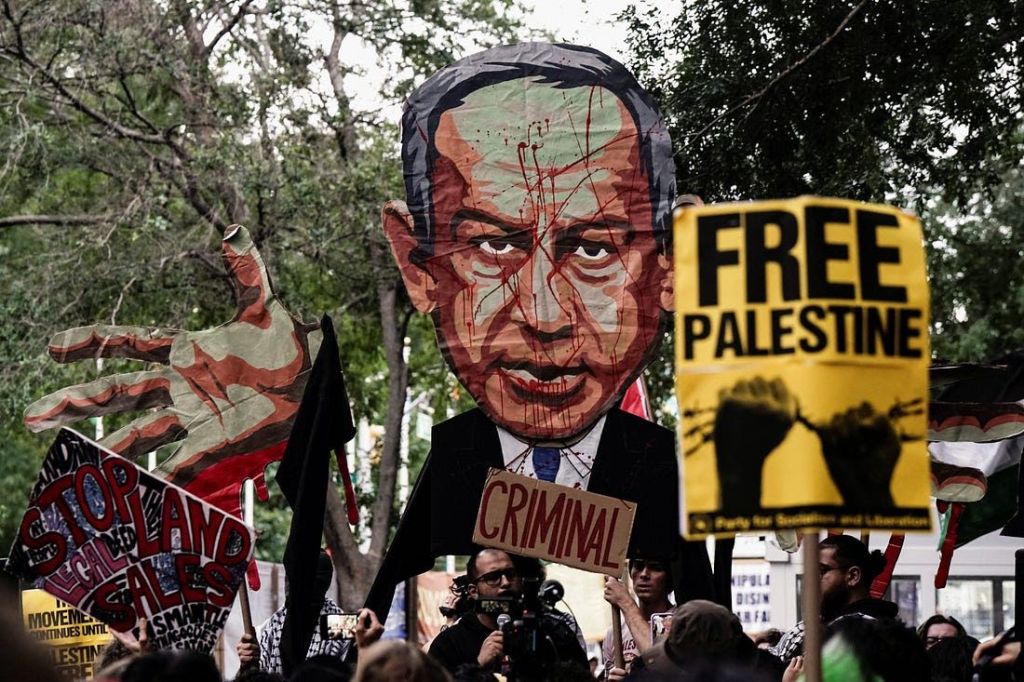
Pro-Palestinian demonstrators protest against Israeli Prime Minister Benjamin Netanyahu on the sidelines of the UN General Assembly in New York City on Sept. 24, 2026. Photo by Bing Guan/Reuters
Retired, living in the Scottish Borders after living most of my life in cities in England. I can now indulge my interest in all aspects of living close to nature in a wild landscape. I live on what was once the Iapetus Ocean which took millions of years to travel from the Southern Hemisphere to here in the Northern Hemisphere. That set me thinking and questioning and seeking answers.
In 1998 I co-wrote Millennium Countdown (US)/ A Business Guide to the Year 2000 (UK) see https://www.abebooks.co.uk/products/isbn/9780749427917

![Israeli army continue attacks on the El-Halayil Bedouin community, forcing 11 Palestinian families to leave their homes in Ramallah, West Bank on February 21, 2026. [Issam Rimawi - Anadolu Agency]](https://i0.wp.com/www.middleeastmonitor.com/wp-content/uploads/2026/02/AA-20260221-40631406-40631404-ISRAELI_FORCES_DISPLACE_11_PALESTINIAN_FAMILIES_FROM_IN_RAMALLAH.jpg?fit=920%2C613&ssl=1)


You must be logged in to post a comment.