Europe fortifies itself against Russia’s hybrid war
Europe’s allies strengthen security as the Kremlin’s sabotage and hostile actions increase
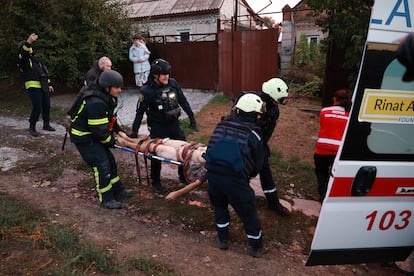
Rescue teams carry the body of a woman killed in a Russian attack on a residential neighborhood in Zaporizhzhia, last Saturday.Kateryna Klochko (AP/LaPresse)
Russia is stepping up its hybrid war against Europe. From sabotage, drone incursions, and arson to plots (mostly foiled) to assassinate pro‑Ukraine activists and Russian dissidents on European soil, the Kremlin is testing the allied response, and incidents against NATO’s European partners are becoming more serious, such as the explosive‑laden drones found this summer at Leipzig Airport in Germany. That gray line between a hybrid attack and a conventional one is blurring, and several European intelligence sources warn of the risk that one of those incidents could escalate — either by a deliberate Kremlin decision or a miscalculation.
“What would have happened if the explosives at Leipzig Airport had detonated?” asks a senior EU source. Senior European and NATO officials consulted over the past week share the concern — not because of a conventional military assault but because that gray boundary is becoming ever more fragile. “The greatest danger now is that the hybrid war will accidentally cross a red line,” says another veteran source, who points to an incident two weeks ago in which flares were fired from a Russian frigate at a Danish helicopter as an example.
In fact, Emily Ferris, a researcher at the Royal United Services Institute (RUSI), says the serious episode involving explosive drones in Leipzig — which Germany clearly attributed to the Kremlin on September 1 — “showed that Moscow, and probably NATO itself, still lacks clarity on the current red lines that would trigger a military response.”
The Kremlin is furious at the stalemate in its war against Ukraine — which is approaching its fifth anniversary — and is moving to undermine allied support for Kyiv while testing the West’s response capacity, which so far has been relatively mild. The uptick in attacks is also occurring at an especially vulnerable moment for Europe, as it considers how to operate without the security umbrella of the United States and on the eve of a key super election year for the European project.
In recent weeks the alarm has risen sharply and Europe is beginning to bunker down against a threat that is becoming less and less hybrid. “We are preparing to face and survive a new kind of war,” admits a European intelligence source. One that does not necessarily involve missiles or tanks but could paralyze a country and undermine society through cuts to water and energy supplies, disruptions to computer systems, or weeks‑long closures of its airports, the source stresses.
Temperatures are rising in European capitals and the secret visit by CIA director John Ratcliffe to Moscow on August 25, the mystery over its purpose, and the messages he received there, has fed concern. The trip revived an unsettling precedent: the last time a CIA director traveled to Moscow was in November 2021, when William Burns tried to dissuade the Kremlin from invading Ukraine. Vladimir Putin launched the full‑scale war on February 24, 2022. As such, Keir Giles, a researcher at the Chatham House think tank, says the comparison is inevitable — and the parallel, he adds, shows how seriously the U.S. appears to view the current Russian threats.
Hybrid warfare is not episodic, but a permanent feature of Russia’s strategy, rooted in Soviet “active measures” and enhanced by modern tools like artificial intelligence–enabled information manipulation and cyber operations. It exploits the seams of open societies — disinformation, cyber, sabotage, coercion — below the war threshold.
Defensive measures such as cybersecurity and critical infrastructure protection mitigate damage but do not deter Russia, which exploits ambiguity and inaction in the gray zone.
Western responses must go beyond resilience, imposing credible costs — through sanctions, cyber countermeasures, diplomatic expulsions, and legal actions — that outweigh the benefits Russia gains from hybrid operations. Resilience alone will not stop hybrid warfare; allies should pair deterrence-by-denial with deterrence-by-punishment.
Deterrence principles must address clear credibility, capability, and communication, and all these measures must remain grounded in the rule of law to ensure legitimacy, allied unity, and stability.
Practical countermeasures to Russian hybrid threats should include public attribution and naming-and-shaming, enhanced NATO and European Union (EU) intelligence sharing, stronger maritime and infrastructure security, targeted sanctions against Russian elites and networks, expulsions of intelligence-linked diplomats, and dismantling of disinformation networks.
A coordinated NATO-EU approach is essential, aligning the EU’s economic and legal levers with NATO’s military and cyber capabilities to prevent Russia from exploiting divisions.
Instead of warning Russia of the possible ramifications of its actions, allies should be proactive by imposing timely, coordinated costs to make hybrid aggression a losing bet for the Kremlin.
Retired, living in the Scottish Borders after living most of my life in cities in England. I can now indulge my interest in all aspects of living close to nature in a wild landscape. I live on what was once the Iapetus Ocean which took millions of years to travel from the Southern Hemisphere to here in the Northern Hemisphere. That set me thinking and questioning and seeking answers.
In 1998 I co-wrote Millennium Countdown (US)/ A Business Guide to the Year 2000 (UK) see https://www.abebooks.co.uk/products/isbn/9780749427917