On April 17, 2026, a group of Syrian billionaires with deep ties to the Assad regime met privately in Washington D.C., invoking the name of former U.S. President Donald Trump to seek intervention in lifting sanctions that have frozen billions in Syrian assets abroad. Their appeal, framed as a humanitarian gesture to ease civilian suffering, has instead ignited a firestorm over the weaponization of personal diplomacy and the resurgence of transactional foreign policy in an era when global markets remain hypersensitive to Middle East instability. This isn’t just about Syria’s frozen wealth—it’s a test of whether the post-Trump international order can resist the pull of patronage networks that bypass institutions, and what that means for investor confidence in emerging markets from Beirut to Baku.
The Sanctions Web: How Syrian Assets Became a Geopolitical Lever
Since 2011, the U.S., EU, and UN have imposed layered sanctions on Syria targeting the Assad regime’s revenue streams, including oil exports, financial transactions, and the assets of designated individuals. Over $10 billion in Syrian state and elite-held assets remain frozen in Western banks, according to the Carnegie Endowment for International Peace. These measures were designed to pressure Damascus into political concessions, but they’ve also crippled legitimate trade, worsened humanitarian conditions, and pushed the regime toward illicit economies like Captagon production. The Syrian billionaires’ ask isn’t for regime legitimacy—it’s for access to liquidity that could stabilize their own holdings while indirectly bolstering the state’s capacity to function.
What makes this moment distinct is the explicit invocation of Trump’s name. During his presidency, Trump signaled openness to engaging with Assad—a stark departure from Obama-era red lines—and his inner circle included figures who viewed sanctions as blunt instruments harmful to U.S. Business interests. Though no evidence suggests Trump is directly involved in these 2026 meetings, the mere association carries weight in circles where personal loyalty still trumps protocol. As one former U.S. Treasury official noted off the record, “In certain networks, a name drop isn’t nostalgia—it’s a signal that the classic rules of engagement might be reactivatable.”
Geopolitical Ripple Effects: From Beirut Banking to Global Supply Chains
The implications extend far beyond Damascus. Syrian elites have long used Lebanese banks as conduits for moving capital, a practice that intensified after 2019 when Syria’s own banking system collapsed under sanctions pressure. Any easing of restrictions could trigger a surge in cross-border flows, testing Lebanon’s fragile financial recovery and potentially reigniting tensions with the IMF, which has tied its $3 billion bailout to strict capital controls. Meanwhile, European energy firms eyeing Syrian phosphate reserves—a key ingredient in fertilizers and a potential alternative to Russian supplies—could see renewed interest if sanctions loosen, altering agricultural supply chains across the Mediterranean.
More broadly, this episode underscores a growing trend: the use of personal diplomacy to circumvent multilateral frameworks. When high-net-worth individuals from sanctioned states leverage former U.S. Presidents’ names to access Washington, it erodes the predictability that global investors rely on. “We’re seeing a shift from rules-based to relationship-based access,” warned Dr. Lina Khatib, Director of the Middle East and North Africa Programme at Chatham House, in a recent briefing.
“When asset holders believe they can bypass institutional channels through personal connections, it undermines the very sanctions regimes designed to enforce accountability—and that creates market volatility no hedge fund can model.”
This dynamic isn’t unique to Syria; similar patterns have emerged in Venezuela and Myanmar, where diaspora elites seek political intermediaries to unlock frozen wealth.
Historical Echoes: When Personal Diplomacy Trumped Policy
The Trump administration’s approach to foreign aid and sanctions was often transactional, exemplified by the 2020 decision to suspend $70 million in health aid to Zimbabwe over minerals and data concerns—a move later reversed but indicative of a broader willingness to tie assistance to bilateral concessions. While current U.S. Policy under the Biden administration has sought to reassert normative frameworks, the persistence of backchannel appeals reveals the durability of Trump-era norms in certain elite circles. As noted in a 2023 Brookings Institution analysis, “The legacy of personalistic foreign policy isn’t in treaties signed, but in the expectations it created among foreign actors about what leverage looks like.”
This context matters as Syria’s economic future is increasingly tied to regional reconstruction efforts. The World Bank estimates that rebuilding Syria will require $250–$400 billion over the next decade—a figure far beyond what Damascus can raise domestically. If sanctioned assets remain locked, reconstruction will rely on alternative financiers, including Gulf states and China, potentially shifting Syria’s long-term alignment away from Europe and toward Beijing-led initiatives. Conversely, any sanctioned asset release—even conditional—could accelerate Western re-engagement, but only if paired with verifiable political steps, a condition the billionaires’ current appeal notably lacks.
IndicatorPre-20112023 EstimateSourceSyrian GDP (Billion USD)$60.2$6.2World BankFrozen Syrian Assets (USD)$0$10+ billionCarnegie EndowmentSyria’s Share of Global Phosphate Exports~5%<0.1% (sanctions-impacted)USGS Mineral Resources ProgramLebanon-Syria Cross-Border Deposits (Est.)$20–25 billion (pre-2019)$3–5 billion (2023)IMF Staff Report
The Real Test: Can Institutions Withstand the Pull of Patronage?
What’s at stake here isn’t just Syria’s balance sheets—it’s the credibility of the sanctions architecture itself. If personal appeals succeed where structured diplomacy has stalled, it risks creating a two-tier system: one for those with access to former presidents’ names, and another for everyone else subject to the full force of coercive economics. That distinction matters for global markets, which depend on consistent rule application to assess country risk. As CSIS fellow Jon Alterman observed in a March 2026 panel, “The danger isn’t that sanctions fail—it’s that they succeed unpredictably, rewarding connections over compliance.”
For now, the Biden administration has not indicated any shift in policy. Treasury sanctions remain in place, and State Department officials continue to tie any relief to irreversible political progress toward a UN-facilitated solution. But the mere fact that these meetings occurred—and that they were framed as viable—suggests a deeper erosion in the norms that once made such appeals unthinkable. In an age where geopolitical risk is priced in real time, the perception of backdoor access can move markets as surely as an actual policy shift.
Looking Ahead: What So for Global Investors and Policy Makers
The Syrian billionaires’ gamble reflects a broader calculation among elites in sanctioned states: that in a multipolar world, personal networks may outlast institutional frameworks. Whether that bet pays off remains uncertain. But the attempt itself reveals a truth often overlooked in sanctions debates—that their effectiveness depends not just on design, but on perceived legitimacy and uniformity of application. When those erode, so does the deterrent value.
For global investors, the message is clear: monitor not just official statements, but the quieter currents of influence where names are dropped and favors are implied. For policymakers, the challenge is to reinforce that sanctions are not bargaining chips, but tools of accountability—whose power diminishes the moment they become negotiable over coffee in a Washington townhouse. The true test of the post-Trump order isn’t whether it can resist a name drop—it’s whether it can convince the world that it doesn’t need to.
Editor-in-Chief Prize-winning journalist with over 20 years of international news experience. Alexandra leads the editorial team, ensuring every story meets the highest standards of accuracy and journalistic integrity.CategoriesWorld
Then we see Jared Kushner and wife Ivanka Trump receiving Syrian billionaire funding for the Driatic pristine Albanian island project:
The Adriatic Grift: How Jared Kushner, Syrian Billionaires, and a Compliant White House Carved Up a Country
That framing, of course, belongs to his wife. On May 31, 2026, Ivanka Trump told a podcast audience that she and Kushner had “discovered” Sazan while sailing off a friend’s boat in the Mediterranean, as though the island had been waiting in darkness for someone with a private equity firm and sovereign wealth fund backing to illuminate it. In a country where Sazan had been public land for generations, that language landed like a verdict. It told Albanians, in the clearest possible terms, what kind of arrangement was being imposed on them.
Tens of thousands of them took to the streets.
The island was never for sale. That was always the point.
And
The network of companies and Qatari billionaires hiding behind Sazan, documents reveal the behind-the-scenes of Jared Kushner’s project
strategic investor status from the Albanian government.
The Al-Khayyat brothers are household names in the Middle East. They run the conglomerate Power International Holding (PIH) with activities in construction, real estate, agriculture and healthcare. PIH was one of the main contractors in building the infrastructure for the Qatar 2022 World Cup.
An investigation by The New York Times, published on April 19, 2026, pointed out the connection between the Al-Khayyat brothers, who are of Syrian origin, and Kushner as well as other members of the Trump family.
Regarding investments in Albania, Ramez Al-Khayyat confirmed to the NYT the partnership with Kushner.
“We are investing in the holding company to make sure it has sufficient capital. So it is a joint venture between the two companies, and we are actually managing it together,” he told the New York Times.
Albania’s Sazan Island has been fought over for millennia
Strategically situated where the Adriatic and Ionian Seas meet, a small rocky outcrop has once again become an object of desire for the wealthy and powerful.
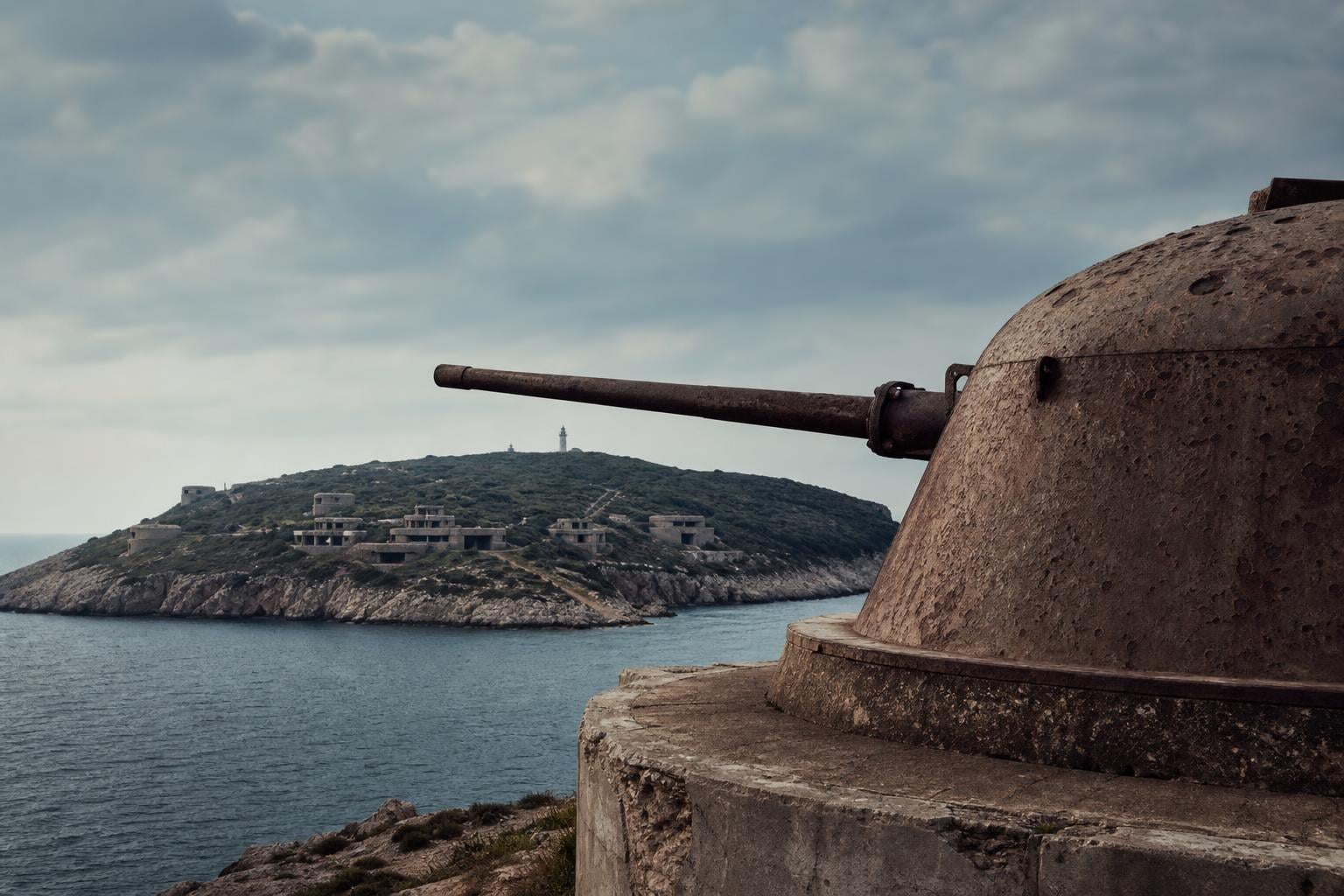
Albania’s Sazan Island has served for decades as a military stronghold.
Hektor Pustina/AP
ByNoah Kirsch
Published June 12, 2026
For thousands of years, world powers have traded control over a small, lush isle off the southwestern coast of Albania. Sazan Island, a 2.2 square-mile spit of land, lies within the Strait of Otranto, a narrow channel separating Italy and Albania, and has served as a crucial base for powers seeking to dominate the Adriatic and Ionian Seas.
There are no permanent residents on Sazan, and yet it has played a key role in Albanian history for more than a century.
“The island no doubt has a long, complicated history,” says Theodora Dragostinova, a professor of history at The Ohio State University who researches the Balkans. With its strategic location at the edge of Albania’s Bay of Vlorë, different empires—including the Romans, Venetians, British, and Ottomans—have each controlled it.
Ishulli i Sazanit (Sazan Island): A Military History
Five point seven square kilometers of fortified rock at the mouth of the Bay of Vlore have been Ottoman, Italian, Soviet, and Albanian inside a single century.
By Enri Zhulati
National Albanian Registry · 501(c)(3) editorial deskCopy link
Albanian America is still being written down — by us. The Census records 230,000 of us; the real number is closer to a million. Add your name to the count in 2 minutes.Be counted →
Ishulli i Sazanit (Sazan Island) is a small place that has held a disproportionate amount of 20th-century history. The island covers roughly 5.7 square kilometers — about 2.2 square miles — at the mouth of the Gjiri i Vlores (Bay of Vlore), where the Albanian coastline turns the corner from the Adriatic into the Ionian. It is the largest island in Albania, and on most maps of the Balkans it is a single dot (Wikipedia: Sazan Island).
The dot has been Ottoman, then Italian, then Albanian, then a Soviet forward base, then Albanian again. It has been a coaling station, a fleet anchorage, a submarine pen, a closed military zone, and, in the last few years, a tightly chaperoned tourist destination. Most of the buildings on the island today were built by foreign militaries. Most of the underground was dug by Albanian conscripts during the Cold War. The island has more bunkers than residents, and that ratio has been true for sixty years.
This article is a heritage history of Sazan, written for an Albanian-American readership. The aim is not a tour guide. It is a single-page reading of why one rock in the Adriatic ended up carrying so much modern Albanian history, and why the diaspora should know it. For broader context, see albanian-history, the Cold War backdrop in operation-valuable, and the long arc of albania-us-relations.
Geography and the Bay of Vlore
Sazan sits about five kilometers off the tip of the Karaburun Peninsula, the long arm of mainland Albania that curves south from the city of Vlore and shelters the Bay of Vlore from the open Adriatic. From the air, the bay reads as a deep, almost enclosed harbor with one narrow opening to the sea. Sazan is the cork in the bottle.
The island itself is roughly 4.8 kilometers long and 2 kilometers across at its widest, oriented broadly north-south. The terrain is hilly, with the highest point reaching about 340 meters above sea level. Vegetation is Mediterranean scrub. There is no permanent civilian population. Fresh water is limited; for most of its modern history, water has been brought in by ship or collected in cisterns.
What makes Sazan strategically important is not its size but its position. The Strait of Otranto, the narrow stretch of sea between Albania and southern Italy, is the gateway between the Adriatic and the Ionian. Any navy that controls Sazan controls the southern entrance to the Adriatic, and by extension the sea lanes to Venice, Trieste, Bari, Brindisi, and the Italian east coast. From Sazan, a coastal artillery battery can range across the strait. From the bay behind it, a submarine fleet can sortie into the Mediterranean unobserved. That is the single fact that has driven every owner of the island since the late 19th century.
The Karaburun-Sazan National Marine Park, established in 2010, includes the waters around the island and gives the area a layer of legal environmental protection. The marine park designation will become important again later in this article when we get to the 2024-2025 development controversy.
Retired, living in the Scottish Borders after living most of my life in cities in England. I can now indulge my interest in all aspects of living close to nature in a wild landscape. I live on what was once the Iapetus Ocean which took millions of years to travel from the Southern Hemisphere to here in the Northern Hemisphere. That set me thinking and questioning and seeking answers.
In 1998 I co-wrote Millennium Countdown (US)/ A Business Guide to the Year 2000 (UK) see https://www.abebooks.co.uk/products/isbn/9780749427917