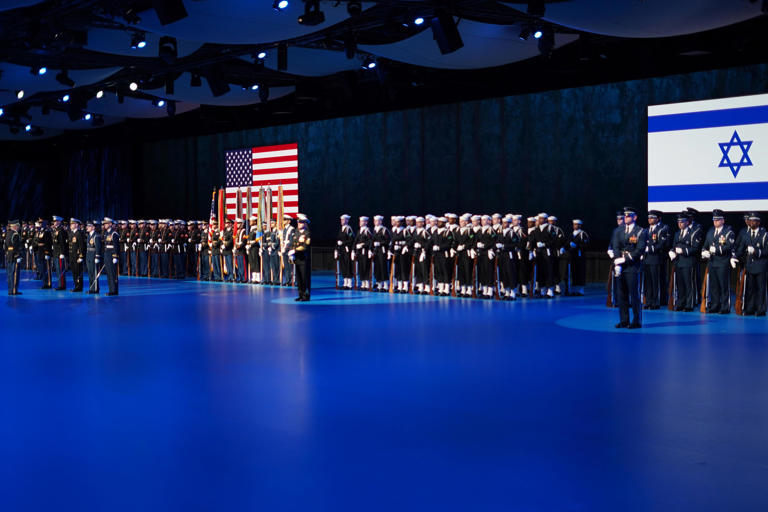
At a time when the American public is expressing unprecedented levels of distrust in the Israeli government, Congress just proposed tying the U.S. to the Israeli military more than ever before.
Buried in the House’s version of the 2027 National Defense Authorization Act (NDAA) released on Tuesday, is section 224, entitled “United States-Israel Defense Technology Cooperation Initiative.” The provision would arguably do more to intertwine the U.S. military with the Israeli military than the more than $200 billion (inflation adjusted) in military assistance Israel has received from the U.S. since its founding in 1948.
WASHINGTON, Nov 3 (Reuters) – President Donald Trump on Tuesday said he made a deal with Israeli Prime Minister Benjamin Netanyahu that Washington would stop $4 billion in funding to Israel after the end of this year.
On November 3, 2026—Election Day—President Donald Trump told Fox & Friends that he and Israeli Prime Minister Benjamin Netanyahu had agreed months earlier to end roughly $4 billion in annual U.S. funding by the close of the year. He described Israel as “a very thriving country” that no longer needed the money, framed the change as removing a “bad talking point” used by critics, and noted that Israel could still purchase American weapons, with further help available “if they need it.”
Netanyahu’s office responded on November 6 without denying the claim. It cast the shift as a deliberate move “from aid to partnership” and “mutual investment,” emphasizing Israel’s strong economy and the relationship’s adaptability. A PMO spokesman said Netanyahu had been working with Trump on the transition.
The existing 10-year Memorandum of Understanding (signed in 2016, running fiscal years 2019–2028) provides about $3.8 billion annually—$3.3 billion in Foreign Military Financing (mostly for U.S. weapons purchases) plus $500 million for cooperative missile defense. It formally expires at the end of September 2028. Israeli President Isaac Herzog and some defense and finance officials reportedly described Trump’s timeline as a surprise (“like a bolt from the blue”), and public statements indicate the precise legal mechanics of any early cutoff remain under discussion. Formal talks on a successor framework began in June 2026; the stated direction is expanded joint research, development, co-production, and reciprocal investment rather than unrestricted grants.
How Military Integration Is Positioned as an Offset
The integration is not presented as a pure dollar-for-dollar cash substitute for the $3.8 billion grants. Instead, both sides describe it as the mechanism that sustains (and in some respects deepens) the security relationship after pure aid ends. Key elements include:
Cooperative missile defense programs: Iron Dome, David’s Sling, and Arrow systems have long involved U.S. co-development and co-production requirements. Portions of interceptors and components are produced in the United States (with Israeli matching funds in some cases). These programs continue to receive dedicated funding in defense bills even as broader FMF is targeted for phase-out. Co-production keeps U.S. industry involved and creates mutual technical dependencies.
FY2027 NDAA provisions (including the U.S.-Israel Defense Technology Cooperation Initiative, often referenced as Section 219 in the House version): The House-passed bill authorized roughly $750 million for U.S.-Israel cooperative programs (an increase over the prior year), covering missile defense, counter-unmanned systems, subterranean operations, and emerging technologies. It directs the Pentagon to designate an executive agent to coordinate bilateral RDT&E, identify Israeli-origin technologies for potential integration into U.S. systems, support joint ventures and licensing, and establish frameworks for U.S.-based co-production and manufacturing. Covered areas explicitly include AI, autonomous systems, quantum technology, directed energy, cyber/electronic warfare, biotechnology, and defense industrial base cooperation. Similar language has appeared in prior years; this version formalizes coordination and expands the scope.
Broader industrial and technology ties: Israeli firms and co-developed systems already feed into U.S. programs. Advocates argue this gives the U.S. access to proven technologies (e.g., in missile defense, counter-tunneling, or counter-drone capabilities) while supporting American manufacturing jobs through co-production. Critics note that once systems are co-developed or co-produced, supply chains, data-sharing arrangements, and industrial partnerships create lasting entanglements that are harder to unwind than annual appropriations.
In short, the planned model redirects resources into joint projects that both countries can describe as mutually beneficial investment. Cash grants shrink or end; shared R&D, co-production lines, technology insertion, and industrial partnerships expand. This is the explicit offset path described in reporting on the post-MOU talks
Retired, living in the Scottish Borders after living most of my life in cities in England. I can now indulge my interest in all aspects of living close to nature in a wild landscape. I live on what was once the Iapetus Ocean which took millions of years to travel from the Southern Hemisphere to here in the Northern Hemisphere. That set me thinking and questioning and seeking answers.
In 1998 I co-wrote Millennium Countdown (US)/ A Business Guide to the Year 2000 (UK) see https://www.abebooks.co.uk/products/isbn/9780749427917