
Myanmar committed genocide against Rohingya minority, world’s top court rules
Judgment ends seven-year legal battle and is seen as critical test for dealing with most serious of all state crimes
Kaamil Ahmed in The Hague, and Oliver HolmesThu 19 Nov 2026 12.05 GMTShare
Myanmar committed genocide against its Rohingya minority nearly a decade ago, the world’s highest court has ruled.
The judgment from the international court of justice (ICJ) – which has never previously found a state responsible for genocide – ends a seven-year legal battle and is seen as a critical global test for dealing with the most serious of all state crimes.
The ICJ president, Yuji Iwasawa, said a majority of nine judges on the 15-seat court found that “the Republic of the Union of Myanmar has committed genocide against the Rohingya”.
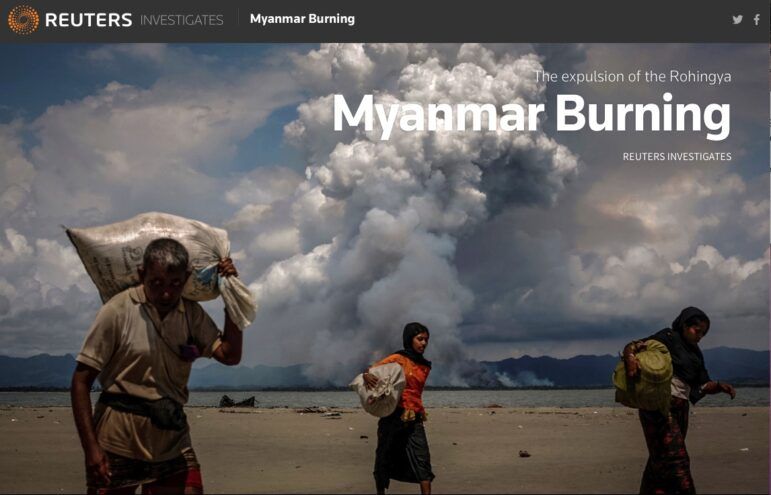
A 2016-17 campaign by Myanmar’s military forced more than 700,000 mostly Muslim Rohingya to flee across the border into Bangladesh, arriving with reports of mass killings of adults and children, gang rapes and burned-down villages.
During a reading of the decision that lasted more than two hours in a packed Great Hall of Justice, Iwasawa called for Myanmar to provide reparations and restitution, including allowing the safe return of Rohingya to their homes, returning or replacing their property, and providing physical and mental rehabilitation.
Governments have been anxiously awaiting the decision, handed down in The Hague, the Netherlands, where the UN-run court is based, in part because the ruling will set a precedent for genocide claims, notably a high-profile case against Israel.
Genocide, defined after the Nazi Holocaust by a 1948 UN convention, is harder to prove than war crimes because it requires evidence of specific “intent” to destroy a national, ethnical, racial or religious group.
“The court is fully convinced that Myanmar committed acts falling under … the genocide convention with an intent to destroy a substantial part of the Rohingya population in Myanmar,” Iwasawa said during a reading of the judgment.
Myanmar’s case was raised by the Gambia, a Muslim-majority state, on behalf of Myanmar survivors. It rested on claims of genocidal statements and “patterns of conduct” that showed attempts to destroy the group during assaults on Rakhine state, including gunning down people as they fled and blocking their return.
In January, the ICJ held closed-door sessions to hear from survivors who travelled from camps in Bangladesh. More than 1 million Rohingya still live there in the world’s largest refugee settlement, and fewer than 600,000 are estimated to remain in Buddhist-majority Myanmar.
……..must also act to uphold it by meeting their own obligations under the Genocide Convention and general international law and doing everything within their power to prevent and punish genocide. Failure to uphold this judgment would only embolden the Myanmar military’s defiance of international law and perpetuate the cycle of impunity.
“This should not be the end of the struggle for justice for the Rohingya. Survivors and victims are entitled to full and effective reparations for the harms they have suffered. They also need sustained international support, including humanitarian assistance, resettlement opportunities and strong political and financial backing for international accountability mechanisms.
“We hope this ruling marks the beginning of a long overdue process of accountability in Myanmar. All crimes under international law, past and present, including war crimes, apartheid and other crimes against humanity, must be effectively investigated and those suspected of responsibility brought to justice.”
https://gijn.org/resource/reporters-guide-to-investigating-war-crimes-tracing-war-criminals/


You must be logged in to post a comment.