I have reproduced this article written on this day.
The Tragic Death of Palestinian Journalists
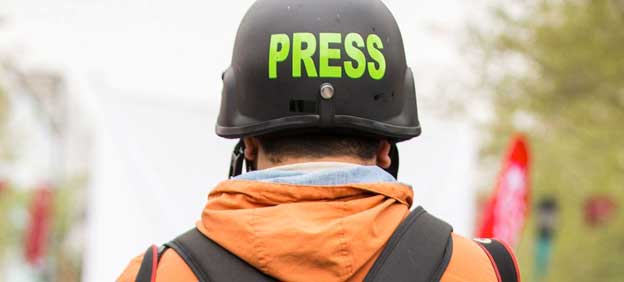
Over 120 journalists have lost their lives in G since 7 October. Credit: Unsplash/Engin Akyurt
OPINION by Alon Ben-Meir (New York)
Wednesday, May 01, 2024
Inter Press Service
World Press Freedom Day 2024
NEW YORK, May 01 (IPS) – It is only fitting, against the backdrop of World Press Freedom Day, to recount the horror being inflicted on journalists and reporters around the world, which is increasing day by day. To tell the story of the mounting death of journalists in Gaza, it is essential to put into perspective the plight of journalists around the world.
The random imprisonment of journalists is rampant in many countries; more than 800 journalists have been incarcerated, and nearly 550 marked the beginning of 2024 from prison; hundreds have been killed, and countless others are harassed to prevent them from decimating information deemed unfavorable to their respective governments.
More than half of these journalists are detained in just four countries – China, Myanmar, Belarus, and Vietnam. Other than these four countries, others do not lag much behind, including Turkey, Russia, China, Afghanistan, and Mexico, which is one of the deadliest countries for journalists. In this regard, it is also important to point out the danger and death that journalists are facing in another war zone in Ukraine.
According to Reporters Without Borders (RSF), since the start of the war in February 2022, Russian forces have reportedly killed 11 journalists and wounded at least 35; 12 others were detained, and two journalists are currently missing, while 233 media outlets were ordered to close down.
Regardless of how egregious these violations are against journalists, tragically, these statistics pale in comparison to what has and still is taking place in the Israel-Hamas in Gaza.
The Committee to Protect Journalists (CPJ) reported that 97 journalists and media workers were confirmed dead in Gaza: among them, a staggering 92 Palestinian journalists, which has by far exceeded the death toll of journalists in any other war zone in recent memory.
In comparison, only two Israelis and three Lebanese journalists were killed. Overall, according to CPJ, 16 journalists were reported injured, four are still missing, and 25 journalists were arrested. On top of that, there are routine assaults, threats and intimidation, cyberattacks, crippling censorship, and even the killing of family members to prevent journalists from doing their job.
The question is why such a disproportionate number of Palestinian journalists were killed in Gaza, and if there is anything that can be done to minimize this inexcusable death that transcends reason and even the horrific reality of a war that crossed the threshold of inhumanity. There are four reasons behind the astounding number of Palestinian journalists who were killed in particular.
First, many Palestinians who were embedded in civilian communities were killed by the initial Israeli bombing that leveled dozens of buildings, killing hundreds of civilians and, among them, many journalists.
Second, many journalists who were trying to report from the front line of the battles between Israel and Hamas were killed in the crossfire. Sadly, they threw caution to the wind and ended up paying with their lives.
Third, many other Palestinian journalists were killed as collateral damage for being in the wrong place and at the wrong time.
Finally, several journalists were deliberately targeted to prevent them from reporting on the scene. There is no definitive number of journalists in this category, as Israel vehemently denies the deliberate killing of Palestinian journalists.
Sadly, other than the need for Palestinian journalists to exercise extra caution, it is critically important to increase the pressure on both Israel and Hamas to take every precautionary measure to prevent journalists from being killed simply because they are dedicated to reporting on what they see and hear.
This is, of course, easier said than done. Nevertheless, RSF and CPJ should leave no stone unturned to expose the culprits behind this atrocious murder of journalists. The UN and the EU should also take every measure at their disposal to prevent the undue death of Palestinian journalists.
The freedom of the press is the heart and soul of any true democracy, and Western democracies must answer the call.
Dr. Alon Ben-Meir is a retired professor of international relations, most recently at the Center for Global Affairs at New York University. He taught courses on international negotiation and Middle Eastern studies.
Of the 50,000 phone numbers in the data, we had been able to verify, with multiple sources for each, the identities of more than 1,000 people from fifty countries. The count included more than 600 politicians and government officials, including 3 presidents, 10 prime ministers, and 1 king. There were 65 businessmen, 85 human rights activists or attorneys, and 2 Emirati princesses. Craig Timberg’s last-minute addition of an American reporter working in Saudi Arabia pushed our count of journalists to 192.
‘Pegasus’, Laurent Richard, S Rigaud
The location of where Pegasus attack vectors originated was updated for the final report which produced the undeniable evidence of this military-grade cyberweapon being deployed by high risk clients:
The Security Lab crew was also making the final editorial changes to their Forensic Methodology Report, which had a lot of moving parts. The list of countries hosting the most servers where Pegasus attack vectors originated had to be updated with raw numbers. The UK, Switzerland, France, and the US were high on that list, but Germany stood atop it. “Some of the biggest hosting companies are in Germany, as well as some of the cheaper ones,” Claudio says. “Pretty common destination when you want to set up infrastructure on a large scale.” Claudio and Donncha were also able to report that NSO had recently—and ill-advisedly—started using Amazon WebServices as a host for at least seventy-three of their servers.
When the report became global it led to the demise of NSO, but UAE employed a number of ex NSO coders, plus some mercenary former agents from the world’s premier signals intelligence organisation, the United State’s National Security Agency. As a result, the high risk (poor human rights record) UAE, having been a customer of NSO, created its own in-house spyware, Dark Matter.
No democratic country has called out UAE, Morocco, Rwanda, Saudi Arabia, Bahrain and the worst of them, Azerbaijan, for use of spyware against their citizens who oppose their vicious repressive governments.
As NSO goes down, more private companies spring up to fill the gap. This is capitalism at its worst.
And remember how human rights are the least of concerns when insurers/bankers see a chance to make big returns when loaning Israeli settlers funds to disposses Palestinians so they can extend their settlements:
And now we have learned about Project Nimbus which Google and AWS has devised for Israel, a cloud computing system. Specifically, Project Nimbus sees Google’s Cloud division, along with partner Amazon Web Services (AWS), providing AI and cloud computing infrastructure to the Israeli government.
The lucrative contract requires direct support to weapons corporations and to a quasi-governmental body tasked with expanding illegal settlements. Google has not been honest about the crucial role it has been playing against Palestinians.
Journalists at The Intercept have an official Israeli government document which proved that Google’s statement that the contract is “not directed at highly sensitive , classified, or military workloads relevant to weapons or intelligence services” is untrue.
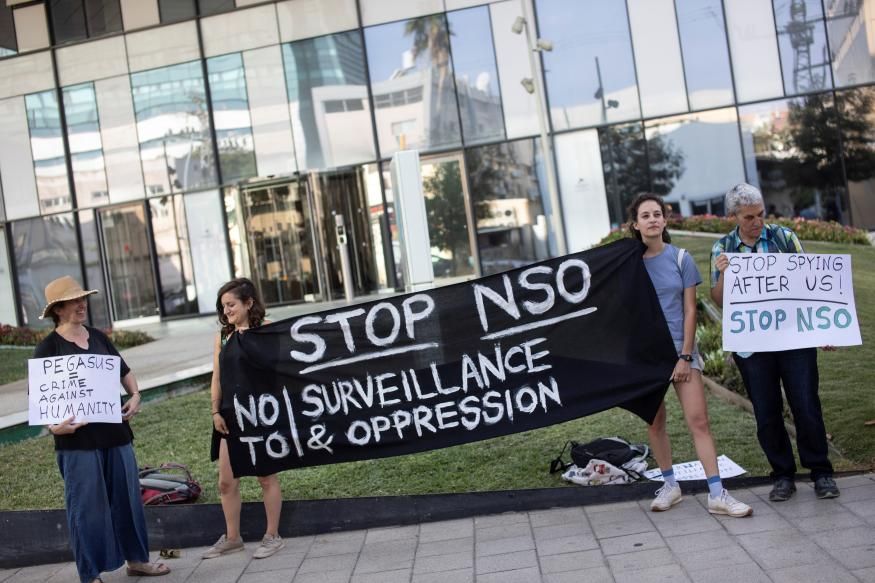
Protesters, now growing in number, demand Google drop the project immediately.
Albeit Systems, Israel’s largest weapons maker, has seen it shares divested by such banks as JPMorgan Chase. However, UBS increased its shares by 875%!!
UBS was founded in Switzerland, but the Swiss always give the impression they stand neutral when it comes to war. But they are making money out of the Israeli company at War with Hamas, but leaving no safe place for Palestinians in their own country.
Many of us remember how Jamal Kashoggi was tortured to death in the most slow and medically precise way by a top Saudi surgeon with a team of assistants. It is believed MBS instructed this manner of death to the team who carried it out. But it reflects how hatred mixed with intense fear can become so intense over time that it can twist the mind of a human being to actually take pleasure in such sadistic acts.
The history of humankind is littered with facts of horrific cruelty to our fellow man. In the 21st century we add the menace of Spyware to track down our prey.
What did Jamal do to instil such fear and hatred?
It is a good moment to reflect on the duty to speak out against authoritarian rule. Our late colleague wrote on Sept. 18, 2017, that he hadn’t protested initially when some friends in Saudi Arabia were wrongly arrested, but then decided he must. “I am raising my voice. To do otherwise would betray those who languish in prison. I can speak when so many cannot.” For his principled stand, Khashoggi was drugged and dismembered by a Saudi hit squad.
And how was the trap laid? Jamal had fled to Washington, DC to protect his wife and family. He felt isolated and depressed that he could not tell the world about the unsettling events now happening in his beloved country.
He met a friend who supported him. She was a stewardess on Egyptian airlines. She suggested Jamal write for the Washington Post, thinking, no doubt, he would be safe working for such a prestigious news outlet.
He took up her advice and felt now he could help his country by exposing the deteriorating situation he considered was taking place under the new regime in Saudi.
She became his wife and, unknown to her, her phone was infected with Pegasus spyware. This enabled Jamal’s murderers to lure him to his place of execution, much to the outrage of the Turkish president once he learned his country had been used for such a horrific act of barbarity.
In reading the Pegasus book by Richard and Rigaud, the methodology to prove how this happened is described, and it took the courage, skill, determination and high risk endeavour to bring the facts about NSO spyware to light.
2023: The stunning Amnesty International Security Lab work published 2021, reappears in India:
And as fast as the Security Lab team raced to keep up with NSO intricate concealment of their spyware presence, the Security Lab still produced the evidence which was so profound and clear and could not be denied.
Jamal, like many journalists who try to free their country of oppressive and corrupt regimes, risk their lives because they love their country and, by speaking truth to power, hope to bring freedom to their people.
And what do we learn about the ‘white hat washing’ NSO carried out whilst in full knowledge its spyware was in the hands of well known human rights abusers such as in Azerbaijan, where the Aliyev government ranks in the bottom 15 percent of countries in the World Bank’s Control of Corruption in 2019? This was the year Pegasus was unleashed on victims such as Khadija, an Azeri journalist.
On September 10, 2019, three days after an attack on Khadija’s iPhone, NSO Group trumpeted its new corporate governance regime. This updated policy was designed to bring the company into “alignment with the UN Guiding Principles of Human Rights,” read the press release, “cementing the company’s existing industry-leading ethical business practices.” NSO announced the formation of a “Governance, Risk and Compliance Committee,” as well as a separate set of outside experts who could offer the company guidance on human rights issues: one former secretary and one former assistant secretary of the US Department of Homeland Security, as well as a French diplomat who had been first secretary at the embassy in Tel Aviv and an ambassador to the US. NSO also announced the hiring of a new general counsel, Shmuel Sunray. Sunray went in with eyes wide open, he would tell reporters. “We understand the power of the tool, and we understand the impact of misuse of the tool,” he said not long after he started at NSO. “We’re trying to do the right thing . . . to find the right balance.” The newly announced policy and personnel were merely a codification of protocols already in place, according to NSO. There would still be a rigid vetting of all potential end users of NSO’s weapons-grade cybersurveillance system. Key to the process was a case-by-case risk analysis to determine the likelihood of misuse by any country seeking a license to deploy Pegasus. NSO’s attorneys and its compliance committee always took into account the country’s record on human rights, rule of law, freedom of the press and expression, and corruption. (NSO said it was aware of the “very strong relations between issues of corruption and the issues of human rights.”) The compliance team had a very good place to start their vetting procedure, which was the annual rankings assigned by at least seven different international indexes, including the World Bank’s Control of Corruption report and Freedom House’s Freedom in the World report.
‘Pegasus’, Laurent Richard, S Rigaud
Contrast the ‘oh so clean NSO human rights declaration’ with what happened to two Azeri citizens, one a journalist, the other a blogger:
To illustrate the ongoing threat to those who expose, even through satire, the wrongdoings of their government, Richard and Rigaud, in their Pagasus book, share the following:
news reports about the case of Mahammad Mirzali, a twenty-seven-year-old Azeri blogger who had fled Baku and settled in Nantes, France, 5,000 kilometers away. Mahammad thought he would be safe enough in France to continue to post messages critical of President Aliyev’s financial corruption and the bloody war in Armenia on his YouTube channel, Made in Azerbaijan. But the distance had not put Mahammad or his family beyond the reach of Azerbaijan. His parents also fled to France after his father and brother-in-law were threatened and encouraged to stifle Mahammad. His sister had suffered the indignation of having an illegal recording of one of her intimate moments circulated online, a shrill echo of the blackmail attempt on Khadija Ismayilova. Mahammad himself was shot at while sitting in a parked car in October 2020, and in March 2021, he was attacked in Nantes and stabbed ten to fourteen times—the medical reports released to the public were uncertain. (Aliyev has publicly stated that there is not enough evidence for him to deign to respond to what he called “groundless and biased accusations” that his government was responsible for the attacks on Mahammad. Three of the four men charged with the crime a year later, however, were Azeri nationals.) Mahammad Mirzali survived, after a six-hour surgery, only to receive a text a week later. “This is the last warning,” it read. “We can kill you without any problem. You’ve seen that we’re not afraid of anyone. . . . We’ll have you killed with a bullet to the head fired by a sniper.” The threats had continued into June, according to the latest reporting, and Donncha suspected they were probably ongoing. So when Amnesty International offered to relocate Claudio and Donncha from their homes to undisclosed safe houses for the week leading up to publication, both of them accepted. The attacks on the Azeri dissident were in Donncha’s head. “He’s writing satire about the [Aliyev] government, and the government is going to try to kill him, twice, in France,” Donncha says. “If the Azerbaijanis know that [the Pegasus Project] is going to come out, are they going to do anything to try to stop us? And it’s not just Azerbaijan.”
‘Pegasus’, Laurent Richard, S Rigaud
Let us not forget Armenian philanthropist, Ruben Vardanyan:
The Pegasus book (by Richard and Rigaud) describes the Kafkaesque experience of a young Moroccan investigative journalist, Omar Radi.
June 22, 2020: Forbidden Stories posted a story of the Pegasus attack on Omar Radi…..2 days later, Omar was summoned to the BNJP offices in Casablanca…..accused of working with foreign intelligence agencies.
Radi’s family have repeatedly expressed concerns about his health as he has asthma and Crohn’s disease and protested over his 2022 transfer to Tiflet from Casablanca, where he was receiving treatment for his digestive condition and visits from family based in the city……
……..After his arrest in 2020, Radi was given a six-year prison sentence in 2021 for undermining state security and sexual assault. Press freedom advocates in Morocco told CPJ they believed the charges were unfounded and in retaliation for his investigative work.
Morocco hit the international news when it suffered a serious earthquake in 2023 in the Atlas Mountains, where many of the indigenous people live. It has been a popular tourist magnet due to its magnificent landscape, where the Amazigh have lived for thousands of years. The Indigenous land of Imazighen is a region called Tamazgha, encompassing Morocco, Algeria, Tunisia, Libya, Western Sahara, Mauritania, the Canary Islands, and parts of Egypt, Mali, and Niger.
The Romans called these people Barbarians, from which the name Berber derives. Needless to say, they prefer to be called Amazigh.
Amazigh man
Deep in Morocco’s Atlas Mountains, the ancient Berbers live on, defying a harsh environment, and remaining loyal to their traditions and way of life in some of the most hard-to-reach parts of the African continent. Indomitable and proud, they call themselves the Amazigh, which is believed to mean “free people” or “noble men,” and trace their origins as an indigenous people in western North Africa to at least 10,000BC
As with many indigenous people, the Amazigh have been protesting the commandeering of their lands for industrial exploitation for a very long time:
the longest protests in Africa— led by the Indigenous Amazigh community in southeast Morocco against the highly exploitative extractive mining industry. Although it concluded around 2020, after a nearly decade-long protest, this movement was preceded by the historical struggle for recognition of the Amazigh identity, culture and language.
Omar Radi took an interest in writing about their protests to defend their lands, and he was silenced, and it would seem, so were they. There has been no reported protests since 2020.
In Israel the cybersurveillance industry was thriving, as Apple had built a centre of excellence just round the corner to NSO, back in 2015:
“When CEO Tim Cook and his gurus were deciding where to situate Apple Inc.’ s largest R& D facility outside the United States, they had few limits. The company’s annual net profits were around $ 40 billion a year and climbing, as was the global market share of its mobile phone. Cook and company had the planet to choose from, and they picked a midsize suburb pinched between sea and desert, 7,500 miles from their headquarters in Cupertino, California, in a country with less than nine million inhabitants and a gross domestic product in the vicinity of Norway’s and Nigeria’s. Apple erected a gleaming twenty-first-century glass box of an eco-friendly building in that faraway spot and reserved 180,000 square feet of office space for seven hundred of its employees—with room to grow. The talk in that building and beyond was that this new facility would be the launchpad for future versions of Apple’s signature product, the iPhone. If anybody at Apple had an inkling that a few dozen NSO cyber-researchers right around the corner from the new digs were spending their days and nights hunting for weaknesses to exploit in the iPhone operating software, they didn’t show it. NSO was barely known at the time and not really on Apple’s threat radar. So the relatively small spyware company’s presence certainly didn’t shake the conviction that the business district of Herzliya, just north of Tel Aviv, was the place to be. “Apple is in Israel,” Tim Cook said on his visit to inaugurate the new R& D center in February 2015, “because the engineering talent here is incredible.” Talent in Herzliya was hard to miss; an air of ambition and confidence permeated the restaurants and bars catering to the thousands of cybersecurity specialists and coders and software engineers working at dozens of neighborhood tech firms. The talk at table was often loud and learned and argumentative, whether debating the merits of the latest dating app or the latest job listings—must possess “a deep knowledge of radical Islam”—or the latest elections. This cohort was among the brightest 1 percent in Israel (the government had the test scores to prove it), working in the most lucrative and most glamorous field in the country. These young men and women were, quite literally, the Chosen People—identified as schoolchildren as possessors of uncommon intelligence, then encouraged to pursue math, physics, and computer science and to prepare for their extraordinary personal destinies.”
Pegasus’ Laurent Richard, Sandrine Rigaud
Amnesty International let it be known Omar Radi was hoping his investigation might lead to a change of mind regarding the treatment of these indigenous people.
June 22, 2020
Omar Radi: the Moroccan journalist who won’t be silenced
Moroccan journalist Omar Radi has learned to assume that he is always under surveillance. He is tailed as he investigates stories, his computer has been hacked and his phone has been targeted by sophisticated spyware
………
phone hacking and old-fashioned street surveillance.
A new Amnesty investigation has revealed that his phone was repeatedly targeted using Pegasus spyware from Israeli company NSO Group between January 2019 and January 2020. The tool silently gives an attacker complete access to messages, emails, media, microphone, camera, calls and contacts.
It is with mounting horror the world watches the US continue to supply Israel’s war on Palestinians. So I add the voice here of elderly statesman, Ralph Nader, who expresses so well how how so many feel in his recent letter.
Bomber Biden Doesn’t Wage Peace, Save Civilians or Listen to American Antiwar Crimes Advocates
Joe Biden has long had a problem with PEACE – as in “ceasefires,” “serious peace negotiations,” and conditioning the transfer or sale of major weapons systems as required by five U.S. criminal statutes. From one side of his mouth, Biden urges futilely Israeli compliance with international law while on the other side he supports the daily shipment of weapons of mass destruction to the Israeli government. These weapons are being used in the genocidal killing of Palestinians in Gaza.
A majority in Congress is even more hawkish and lets Biden do whatever he wants in making war abroad. The cornerstone of our Constitution – the separation of powers – has been demolished in area after area. (See, our open letter of November 28, 2023, to the members of the U.S. Congress).
By contrast, American public opinion has turned against U.S. arms shipments to Israel and the annihilation of Palestinian civilians from infants to the elderly. Whole extended families are being wiped out by American-made bombs and missiles. The homeless survivors are injured, starving and suffering from untold illnesses.
The Israeli state terror is producing a Palestinian Holocaust. Netanyahu’s violent anti-semitism against the Arabs of Palestine is out of control. Many courageous Israeli human rights groups protest, to no avail, (See, the December 13, 2023, open letter to Biden that appeared in the New York Times) as Netanyahu and his extremist coalition reveal their long-time objective of driving millions of Palestinians out of what is left of their Palestine.
As for the Hamas raid on October 7th, and the total collapse of the highly touted Israeli border security, a World War II Holocaust survivor told the New York Times, “It should never have happened…” Yet, Netanyahu has blocked an official investigation of this unexplained multi-tiered technological and human intelligence debacle.
Meanwhile, public dissatisfaction with the dictatorial decision-making by the White House and the absence of Congressional action is growing rapidly. More and more labor unions are now opposing Biden’s bombings, Jewish Americans working with Jewish Voice for Peace and If Not Now are brilliantly organizing demonstrations. Veterans for Peace’s 27 chapters around the country are in the streets peacefully demanding a ceasefire, cessation of weapons shipments and major increases in humanitarian aid. They are mostly ignored by the corporate media, NPR and PBS.
Religious groups are beseechingly calling for peace. This week in the latest public letter, 140 Global Christian Leaders, organized by Churches for Middle East Peace (CMEP) called on President Biden “…to have the moral courage to end U.S. complicity in the ongoing violence and, instead, do everything in [his] power to…” stop the “death and destruction” in Palestine.
The CMEP receives little or no coverage by the mainstream media even though this organization represents millions of people.
But then look who is not taking a pro-peace stand, staying silent or actively backing the Israeli war machine. The American Legion and the Veterans of Foreign Wars are on the sidelines. The AFL-CIO Labor Federation finally came out tepidly for a ceasefire but has exerted very little of its muscle on Capitol Hill.
AIPAC, the “pro-Israeli government can do no wrong lobby” has been cultivating relationships with these U.S. organizations and others like them for decades.
The worst abdications have come from the legal profession in the form of State Bar Associations and the American Bar Association (ABA) – the largest organization of lawyers in the world. These lawyers are all “officers of the court” instructed to stand for the rule of law. Except for a brief time in 2005-2006 (https://nader.org/2013/04/19/aba-white-papers/ ) the ABA has idled while Presidents regularly have violated our Constitution and all kinds of laws – domestic and international – with impunity, facilitated by a supine Congress.
Bruce Fein and I have asked 50 State Bar Associations to be first responders in challenging the ongoing breakdown of the rule of law due to their professional duties and knowledge. None have responded.
As for the healthcare professionals watching Israel raining death and destruction directly on Gaza’s hospitals and health clinics, inundated with desperate patients, their endangered physicians and assistants without the means to devote their care, the response is overwhelmingly silent. The American Public Health Association and the American Medical Student Association are among the few to have condemned Israel’s atrocities.
Yet, the desperate pleas by their wounded professional colleagues have failed to register with the likes of the American Medical Association, the American College of Surgeons, the American Academy of Family Physicians, the American Association for the Surgery of Trauma and many others. (See the letter of March 1, 2024, which has gone unanswered).
What can turn our country around? An organized citizenry of less than one percent of the voters in Congressional Districts, giving voice to the voiceless majority, can free Congress from its captivity imposed by the forces of greed, power and violent Empire, draining resources from our dire domestic needs.
As I wrote in the Capitol Hill Citizen (February/March 2024 issue), Congress has become a weapon of mass destruction with multiple warheads. Only the people can recover their sovereign power, under the Constitution, now delegated to a Congress that sells out to the highest corporatist bidders.
On the Israeli slaughter of Gaza’s people, a small but growing number of Democrats in Congress are standing tall. They need your active backing to expand their numbers. (See, Ceasefire Tracker: https://workingfamilies.org/ceasefire-tracker/).
As for the cruel, vicious, genocidal, maniacal Republicans, they remain disgraced in their full-throttled support for Netanyahu, who is fighting for his job, trying to escape Israeli prosecutors and is hugely unpopular in Israel.
The GOP position was expressed by Arkansas Senator Tom Cotton – a lawyer no less – who said last October, for posterity’s eternal damnation: “As far as I’m concerned, Israel can bounce the rubble in Gaza.” This is exactly what the massacring Israeli juggernauts have done with the weapons, taxpayers’ money and diplomatic cover enabled by corrupt outlaws like Tom Cotton. Ralph Nader
I present here extracts from the Pegasus book to introduce the software/malware birth story:
Yet building the case to prove the use of NSO Pegasus, the bribery by cartels to locate their opponents using the malware, took decades…..
First of all, these particulars were very hard to check in 2019. The head of Felipe Calderón’s war on the cartels was just then being publicly accused of taking bribes from the drug lords he claimed he was trying to eradicate, so the former Mexican president wasn’t picking up his phone to talk to reporters. NSO employees were effectively muzzled. No European police official was willing to go on the record admitting that they licensed and operated Pegasus spyware. Then, too, Shalev’s recounting of the NSO story was filigreed with fine little narrative gems—and they were exclusive! Which meant that while the stories were often too good to be true, they were also too good to leave entirely untold, or to leave for another writer to tell instead. So even really good and well-informed reporters such as Bergman and a few others would just put them in quotes and add a clause or two of their own to serve as the written equivalent of an arched eyebrow. The already harried NSO press team did have to occasionally do some cleanup in the aftermath of a Shalev interview. The boss was not well versed in the technical specs of the Pegasus system, or the intricacies of high finance, or the fine points of the laws and regulations that governed the cybersurveillance industry in Israel and abroad. But he did exhibit a genius for controlling the narrative. Shalev Hulio, it must be admitted, tells a very good story. His story of the origins of NSO may be his best. It starts out as a kind of buddy movie: starring him and his best pal, Omri Lavie. They were both born around 1980, into the false hopes that followed the Camp David Accords and the Israel-Egypt Peace Treaty, and raised with the whiff of peril always in the air. (Between 1993 and 1995 alone, there were fourteen separate suicide bombings in Israel, leaving eighty-six dead.) They were similar boys. Smart enough but undisciplined. Shalev and Omri met in the mid-1990s while both were studying arts and theater at a high school in Haifa (after Shalev washed out of a program for gifted students because of congenital misbehavior)……….
Shalev and Omri, founders of NSO…. by the spring of 2011, Shalev and Omri had a product to take to market. They called it Pegasus, Shalev says, “because what we built was actually a Trojan horse we sent flying through the air to devices.”……Claudio Guarnieri ……internet security researcher trying to identify new cybersurveillance tools and to call out their purveyors……..“I think NSO was the first company that was solely focused on one thing and one thing only, which was mobile,” says Claudio, looking back a decade later. “At the time that was a bit premature. But I think that they were seeing that that’s where the market really was going to be……..If a start-up spyware company wished to go bowling for dollars in 2011, there was no better place than Mexico. The lights in the alley were on twenty-four hours a day, and there were plenty of open lanes, because President Felipe Calderón was already five years into a ferocious battle with the Mexican drug cartels.
‘Pegasus’ Laurent Richard, Sandrine Rigaud
The Pegasus book goes on to describe the timing of Calderon acquiring Pegasus malware:
in December 2006. The new president of Mexico sent 6,500 troops into the fight and quickly expanded the combatants to include more than 20,000 soldiers and federal police. Calderón did not waver, even as the death toll mounted—almost 7,000 Mexicans were killed in 2008 alone. That was the same year the United States decided to join its neighbor’s fight, sending military and law enforcement agents to Mexico to help coordinate. Better than that, the Americans poured money over the border and into the newly minted “Merida Initiative.”
The US Congress appropriated $1.5 billion to aid Calderón and his fighters over the next three years, which meant that even after the Mexican military and police forces upgraded their weaponry and hardware, there was plenty left over for the latest in digital technology: malware capable of monitoring and tracking the cartels and their abettors. Procurement officers from Mexican military, law enforcement, and intelligence agencies had real money to spend on cutting-edge spyware tools. NSO was a little late to the first frame of the contest. A handful of Israeli tech companies had already closed deals for spyware in Mexico, as had Gamma Group, based in the UK or Germany or the British Virgin Islands (it was hard to tell). Hacking Team, the presumed world leader in this blossoming field of cybermercenaries, headquartered in Claudio’s hometown of Milan, Italy, also had its sights on this spectacular, and spectacularly complicated, market. For a new and uninitiated private cybersurveillance vendor like NSO, simply deciphering the tangle of Mexican government acronyms could be head spinning.
Book, Laurent Richard, Sandrine Rigaud
Then the link to the vital middle man:
The NSO team was fortunate to find just the right guide through the maze of la Plaza del Mercado Vigilancia Cibernética: a man known as “Mr. Lambo” (he favored expensive Italian roadsters) or “El Chino” (he was of Japanese descent, but close)—Jose Susumo Azano Matsura…….Azano saw the potential of NSO, this new entrant into the “Intrusion as a Service” industry, right away. STDi reportedly paid NSO $500,000 for the exclusive right to resell its Pegasus technology, and Shalev armed Azano and his team with a set of talking points to take to potential customers in the Mexican government. That document is a perfect little snapshot of the promise of NSO’s earliest technology, which was ambitious right from the start. The Pegasus system, according to this document from 2011, provided a “tactical active approach” for breaking through the wall of encryption built into the most common mobile phones on the market, BlackBerrys and Androids.
These devices, the NSO talking points lamented, had become “a secure and convenient method for communication for all kinds of criminal activities, which is difficult to monitor today.”
Book, Laurent Richard, Sandrine Rigaud
Then the first real deployment of Pegasus:
The Pegasus system offered a soup-to-nuts solution. The first step was injection: finding a vulnerability in the phone’s operating system that opened the door for Pegasus users to surreptitiously plant the spyware on the phone. Step two was configuring the software so it could successfully monitor, collect, and prepare all data for retrieval. This data included all contacts and calendar entries, all email, voicemail, and instant messages, all system files, as well as current and past geolocation. The earliest Pegasus system, according to the talking points anyway, had the ability to remotely turn on the microphone to monitor “environmental voice interception”—which is to say any live conversation within earshot of the phone. It could also remotely activate the mobile phone’s camera for capturing snapshots. Step three was data retrieval, wherein Pegasus would exfiltrate the contents of the phone and place them in one of the end user’s servers, ready for archiving, mining, and analysis. The Pegasus system, as offered, included NSO-provided hardware, software, maintenance, and training for the various sorts of operators needed across the platform. There was an array of “infection vectors” to choose from, each tailored to a target’s device and operating system; “front-end consoles,” where government-paid operatives executed the initial infection and configured the Trojan horse malware for monitoring and the exfiltration; “anonymizers” to hide the end user’s real IP address and “camouflage” its activities on the internet; firewalls and virtual private networks (VPN) for added security and convenience; and “rackable servers” for storing the growing mass of data retrieved from the targets. As a rule, NSO figured 2 terabytes was a good starting point, enough to monitor four hundred different mobile phones—at 50 megabytes of data retrieved per target per day—for an entire year. But NSO also encouraged Azano and his team at STDi to assure potential buyers that “this cluster of servers can grow with the Customer future needs seamlessly.” NSO technicians would do the entirety of the initial setup, maintain the hardware, upgrade the software as needed, monitor the system in real time for any malfunction, and be available to troubleshoot. They would also train the ops who worked on the front-end consoles. For the “attack” and “configuration” agents, NSO recommended local people with degrees in criminology, anthropology, or psychology, an “ability to provide unique insight into target psyche” and to “work under pressure, in non-standard hours.” End users could count on up to six weeks of dedicated time from NSO talent to get the system up and running and the operators properly schooled. NSO looked good to Azano, another sluicing river of income for STDi. Azano, meanwhile, looked good to Shalev and Omri. NSO’s new reseller provided instant intelligence in Mexican commercial traditions. Mr. Lambo, for instance, was schooled in the operative custom of mordida (the bite); knew which officials in the chain had to get a cut of any big sale, what size cut would be deemed acceptable, and how to make sure it was safely and secretly dispersed. Azano also provided connections; he knew the generals who made the final decisions at SEDENA, the admirals at SEMAR, the supervisors at CISEN and the PF, and the top prosecutors at the PGR. Azano’s contacts apparently went all the way to the top, to the Office of the President, to Felipe Calderón himself. On May 25, 2011, just weeks after Azano signed on to market NSO’s spyware system, Shalev Hulio got an email from one of his NSO operatives: “Mr. Azano notifies me that the demo to the Secretary of Defense and the President will take place next Friday. They called me after confirmation, and they asked me to do my best to be there on Tuesday, since the Secretary of Defense requested a demonstration the day before (Thursday) and for the President on Friday.” Neither Calderón, nor his SecDef, nor Azano himself has confirmed that the scheduled demo actually happened, but six weeks later, in July, STDi closed a deal with SEDENA—the first major sale in the history of NSO. The contract was reportedly worth a little over $15 million, which more or less launched NSO as a viable company. When Shalev finally told the story of that first deal, not long before Forbidden Stories and the Security Lab got access to the leaked data, he didn’t dwell on Azano (who was at the time in a US prison) and STDi. He talked about the general he met in Mexico City, and the assurances the military man gave Shalev and Omri about the way their powerful new cybersurveillance tool would be used and all the good it would do. “The country had decided to establish a separate new body—a branch of the military—to deal with the drug issue,” Shalev remembered, in another of his uncheckable stories. “This body would include spotless individuals with no history of corruption who would undergo a polygraph test. Then we met with the general, the head of that branch. He said: ‘You fit us like a glove. We will base our entire drug-fighting apparatus on your new technology. This is how the biggest situation room—not just in the region but one of the biggest in the world—will fight crime and drugs.’ And to them, we agreed to sell.”
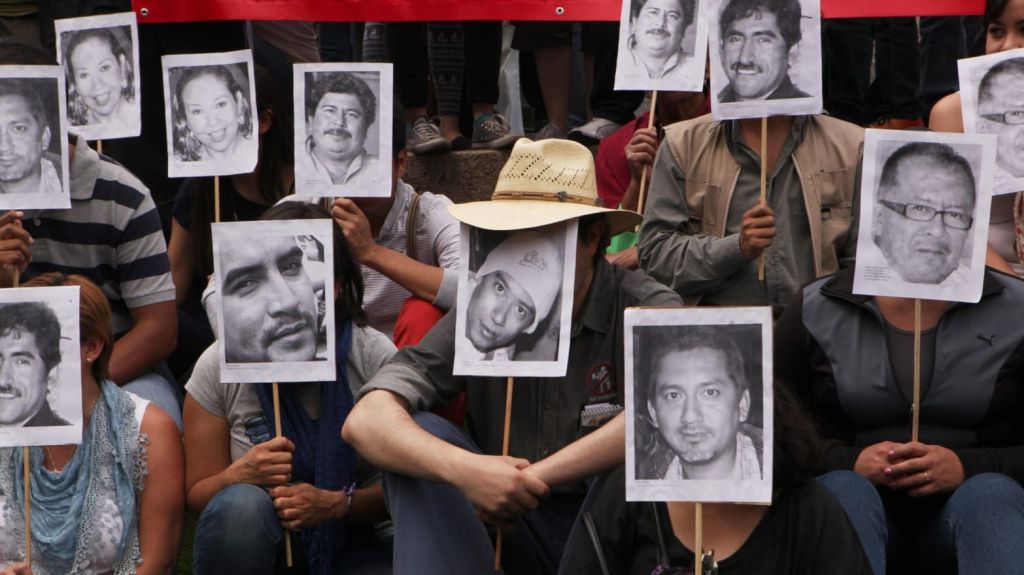
So many journalists have been murdered since the Mexican government acquired the NSO malware, Pegasus.
From The Daily Beast
We were essentially picking up reporting threads left unfinished by a handful of brave Mexican journalists who had been killed, most likely by assassins from the local drug cartels whose violent and criminal activities the reporters had been investigating. Outside of active war zones, Mexico was and remains to this day the most dangerous place in the world to be a journalist committed to telling the truth about bad guys. More than 120 journalists and media staffers had been killed in Mexico in the first two decades of the twenty-first century. Another score or so had simply disappeared without a trace.
‘Pegasus’ by Laurent Richard, Sandrine Rigaud.
UNESCO.org have maintained a list of all journalists killed globally since 1993.
Mexico’s constitution of 1917 established economic and political principles for the country, including the role of its president. The president today is popularly elected to a single six-year term and has the power to select a cabinet, the attorney general, diplomats, high-ranking military officers, and Supreme Court justices (who serve life terms). The president also has the right to issue reglamentos (executive decrees) that have the effect of law. This is a chronologically ordered list of the presidents, from the earliest to the most recent.
Since Mexico launched a war on the cartels in 2006, the United States has provided it with billions of dollars in security and counternarcotics assistance.
Felipe Calderon was President at that time. His government were enthusiastic about Pegasus.
The following quote gives a flavour of the misery endured by the population during Calderon’s time in power:
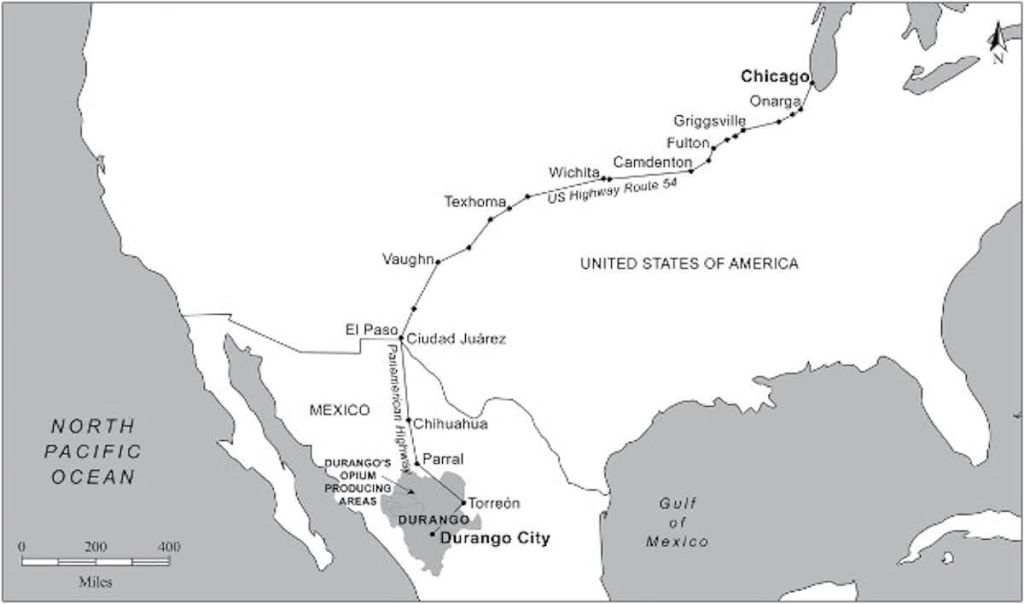
This macabre, barbaric execution, in November 2008, took the number of murders in the anarchic city of two million people to about 1,300 that year. The toll would cap 1,700 before the end of December. The national figure of those killed across Mexico reached over 5,400 in 2008. In 2009, despite successive waves of military re-enforcements and a promise by Mayor José Reyes Ferriz on 1 January that Juárez ‘cannot have another year like that’ the toll was even higher: 2,657 people murdered, making Ciudad Juárez the world’s most murderous city, with 192 homicides per 100,000 citizens. The total of those murdered across Mexico in 2009 reached 7,724.1 This means that by the end of that year, more than 16,000 people had been killed since Mexican president Felipe Calderón launched a military offensive against the cartels in December 2006, with many of the victims mutilated, like this man, horribly and carefully, then exhibited to convey some message or threat. By summer 2010, the total killed since December 2006 had exceeded 24,000. The killing is everywhere across Mexico, but concentrated along the border with the USA – 2,100 miles long, the busiest border in the world and a place that belongs to both countries, and yet to neither. Ciudad Juárez lives cheek by jowl with the United States and its ‘twin city’ El Paso, on the other side of the frontier. Sometimes the proximity is surreal: from the campus of the University of Texas in El Paso, one sees, in the foreground, the diligent enjoyment of life – students strolling to and fro. Across mid-distance, less than half a mile away, runs the border in two forms: an articulately harsh wall decorated with barbed wire and the trickle of the Rio Grande. And beyond the boundary, one of the poorest barrios – or colonias as they are called here – in Mexico: a bleached, ramshackle shanty town called Anapra, thrown up out of wood and corrugated iron on the edge of a burgeoning city. The desert dirt and dust on which Anapra is built are criss-crossed by outlaw electricity supply cables to the barrio huts. El Paso and Juárez form the heart of, and midway point along, this singular strip of land conjoining two countries. The borderland is a place of paradox: of opportunity and poverty, promise and despair, love and violence, beauty and fear, sex and church, sweat and family. Even the frontier itself is a dichotomy, simultaneously porous and harsh. The US border patrol recognises the contradiction in its recruiting billboard on Interstate 19 north of Nogales, Arizona, advertising ‘A Career in Borders, But No Boundaries’. The frontier itself can be brutal. In 1994, the United States initiated ‘Operation Gatekeeper’ in San Diego, ‘Operation Hold the Line’…
US President during the time of Calderon was Republican President George Bush from 2001 to 2009, followed by Democrat Barak Obama. Pegasus was launched 2010.
On 2 March 2017, Cecilio Pineda Birto made a broadcast about alleged corruption. Hours later he was dead….
Another courageous journalist, Cecilio Pineda Birto, had been killed because of his quality reporting on drug cartels, how they kidnapped locals and ransomed them for cash. The deployment of NSO spyware infecting his phone tracked him down.
The global story is encapsulated in the dire situation in Mexico, it is Exhibit A of
What happens when spyware like Pegasus flies wild, for years, without necessary safeguards in place…..that a private company in Mexico was using Pegasus to perform unwarranted surveillance on people who were neither criminal nor criminal suspects.
……August 5, 2020, from somebody in senior management at the NSO Group. Cherie Blair, former First Lady of the United Kingdom, longtime barrister, noted advocate for women entrepreneurs in Africa, South Asia, and the Middle East, a prominent voice for human rights worldwide, was obliged to pick up the phone. Mrs. Blair had recently signed on as a paid consultant to the Israeli firm NSO to help “incorporate human rights considerations into NSO activities, including interactions with customers and deployment of NSO products.” This was a delicate high-wire act, ethically speaking, because NSO’s signature product, cybersurveillance software called Pegasus, was a remarkable and remarkably unregulated tool—extraordinarily lucrative to the company (NSO grossed around $250 million that year) and dangerously seductive to its clients. Successfully deployed, Pegasus essentially owns a mobile phone; it can break down defenses built into a cell phone, including encryption, and gain something close to free rein on the device, without ever tipping off the owner to its presence. That includes all text and voice communications to and from the phone, location data, photos and videos, notes, browsing history, even turning on the camera and the microphone of the device while the user has no idea it’s happening. Complete remote personal surveillance, at the push of a button.
From ‘Pegasus’ Laurent Richard, Sandrine Rigaud
Pegasus spyware group blacklisted by the US government
American companies are restricted from exporting their goods and services to NSO Group, the company that built Pegasus
Here are some extracts from the current book I’ve begun reading about the spread of an evolved spyware application, Pegasus. The authors describe earlier spyware consequences and now believe each and every one of us who has a phone is going to be losing their democratic rights if we don’t act in time to prevent the looming threat. This book was published in 2021. I have only now come across it. I hope I am in a minority who have not found it earlier.
The authors provide some history of Spyware in recent historic context, such as:
Amesys, a unit of French technology firm Bull SA, installed a monitoring center for Gadhafi….
that allowed his agents to monitor the emails, chats, and messages of anybody in Libya. The Gadhafi regime was able to identify and track the dictator’s many political opponents almost at will. “Whereas many Internet interception systems carry out basic filtering on IP addresses and extract only those communications from the global flow (Lawful Interception),” read an Amesys-produced poster hanging in the office in Tripoli, “EAGLE Interception system analyzes and stores all the communications from the monitored link (Massive Interception).”
Book, ‘Pegasus’, Laurent Richard, Sandrine Rigaud
Consequences:
According to the testimony of several detainees in a French court in 2013, Gadhafi’s interrogators were able to quote back to them—verbatim—their emails, SMS exchanges, Facebook threads, chat-room conversations, even private phone conversations. The security agents usually demanded from their captives the identities behind the various user names they had been communicating with online or on the phone. If threats, beatings, electric shock, and other torture weren’t enough to convince the detainees to reveal the names of otherwise anonymous comrades, Gadhafi’s agents would ship them off to prison. Threats and beatings continued there, along with brief field trips to a courtyard to witness the executions of other prisoners. When these revelations started to come out in France, Bull SA made the prudent business move. They simply off-loaded the technology that ran the Eagle system to another French company, Nexa Technologies—which continued to make it available on the open market. Egyptian president Abdel Fattah al-Sisi, who seized power following the chaos of the Arab Spring, became one of the French cyberweapon’s most enthusiastic end users. (The surveillance system was reported to be a $12 million gift from al-Sisi’s friends in the United Arab Emirates.) “The grave human rights violations committed to this day by the various branches of the [Egyptian] security services include arbitrary mass ararrests, with the incarceration of at least 60,000 political prisoners since 2013; extrajudicial executions; enforced disappearances . . . and the systematic use of torture,” the Paris-based International Federation for Human Rights had noted in a recent report, Egypt: A Repression Made in France. “This modus operandi of the security forces, aimed at eliminating all possibility of dissent, has become everyday reality for all Egyptians, and it specifically targets political opponents and civil society: members of political parties, the Muslim Brotherhood and their supporters, activists in revolutionary movements and of all stripes, human rights defenders, lawyers, journalists, writers, researchers, in addiaddition to LGBTQ people or those perceived as such.” The Bull/Amesys/Nexa axis was hardly alone in selling spyware systems to questionable regimes—regimes that had nevertheless been designated by France as “a bulwark against Islamic fundamentalism,” according to the report. “The enormous increase of arms sales beginning in 2013 and al-Sisi’s arrival in power in Egypt in 2014 have proven profitable for at least eight French companies that have sold equipment—both conventional weapons and surveillance equipment—to Egypt.”
Book, ‘Pegasus,’Laurent Richard, Sandrine Rigaud
It is maybe helpful to remind yourself which French President was in power during these Spyware sales:
Thanks to covert licensing of spyware, thus allowing it to pass into the administrations of dictators, the thousands of would be magnificent contributors to their country have been silenced. For example:
1933: the stirrings of WWII and opportunities for lucrative trade emerging.
I refer you to the book (published 2001) by Edwin Black ‘IBM and the Holocaust’.
It is a magnificent piece of work and reveals the integral aspect of trade and profit during wartime, where holding high moral standards is excluded from the process.
As a child born a couple of years after the war ended, I have been curious about the era before I was born and ever since.
I read books like this which have shocked yet enlightened me about how minority discontent can overturn majority complacency and turn day into never ending night for so many.
I looked up the summary as it best covers this startling piece of work.
IBM and the Holocaust is the stunning story of IBM’s strategic alliance with Nazi Germany — beginning in 1933 in the first weeks that Hitler came to power and continuing well into World War II. As the Third Reich embarked upon its plan of conquest and genocide, IBM and its subsidiaries helped create enabling technologies, step-by-step, from the identification and cataloging programs of the 1930s to the selections of the 1940s.
Only after Jews were identified — a massive and complex task that Hitler wanted done immediately — could they be targeted for efficient asset confiscation, ghettoization, deportation, enslaved labor, and, ultimately, annihilation. It was a cross-tabulation and organizational challenge so monumental, it called for a computer. Of course, in the 1930s no computer existed.
But IBM’s Hollerith punch card technology did exist. Aided by the company’s custom-designed and constantly updated Hollerith systems, Hitler was able to automate his persecution of the Jews. Historians have always been amazed at the speed and accuracy with which the Nazis were able to identify and locate European Jewry. Until now, the pieces of this puzzle have never been fully assembled. The fact is, IBM technology was used to organize nearly everything in Germany and then Nazi Europe, from the identification of the Jews in censuses, registrations, and ancestral tracing programs to the running of railroads and organizing of concentration camp slave labor.
IBM and its German subsidiary custom-designed complex solutions, one by one, anticipating the Reich’s needs. They did not merely sell the machines and walk away. Instead, IBM leased these machines for high fees and became the sole source of the billions of punch cards Hitler needed.
IBM and the Holocaust takes you through the carefully crafted corporate collusion with the Third Reich, as well as the structured deniability of oral agreements, undated letters, and the Geneva intermediaries — all undertaken as the newspapers blazed with accounts of persecution and destruction.
Just as compelling is the human drama of one of our century’s greatest minds, IBM founder Thomas Watson, who cooperated with the Nazis for the sake of profit.
Only with IBM’s technologic assistance was Hitler able to achieve the staggering numbers of the Holocaust. Edwin Black has now uncovered one of the last great mysteries of Germany’s war against the Jews — how did Hitler get the names?
About the author (2001)
The son of Polish survivors, Washington-based writer EDWIN BLACK is the author of the award-winning Holocaust finance investigation, The Transfer Agreement, and is an expert on commercial relations with the Third Reich.
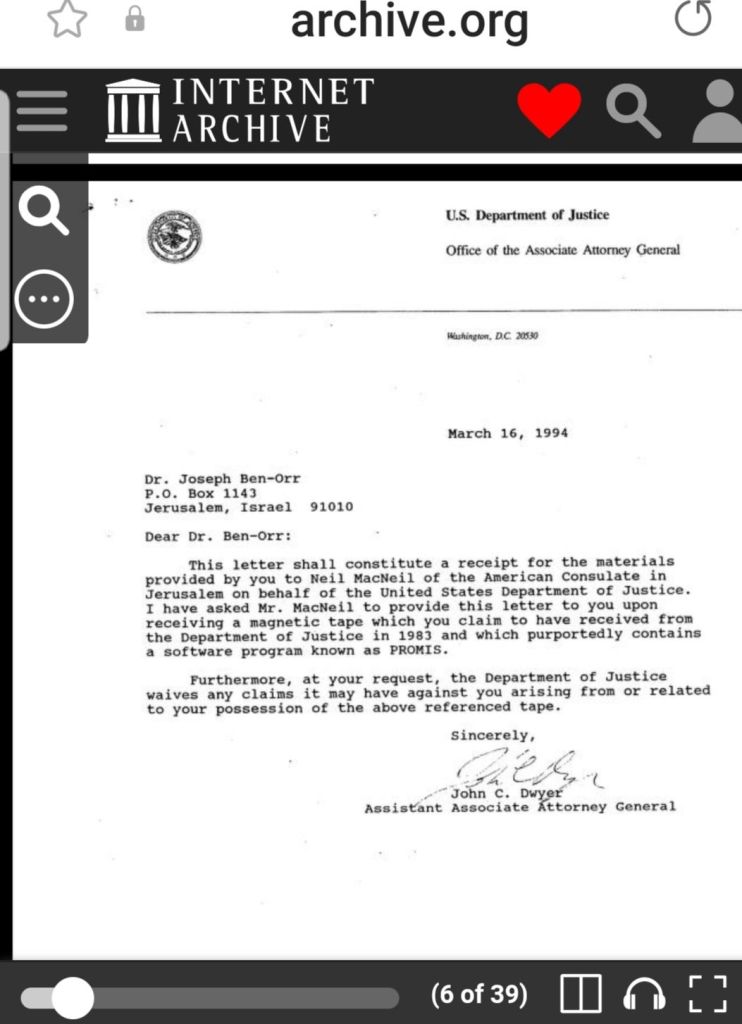
And then I refer you to another book by Gordon Thomas, ‘Gideon’s Spies’, (last update published 2009) in which he describes how Robert Maxwell became involved with PROMIS (Prosecutors Management Information System) which was created by a US company, Inslaw. According to federal documents, PROMIS was misappropriated by the Dept of Justice after a visit to Inslaw by an Israeli Mossad representative, Rafi Eitan in 1983.
There were two key players linked to the PROMIS software leaving the US:
Rafi Eitan, an Israeli soldier during the War of Independence and the Palestinian Nakba (1948 – 49). He became Mossad’s deputy director of operations.
and his US friend:
Dr. Earl Brian, a young American physician who, when he knew Rafi Eitan, was working for Governor Ronald Reagan in California. Earl Brian was known to have close business ties with Ronald Reagan.
PROMIS was then given or sold to, at profit, Israel and was later licensed to as many as 80 countries by Earl Brian.
Israeli LAKAM programmers rearranged the various components of PROMIS in a such a way that no one could relate it back to Inslaw as their creation. Yet Eitan chose to keep the name for marketing purposes. They streamlined the software to amass and correlate data at a speed and scale beyond human capability.
They also used it to track Palestinians.
Brian Meese, another close friend and business associate of Earl Brian and who had become Presidential counsel to President Ronald Reagan, is thought to have profited from sales of the stolen PROMIS software.
Then this article online explains:
The implications continue: that Meese profited from the sales of the stolen property. That Brian, Meese’s business associate, may have been involved in the October Surprise (the oft-debunked but persistent theory that the Reagan campaign conspired to insure that US hostages in Iran were held until after Reagan won the 1980 election, see sidebar). That some of the moneys derived from the illegal sales of PROMIS furthered covert and illegal government programs in Nicaragua. That Oliver used PROMIS as a population tracking instrument for his White House-based domestic emergency management program.
Gordon Thomas describes how the final PROMIS was not ready for sale until someone had programmed a trapdoor, so they could track all activities by licensed users in their various countries. To do this, Ben-Menashe was asked by Rafi Eitan if he knew anyone who could do that work. Indeed he did. He was at school with a northern California whizz kid, who had been a child genius and who was likely to take on such a project. Once approached, this person was offered $5,000 for the work (cheap at the price) and this person accepted. Once ready, the software had to be tested.
Jordan was selected as the site, not only because it bordered on Israel, but because it had become a haven for the leaders of the Intifada. From the desert kingdom, they directed the Arab street mobs on the West Bank and Gaza to launch further attacks inside Israel. After an atrocity, PLO terrorists would slip across the border into Jordan, doing so often with the connivance of the Jordanian army.
Consequently, long before the Intifada, Jordan had become a proving ground for Mossad to develop its electronic skills. In the 1970s, Mossad technicians had tapped into the computer IBM had sold to the country’s intelligence service. The information gained had supplemented that provided by the deep-cover Kate’s Rafi Eitan had placed inside King Hussein’s palace. Promis would offer much more.
P.201 Gideon’s Spies
Earl Brian used his company to sell Promis to Jordan and once installed in Amman’s military HQ, ‘they discovered the Jordanians had a French-designed system to track the movement of PLO leaders. Promis was then secretly wired into the French system which PLO leaders the Jordanians were tracking.’ (Gideon’s Spies)
The next sale of PROMIS was to Arafat. Only one person could make that sale, and that was Robert Maxwell.
Maxwell needed little convincing and, in his usual ebullient manner when there was a deal to be profited from, said he had a computer company through which to sell Promis. Degem Computers Limited was based in Tel Aviv and was already playing a useful role in Mossad’s activities. Maxwell had allowed Mossad operatives, posing as Degem employees, to use the company’s suboffices in Central and South America. Now Maxwell saw an opportunity not only to make a healthy profit from marketing Promis through Degem, but to further establish his own importance to Mossad and ultimately Israel.







 borderslynn
You must be logged in to post a comment.