The amount of toxic “forever chemicals” flowing into the River Mersey in north-west England has reached some of the highest levels recorded anywhere in the world.
My team’s research links much of this contamination to old landfills, waste facilities and past industrial activity. Even if these chemicals were banned tomorrow, they would continue polluting our rivers for decades, possibly centuries.
But there is a path forward. We’ve developed a new method to track and prioritise the largest sources for clean-up, giving regulators a clearer picture of where to act first.
Per- and polyfluoroalkyl substances (PFAS), more commonly known as “forever chemicals”, are a large family of human-made chemicals found in everyday products like food packaging, water-repellent clothes and fire-fighting foams. They are valued for their ability to resist very high temperatures and to repel water and oil, but these same properties make them extremely persistent.
Once released, some PFAS could take thousands of years to break down. They accumulate in the environment, build up – with different compounds accumulating at different rates – inside the bodies of wildlife and people, and have been associated with harms to health. The most studied types have been linked to cancers, hormone disruption and immune system problems.
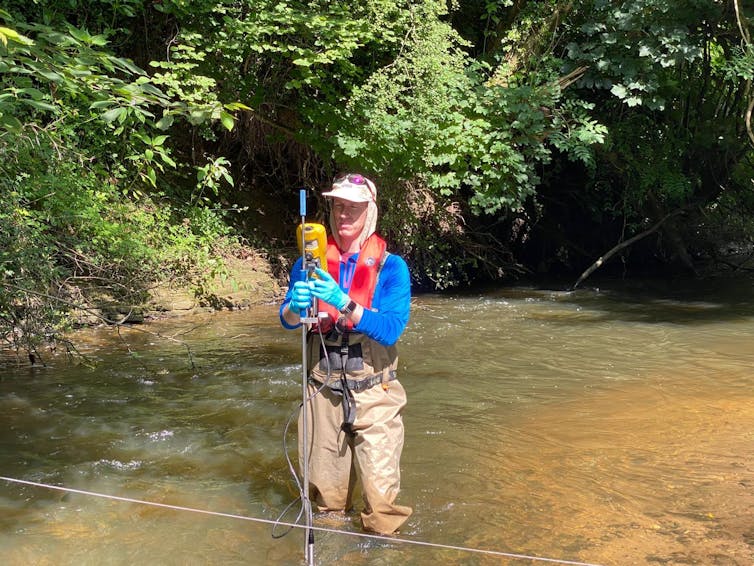
Patrick Byrne has been measuring PFAS ‘loads’ in rivers over a period of time, not just the concentration at one moment. CC BY-NC-ND
Last year, my research team discovered that the amount of two potentially cancer-causing PFAS chemicals washing off the land and into the Mersey was among the highest in the world. In our follow-on research, we travelled upstream to try and locate where these PFAS are coming from. But with hundreds of potential PFAS sources, how do we isolate the largest ones?
The secret is measuring something called the PFAS load – the total amount of PFAS flowing through the river at a given point, rather than just the concentration in the water.
Here’s why that matters: a small stream can have high concentrations but carry only a small total amount, while a large river with lower concentrations can be transporting far more PFAS overall. If we only look at concentration, we risk missing the really heavy polluters.
By measuring PFAS loads at multiple points along the Mersey system, we could see exactly where the largest increases occurred. That told us both the location and the scale of PFAS inputs.
We detected PFAS chemicals at 97% of our sample sites, even in supposedly pristine streams draining from the Peak District national park. But the big breakthroughs came when we matched the largest PFAS load increases to specific areas.
PFBS (a type of PFAS) was coming in huge amounts from land draining old landfills in the Glaze Brook watershed near Leigh, west of Manchester. PFOA, a globally banned and cancer-causing PFAS, appeared to originate from a waste management facility on the River Roch, north of Manchester. PFOS, another banned PFAS, was entering the River Bollin, with strong evidence pointing to historic firefighting foam use at Manchester Airport.
What’s most striking to me is that all these sources are rooted in the past – old landfills, waste sites or historic industrial use. These chemicals are no longer in production, but they are still escaping into the environment, decades later.
This is where PFAS load measurements make a real difference. Instead of chasing the highest concentrations – which might lead to cleaning up small streams that contribute little overall – we can target the sites releasing the largest total amounts of PFAS into our rivers.
It’s a simple idea with major implications. In a world where environmental regulators face tight budgets and limited monitoring capacity, knowing exactly which sites are the biggest sources is vital.
The Mersey is just one example. Around the world, PFAS contamination follows a similar pattern: numerous potential sources scattered across the landscape, many of them historical. The chemicals’ extreme persistence means they will continue cycling through rivers, soils and wildlife for generations unless active steps are taken to remove or contain them.
Our latest study shows that measuring PFAS load can help solve one of the toughest challenges in managing chemical pollution: working out where to start. By identifying and prioritising the biggest sources, regulators have a realistic chance of reducing the flow of forever chemicals into our rivers – and perhaps one day, making that nickname a little less true.
Many years ago, one of my blogs was about a powerful Mesoamerican cult which elicited wonderful art and architecture, and it was a positive cult, revering Nature and humbled before it.
Today we have followers of fashion, music icons, great thinkers, drive our favourite motor vehicles and so on…and always we have had religious diversity, with sometimes clashing of belief systems.
We form cultures, and reinforce our strength of belief in them through wearing merchandise proclaiming that belief, and wearing badged clothing. We join together to celebrate them and talk to our fellow enthusiasts online, sometimes day by day, even hour by hour.
And in 2015, Dr Steven Hassan wrote a book, based on his escaping from the mind controlling Moonies Cult:
In the late 1950s the church spread to the West and in the 1970s was identified as a “cult.” Parents protested their children’s membership in the group, which often damaged careers and family ties. They sought the help of deprogrammers and filed civil lawsuits. Controversy surrounding the church led to congressional hearings, and in 1982 Moon was convicted of tax evasion. His supporters, including many mainline church leaders, saw the trial as an example of government religious persecution
His deprogramming led him to study what had happened to him and he earned a doctorate in the subject and became dedicated to helping people escape the psychological warfare people have been sucked into and harmed by the experience.
He wrote this in the preface to his book:
I dedicate this book to all those who have suffered from abusive mind control in the hope that it helps them heal. Freedom of mind—which includes critical thinking, pursuing facts, listening to one’s conscience, and acting with integrity—is the foundation of all our other freedoms, including freedom of religion.
We are also aware of psyops around the world, spreading so easily through social media:
Russian Strategic Psychological Operations (Psyops), specifically information operations, have an important place in the Kremlin’s foreign policy and Russian military strategy. Russia is conducting psyops on a global scale. Still, the war in Ukraine, the increasing attention to the Arctic region, and the Swedish and Finnish ascension to NATO are all factors which increase strategic value in psyops targeting Northern Europe.
It seems, now we no longer ‘see through a glass darkly, but now face to face’ that Charlie Kirk was not right enough for the Far Right Groyper cult.
Well, I am not well versed in this ‘meme’ terminology, so I looked this up.
The original Groyper was a variant drawing of the famous (and infamous) Pepe the Frog cartoon, which portrayed Pepe as overweight, sitting down with one knee in the air and his head resting on his hands. The Groyper is also giving the viewer a smug smile.
In the following years, as Pepe the Frog became increasingly associated with the online far-right, so did the Groyper. By 2019, many alt-right accounts used variations of the Groyper drawing as their profile pictures on social media.
and we are informed by knowyourmeme.com:
The people responsible were part of the then-budding “Groyper Army,” a subset of the far-right, largely focused on American white nationalism and preserving the white race. Like a TikTok cult or a group of friends, they all changed their profile pictures to the same thing: Groypers.
Then-22-year-old Nick Fuentes, a controversial far-right figure, was the de facto leader of the online “army.” He hosted a YouTube show called “America First” in which he harped on Groyper Army talking points and championed the movement.
Conservative pundits and politicians like Shapiro and Trump Jr. were targeted because they weren’t viewed as conservative enough.
For example, the Groypers took issue with the Republican Party’s use of LGBTQ+ speakers and Shapiro’s status as a Jewish man in the movement, according to outlets like Vox.
Tyler Robinson, the 22 year old confessed killer of Charlie Kirk, is from a Republican registered family, a Mormon religion and was seemingly radicalised by the Groyper cult. His minister and father turned him in, the right thing to do.
The group Turning Point, founded by Charlie Kirk is defined by an AI search as:
Turning Point USA has been criticized for promoting extremist views and has been labeled by some organizations as a platform for hate and bigotry, particularly against marginalized groups. The Southern Poverty Law Center has identified it as having ties to hard-right extremism and has documented instances of racist and discriminatory rhetoric associated with its leadership. Southern Poverty Law Center racism.org
It is worth noting that Charlie Kirk did provoke other Right wingers recently, concerning the ‘Epstein files’
While Kirk positioned himself as an ardent defender of Israel, he more recently showed a willingness to engage with other conservative commentators deeply critical of Israel, such as Jewish American comedian David Smith, who has regularly criticised Israel for conducting a genocide in Gaza and lobbied the US to stop sending arms to the country.
Kirk’s hosting of Smith and lobbying for the release of the Epstein files put him in the crosshairs of Trump ally and far-right influencer, Laura Loomer.
“I don’t ever want to hear @charliekirk11 claim he is pro-Trump ever again,” Loomer wrote on X in August. “Lately, Charlie has decided to behave like a charlatan, claiming to be pro-Trump one day while he stabs Trump in the back the next.”
It is worthy of note that a former MSNBC analyst Matthew Dowd was sacked for his recent comments:
Rebecca Kutler fired Matthew Dowd because he said the following about Kirk:
He was constantly pushing this sort of hate speech aimed at certain groups. And I always go back to: Hateful thoughts lead to hateful words, which then lead to hateful actions. … You can’t say these awful words and not expect awful actions to take place.
Interesting about what happened to quality FBI staff stationed in Salt Lake City:
A month before the Charlie Kirk political assassination at Utah Valley University (UVU), a woman named Mehtab Syed was pushed out of her role as head of the FBI’s Salt Lake City field office. Maybe she did something wrong, or perhaps she was no longer a good fit. While those are the usual lines used to explain a firing, there seems to be much more to Syed’s removal than meets the eye.
Gathering the data and analysing it is often the only way we can stand outside the problem and make clear our view of where radicalisation is being generated sufficient to cause extreme violence.
ADL has done that, and their analysis is highly revealing:
The Covid pandemic probably tilted the vulnerable young minds, isolated from healthy interaction with their peers, to make more ‘friends online’ who some turned out to be radicalising forces.
Zev Shalev has reviewed Charlie Kirk’s effort to prove he had become a critical thinker, losing donor funds for doing so. On Substack, September 15th, Shalev writes:
Kirk’s death wasn’t just an assassination—it was a warning to anyone approaching the Epstein question. “Conviction without courage is just noise,” Kirk once said. In his final months, he proved his courage and conviction by standing up to billion-dollar donors, against Israeli pressure, against his own party’s leadership. Kirk found the courage to ask the questions that mattered. That courage—not the bullet that silenced him—is his legacy.
While it’s easy to fall into the temptation of solving the whodunnit of Charlie Kirk’s assassination, or devolve into partisan fights that achieve nothing but to further divide us, the efforts of citizens and representatives from both parties would honor his courageous legacy by demanding the Epstein Files be released and voting in favor of Thomas Massie and Ro Khanna’s discharge petition.
“Courage is the ultimate virtue,” Kirk opined. “If people aren’t courageous, you don’t have honesty, you don’t have justice, you don’t have beauty, you don’t have wonder.”
Charlie Kirk’s insurgency lives on in every voice that refuses to be bought, every question that refuses to be buried, every truth that refuses to die.
Grasp courage. Release the Epstein Files. For Charlie, and for America.
It is interesting to note Charlie Kirk’s father was involved as an architect in Trump’s Tower in New York:
In a surprising turn of events, the architecture firm owned by Charlie Kirk’s father is gaining attention after its connection to Trump Tower in New York. The revelations have sparked discussions among people about the extent of influence such connections can hold in both business and media realms.
Washington Post columnist says she was fired over her ‘unacceptable’ Charlie Kirk social media posts
‘The Post accused my measured Bluesky posts of being ‘unacceptable’, ‘gross misconduct’ and of endangering the physical safety of colleagues — charges without evidence, which I reject completely as false,’ Karen Attiah wrote Monday
Jimmy Kimmel deserves better than this. He’s a class act. Case in point – after my first appearance on his show back in 2018, he very thoughtfully asked whether I was receiving adequate security at that time, as Trump was repeatedly smearing journalists as “the enemy of the people,” comments that resulted in threats aimed at many of us in the White House Press Corps. I’ll never forget that moment of kindness from Jimmy. It spoke volumes. Make no mistake, our right to free speech is under attack in this country. This right must be defended as it is essential to the American way of life.
Sept 18th, Adam Kinzinger comment:
Brendan Carr’s actions this week are a textbook example of how government intimidation can erode the First Amendment. Yesterday, after Jimmy Kimmel criticized the President’s reaction to the killing of Charlie Kirk, Carr publicly threatened ABC and its parent company Disney. He suggested that the network’s broadcast license could be jeopardized, framing his threat in terms of the FCC’s “public interest obligations.” That is not merely commentary—it is an official signaling of regulatory retaliation aimed at silencing a viewpoint.
Sept 19th, Gary Kasparov remembers his life in Russia:
Very quickly, the Russian government set about squeezing the country’s fledgling free press. They did so in a pincer movement that attacked individual journalists, presenters, and programs from one side and the owners of media enterprises from the other.
The government ratcheted up the pressure to pull shows that didn’t fit their narrative. One early casualty was Kukly (dolls), a puppet show that poked fun at Russia’s elites. NTV dropped a political talk show called Svoboda Slova (freedom of speech) after a pro-Kremlin team took over the network.
Kremlin officials pressured upstart businessmen to sell their stakes in media conglomerates. Government agents raided network headquarters. The authorities strategically orchestrated mergers to ensure conformity and compliance, sacking “bad oligarchs” and installing “good oligarchs” in their place.
Independent journalists faced libel and defamation lawsuits.
18th September,some extracts from Distractify:
FCC Chair Brendan Carr’s Chapter of Project 2025 Called for Freedom of Speech
Apparently FCC Chairman Brendan Carr has had a change of heart when it comes to the First Amendment.
He joined The Heritage Foundation in February 2022 and contributed to Project 2025.
Brandon Carr contributed quite a bit to Project 2025.
For those who don’t know, the Federal Communications Commission regulates U.S. internet access and communications networks such as TV and radio. When it comes to free speech, the FCC adheres to the First Amendment, which states the federal government “shall make no law … abridging the freedom of speech, or of the press.”
Some of Carr’s goals as outlined in Project 2025 address tech giants like Google, Meta, and others. “Today, a handful of corporations can shape everything from the information we consume to the places we shop,” he wrote. “These corporate behemoths are not merely exercising market power, they are abusing dominant positions.” Carr wants to make these companies responsible for libelous statements made by its users. He also wanted more transparency regarding algorithm changes.
Carr also focused on broadcast companies like CBS and NBC, supporting President Trump’s allegations that they were engaging in political bias against conservatives. This is particularly noteworthy following ABC’s decision to pull Jimmy Kimmel Live! off air indefinitely in September 2025. While the Disney subsidiary didn’t cite a reason, many believe it is related to remarks Kimmel made in reference to the assassination of right-wing podcast host Charlie Kirk.
Brendan Carr is celebrating the suspension of ‘Jimmy Kimmel Live!’
Brian Stelter, the Chief Media Analyst for CNN, reached out to Carr for a comment about ABC pulling Kimmel’s show. In a post to X, Stelter revealed that Carr responded with a gif from The Office in which Michael Scott (Steve Carell) and Dwight Schrute (Rainn Wilson) are dancing and raising the proverbial roof.
Anderson Cooper had Stelter on Anderson Cooper 360, where he asked the media analyst about Carr’s response. Stelter said he and Carr had been in touch for months as he was reporting on the FCC. “He’s been very aggressive about using the media to try and pressure companies like Disney,” explained Stelter. Carr also texted Stelter, celebrating Nexstar’s decision to pressure ABC affiliates to pull Kimmel’s show off the air.
When actor Kevin McHale posted, “This was all in Project 2025, btw,” referencing the Jimmy Kimmel situation, Carr responded with a gif of Jack Nicholson grinning and nodding. A few people have pointed out Carr’s hypocrisy by sharing a screenshot of a post he made to X back in February 2019. “Should the government censor speech it doesn’t like?” asked Carr. “Of course not,” he said. Apparently, that didn’t last.
“He did not hate his opponents. He wanted the best for them,” Trump said of Kirk. “That’s where I disagreed with Charlie. I hate my opponents, and I don’t want the best for them. I’m sorry,” Trump added. “I am sorry, Erika.”
“Charlie’s angry… he’s angry at me,” Trump added.
And of the Democrats recently murdered by a hate inspired shooter, we will not forget the Hortman’s and their lovely dog.
Robert Reich, 22nd Sept. reported:
Immediately after Kimmel’s suspension, Disney viewers and customers began to cancel their subscriptions to Disney+ and Hulu and threaten a broader consumer boycott.
According to Strength in Numbers, the Disney boycott quickly became four times as large as any boycott over the last five years.
Disney’s stock dipped about 3.5 percent and continued to trade lower in subsequent days — a loss in market value amounting to some $4 billion.
The genocide in Gaza has exposed the weaponization of the Holocaust as a vehicle not to prevent genocide, but to perpetuate it, not to examine the past, but to manipulate the present.
Nearly all Holocaust scholars, who see in any criticism of Israel a betrayal of the Holocaust, have refused to condemn the genocide in Gaza. Not one of the institutions dedicated to researching and commemorating the Holocaust have drawn the obvious historical parallels or decried the mass slaughter of Palestinians.
Holocaust scholars, with a handful of exceptions, have exposed their true purpose, which is not to examine the dark side of human nature, the frightening propensity we all have to commit evil, but to sanctify Jews as eternal victims and absolve the ethnonationalist state of Israel of the crimes of settler colonialism, apartheid and genocide.
The hijacking of the Holocaust, the failure to defend Palestinian victims because they are Palestinian, has imploded the moral authority of Holocaust studies and Holocaust memorials. They have been exposed as a vehicles not to prevent genocide but to perpetrate it, not to explore the past, but manipulate the present.
Any tepid recognition that the Holocaust may not be the exclusive property of Israel and its Zionist supporters is swiftly shut down. The Holocaust Museum LA deleted an Instagram post that read: “NEVER AGAIN” CAN’T ONLY MEAN NEVER AGAIN FOR JEWS” after a backlash. In the hands of Zionists, “never again” means precisely that, never again onlyfor Jews.
Aimé Césaire, in “Discourse on Colonialism,” writes that Hitler seemed exceptionally cruel only because he presided over “the humiliation of the white man,” applying to Europe the “colonialist procedures which until then had been reserved exclusively for the Arabs of Algeria, the coolies of India and the nègres d’Afrique.”
It was this distortion of the Holocaust as unique that troubled Primo Levi, who was imprisoned in Auschwitz from 1944 to 1945 and wrote “Survival in Auschwitz.” He was a fierce critic of the apartheid state of Israel and its treatment of the Palestinians. He saw the Shoah as “an inexhaustible source of evil” that “is perpetuated as hatred in the survivors, and springs up in a thousand ways, against the very will of all, as a thirst for revenge, as moral breakdown, as negation, as weariness, as resignation.”
He deplored “Manichaeanism,” those who “shun nuance and complexity” and who “reduce the river of human events to conflicts, and conflicts to duals, us and them.” He warned that the “network of human relationships inside the concentration camps was not simple: It could not be reduced to two blocs, victims and persecutors.” The enemy, he knew, “was outside but also inside.”
Levi writes about Mordechai Chaim Rumkowski, a Jewish collaborator who ruled the Lodz ghetto. Rumkowski, known as “King Chaim,” turned the ghetto into a slave labor camp which enriched the Nazis and himself. He deported opponents to death camps. He raped and molested girls and women. He demanded unquestioned obedience and embodied the evil of his oppressors. For Levi, he was an example of what many of us, under similar circumstances, are capable of becoming.
Ghetto Lodz, Litzmannstadt, Mordechai Chaim Rumkowski, head of the Council of Elders meets with German officials on a street of the ghetto, Poland 1940, World War II. (Photo by: Dukas/Universal Images Group via Getty Images)
“We are all mirrored in Rumkowski, his ambiguity is ours, it is our second nature, we hybrids molded from clay and spirit,” Levi wrote in “The Drowned and the Saved.”“[H]is fever is ours, the fever of our Western civilization that ‘descends into hell with trumpets and drums,’ and its miserable adornments are the distorting image of our symbols of social prestige.”
“Like Rumkowski, we too are so dazzled by power and prestige as to forget our essential fragility,” Levi adds. “[W]illingly or not, we come to terms with power, forgetting that we are all in the ghetto, that the ghetto is walled in, that outside the ghetto reign the lords of death and that close by the train is waiting.”
These bitter lessons of the Holocaust, which warn that the line between the victim and victimizer is razor thin, that we can all become willing executioners, that there is nothing intrinsically moral about being Jewish or a survivor of the Holocaust, are what Zionists seek to deny. Levi, for this reason, was persona non grata in Israel.
Holocaust studies, which exploded in the 1970s and were epitomized by the deification of the Holocaust survivor and fervent Zionist Elie Wiesel — literary critic Alfred Kazin called him a “Jesus of the Holocaust” — have now surrendered any claim to championing universal truths. These Holocaust scholars use a benchmark evil, as Norman Finkelstein points out, “not as a moral compass but rather as an ideological club.” The mantra “Do not compare,” Finkelstein writes, “is the mantra of moral blackmailers.”
Zionists find in the Holocaust and the Jewish state a sense of purpose and meaning, as well as a cloying moral superiority. After the 1967 war, when Israel seized Gaza and the West Bank, Israel, as Nathan Glazer approvingly observed, became “the religion of the American Jews.”
Holocaust studies are based on the fallacy that unique suffering confers unique entitlement. This was always the purpose of what Finkelstein calls “The Holocaust Industry.”
“Jewish suffering is depicted as ineffable, uncommunicable, and yet always to be proclaimed,” writes the European historian Charles Maier in “The Unmasterable Past: History, Holocaust, and German National Identity.” “It is intensely private, not to be diluted, but simultaneously public so that gentile society will confirm the crimes. A very peculiar suffering must be enshrined in public sites: Holocaust museums, memory gardens, deportation sites, dedicated not as Jewish but civic memorials. But what is the role of a museum in a country, such as the United States, far from the site of the Holocaust? … Under what circumstances can a private sorrow serve simultaneously as public grief? And if genocide is certified as a public sorrow, then must we not accept the credentials of other particular sorrows too? Do Armenians and Cambodians also have a right to publicly funded holocaust museums? And do we need memorials to Seventh Day Adventists and homosexuals for their persecution at the hands of the Third Reich?”
Any crime Israel carries out in the name of its survival — its “right to exist” — is justified in the name of this uniqueness. There are no limits. The world is black and white, a never-ending battle against Nazism, which is protean depending on who Israel targets. To challenge this bloodlust is to be an anti-Semite facilitating another genocide of Jews.
This simplistic formula not only serves the interests of Israel, but also the interests of colonial powers that carried out their own genocides, ones they seek to obscure. What was the annihilation of Native Americans by European settlers, the Armenians by Turks, the Indians in the Bengal famine by the British or the Soviet-orchestrated famine in the Ukraine? What was the dropping of the atomic bombs on Hiroshima and Nagasaki? Is Manifest Destiny any different from the Nazis’ embrace of the concept of Lebensraum? These too were holocausts, fueled by the same dehumanization and bloodlusts.
The sacralization of the Nazi Holocaust offers a bizarre quid pro quo. Arming and funding the state of Israel, preventing U.N. resolutions and sanctions from being adopted to condemn its crimes, and demonizing Palestinians and their supporters, is proof of atonement and support for Jews. Israel, in return, absolves the West of its indifference to the plight of Jews during the Holocaust, and Germany for perpetrating it.
Germany uses this unholy alliance to separate Nazism from the rest of German history, including the genocide German colonists carried out against the Nama and Herero in German South-West Africa, now Namibia.
“[S]uch magic,” Israeli historian and genocide scholar Raz Segal writes, “legitimizes racism against Palestinians at the very moment that Israel perpetrates genocide against them. The idea of Holocaust uniqueness thus reproduces rather than challenges the exclusionary nationalism and settler colonialism that led to the Holocaust.”
Segal, the director of the program in Holocaust and Genocide Studies at Stockton University in New Jersey, wrote an article on Gaza on Oct. 13, 2023 — six days after the incursion by Hamas and other Palestinian fighters into Israel — titled: “A Textbook Case of Genocide.” This denunciation from an Israeli Holocaust scholar, whose family members perished in the Holocaust, was a very lonely stance.
Segal saw in the Israeli government’s immediate demand that Palestinians evacuate the north of Gaza, and the blood-curdling demonization of the Palestinians by Israeli officials — the defense minister said Israel was “fighting human animals” — the stench of genocide.
“The whole idea about prevention and ‘never again’ is that — as we teach our students — there are red flags that once we notice them, we’re supposed to work in order to stop the process that could escalate to genocide,” Segal said when I interviewed him, “even if it’s not genocidal yet.”
“Holocaust studies as a field might be dead, which is not necessarily a bad thing,” he continued. “If indeed Holocaust studies is intertwined from the beginning with the ideology of global Holocaust memory, maybe it’s good that we won’t have Holocaust studies anymore. And maybe it will open the door for even more interesting and important research on the Holocaust as history, as real history.”
Segal paid for his courage and his honesty. The offer to lead the University of Minnesota’s Center for Holocaust and Genocide Studies — which has issued no condemnation of the genocide — was revoked.
Nearly two years into the genocide, the International Association of Genocide Scholars finally issued a statement saying that Israel’s conduct meets the legal definition set out in the U.N. Convention on Genocide.
But the vast majority of Holocaust scholars remain mute, endlessly condemning the atrocities committed by Hamas while ignoring those committed by Israel. They were mute when South Africa argued before the International Court of Justice that Israel was committing genocide. They were mute when Amnesty International published a report in December 2024 accusing Israel of genocide.
“How many Palestinian students apply to graduate programmes in Holocaust and Genocide Studies around the world? Usually none. How many Palestinian scholars identify themselves as scholars in this field? They, too, can be counted on one hand,” Segal writes in a co-authored article in the Journal of Genocide Research.
Genocide is coded in the DNA of Western imperialism. Palestine has made this clear. The genocide is the next stage in what the anthropologist Arjun Appadurai calls “a vast worldwide Malthusian correction” that is “geared to preparing the world for the winners of globalization, minus the inconvenient noise of its losers.”
The funding and arming of Israel by the United States and European nations as it carries out genocide has imploded the post-World War II international legal order. It no longer has credibility. The West cannot lecture anyone now about democracy, human rights or the supposed virtues of Western civilization.
“At the same time that Gaza induces vertigo, a feeling of chaos and emptiness, it becomes for countless powerless people the essential condition of political and ethical consciousness in the twenty-first century — just as the First World War was for a generation in the West,” Pankaj Mishra writes in “The World After Gaza.”
The ability to peddle the fiction that the Nazi Holocaust is unique, or that Jews are uniquely entitled, has ended. The genocide presages a new world order, one where Europe and the United States, along with their proxy Israel, are pariahs. Gaza has illuminated a dark truth — barbarism and Western civilization are inseparable.
Israel’s objective is ‘annihilation of diplomacy’ itself
8 hours ago
22:16 BST
“The stated objective of Israel’s attack on Qatar today was the assassination of Hamas’s ceasefire negotiation team, but the unspoken objective was the annihilation of diplomacy itself,” wrote Hanna Alshaikh, Palestine Project Coordinator, Arab Center in Washington, on the center’s website.
Gaza flotilla fire: What the surveillance videos tell us
Middle East
On the night of September 8-9, just after midnight, a boat that is part of a flotilla carrying humanitarian aid to Gaza was struck by an incendiary device off the coast of Tunisia. Members of the Global Sumud Flotilla say they heard a drone flying three or four metres above their heads before the device hit, causing a fire that damaged the boat but caused no injuries. A drone expert said that such devices can be dropped by commercially available consumer drones.
Israel Steps Up Attacks on Gaza City Ahead of a Planned Wider Offensive
An Israeli strike hit the Mushtaha Tower in Gaza City on Friday. The Israeli military said Hamas used the building for intelligence-gathering, but Hamas denied the accusation.
The Israeli military destroyed a landmark building after saying it had taken control of almost half of the city, where hundreds of thousands of civilians are sheltering amid a worsening humanitarian crisis.
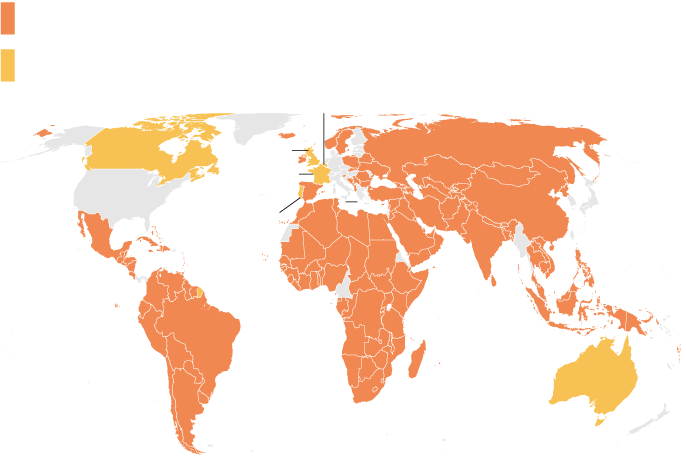
More countries announce plans to recognize a Palestinian state
Belgium, Australia, Portugal, Canada and Malta announced plans to join Britain and France in recognizing Palestinian statehood, joining more than 140 other countries.
Countries that have recognized a Palestinian state
Note: Data is as of September 2, 2025 and includes all countries that have formally recognized or announced plans to recognize Palestinian statehood since 1988. Several European countries, such as Czech Republic and Hungary, originally recognized a Palestinian state in 1988 when they were part of the Communist bloc of Soviet-aligned nations and followed a unified policy, but their current diplomatic stance may be different.
Correction: This graphic has been updated to reflect that North Korea recognizes the State of Palestine.
Sources: United Nations, State of Palestine’s Ministry of Foreign Affairs and Expatriates, statements from national governments
Hey folks, I know it’s Saturday, and I don’t mean to be the bearer of bad news. But as I promised you from day one—I don’t sugarcoat. I bring you the inside story the way I hear it, the way I know it. No spin, no filter, no corporate agenda. Just the truth.
Donald Trump has completely lost it. He’s not only planning to go to war with Venezuela—to manufacture a crisis that gives him cover to implement Project 2025 and stay in power forever—but he’s also preparing to go to war with America itself. Plans are on the table to unleash the National Guard on cities like Chicago and Portland. And make no mistake, folks: none of this is about the safety or security of our country. It’s all part of Trump’s authoritarian playbook—an orchestrated campaign of chaos designed for one purpose only: to cement himself in power for good.
My sources tell me this is the week. Plans are being drawn to deploy the National Guard into Chicago—and possibly another city, maybe Portland. And you won’t believe it until you see it with your own eyes: Donald Trump is now using AI-generated propaganda that he blasts out on Truth Social and the White House even reposts. Complete with helicopters, fire, and his chilling line, “I love the smell of deportations in the morning.” And now he’s going even further, threatening, “Chicago is about to find out what the Department of War is all about.” This isn’t satire. It’s not a movie trailer. It’s the President of the United States openly fantasizing about turning our cities into war zones.
Illinois Governor JB Pritzker called it an “invasion.” Chicago’s Mayor Brandon Johnson said flatly, “Unconstitutional.” And yet, Trump doesn’t care. He’s already renamed the Department of Defense into the Department of War, bragging that America needs a “warrior ethos.” Folks, that isn’t policy—it’s the vocabulary of dictatorship.
But here’s where you have to look deeper.
While the cameras are fixed on Trump threatening to occupy American cities, my sources are telling me the bigger play is brewing south of our border. Preparations are already underway for military strikes against Venezuela.
You’ve heard the drumbeats: warships in the Caribbean, F-35s to Puerto Rico, a $50 million bounty on Nicolás Maduro. He says it’s about gangs and terrorism. But let me tell you what it’s really about: declaring a state of war that gives him cover to do whatever he wants. No oversight. No due process. Eleven men blown up in international waters, no trial, no evidence, just his word—and we’re supposed to accept it.
This is how autocrats seize power. Manufacture chaos at home, declare enemies abroad, and then insist that only one man—the “strongman”—can keep order.
It’s Putin’s playbook. It’s Xi’s playbook. It’s Kim’s playbook. And Donald Trump is begging to be accepted into their club.
Think about what this means.
A president who does nothing to stop Russia’s daily attacks on Ukraine. Who stands silent while Putin kidnaps over 25,000 Ukrainian children. Who laughs nervously as Xi, Putin, Kim, and Modi mock him at their parades. Yet, when it comes to his own people, his own cities, he’s ready to send in troops.
It’s grotesque. It’s un-American. And it’s a warning.
What Trump is preparing isn’t just a deployment. It’s the beginning of a doctrine: Trump versus America. If he can frame Chicago as “the enemy,” then he can frame anyone—any governor, any journalist, any protester, any survivor—as an enemy of the state. And from there, it’s one step to the death of democracy.
And if you think that’s shocking, you won’t believe this. While Trump is preparing to send the National Guard into Chicago and preparing for war abroad, he’s also busy turning the White House into his personal Mar-a-Lago
My sources tell me that just yesterday, he quietly unveiled a new “Rose Garden Club” — a members-only society with buy-in at a staggering $500,000 a head. Yes, you read that right: half a million dollars just to secure access. Trump has literally transformed the people’s Rose Garden into a private playground for the wealthy elite, just as he did with Mar-a-Lago in Florida. Cocktail parties, whispered deals, donors rubbing shoulders with lobbyists — all from inside the very heart of American democracy.
At the unveiling, Trump boasted that the Rose Garden was now “a place where our members can gather with congressmen, senators, and leaders to talk business and make America strong again.” In other words, he’s selling direct access to power—half a million dollars for a seat at the table.
Here is the transcript of the speech Trump delivered at the opening of the Rose Garden Club:
This is more than just a grift. It’s a message. He is not planning on leaving. He’s planting roots in the White House as though it were his personal estate, a gilded club for sale to the highest bidder. George Washington, Abraham Lincoln, the great leaders who saw the White House as a sacred trust of the people — they would be turning over in their graves. Trump has reduced it to another cash register, another hustle, another monument to himself.
Folks, this is what dictatorship looks like: while the nation burns, Trump uses the Rose Garden to sell access to the White House.
I want to take this moment and talk to you from the heart. I’m not trying to scare you, but I need you to understand just how serious this is. What’s transpiring right now—the planned attacks on Venezuela, the deployment of National Guard troops into American cities, the Rose Garden being turned into a half-million-dollar pay-to-play club—it all points to one thing: Donald Trump is not preparing to leave power. He is preparing to stay in power forever.
And if we don’t stand together now, if we don’t raise our voices now, there will come a day when we wake up and regret that we didn’t do everything we could while we still had the chance. I’ve said it before and I’ll say it again: everybody can do something. Spread the message. Become a subscriber. If you can, become a paid subscriber. Contribute. This is how we fight back.
I want you to remember something about me. I wasn’t always on this side of the fight. I was once deep inside Trump’s circle. I saw firsthand how the deals were made, how the lies were spun, how the money flowed and the corruption spread. I know these people because I lived in their world—and I chose to break free, to speak the truth, to risk everything to expose what I saw.
I can’t change my past, but I can use it to warn you about the future they are building.
My son Aaron is on the frontlines exposing Trump and his inner circle, being attacked by his minions for daring to report the truth. And I’m risking my freedom every single day to bring you information the media won’t touch, stories you won’t hear anywhere else. Why? Because I know these people. I know what they’re about to do. That’s why I’m sounding the alarm—because if we don’t save our democracy now, it may be too late.
That’s why I’m asking you, personally, to stand with me in this fight.
I don’t have billionaires behind me. I don’t have corporate sponsors. What I do have is you.
We are more than just a community—we are building a movement. A resistance rooted in truth, powered by ordinary people refusing to be silenced.
Trump is betting on fear. But our strength is solidarity.
So I’m asking you:
Spread this message far and wide. Share it in your group chats, on your socials, at your kitchen tables. Let people know what’s really happening.
Subscribe. If you haven’t yet, join us. Every new subscriber makes this movement harder to ignore.
And don’t forget—pick up your copy of my book, Shadow Diplomacy, at LevRemembers.com. Trump never wanted you to read it, because it lays out the exact playbook of shadow dealings.
This is not just about Chicago. This is about whether America becomes another chapter in the book of failed democracies—another dictatorship where one man rules by fear.
I refuse to let that happen. And I know you do too.
So stand with me. Spread this message. Support this movement. Because together—we are not just witnesses. We are the resistance.
God bless you. God bless America.
—Lev Parnas
And another view on current events by Heather Cox Richardson:
From Heather Cox Richardson, Political Historian: September 6, 2025 (Saturday)
“Today the social media account of President Donald J. Trump posted an AI-generated image of Trump as if he were Lieutenant Colonel Bill Kilgore from the 1979 film Apocalypse Now in front of the Chicago skyline with military helicopters and flames and the caption “Chipocalypse Now.” Kilgore loved the war in Vietnam in which he was engaged; his most famous line was “I love the smell of napalm in the morning.”
Over the image, Trump’s social media post read: “‘I love the smell of deportations in the morning…’ Chicago about to find out why it’s called the Department of WAR.” The words were followed by three helicopter emojis, symbols the right wing uses to represent former Chilean dictator Augusto Pinochet’s goons’ disappearing political opponents by pushing them out of helicopters.
Although it has become trite to speculate about what Republicans would say if a Democratic president engaged in the behavior Trump exhibits daily, this open attack of the president on an American city is a new level of unhinged. Mehdi Hasan of Zeteo wrote: “The president of the United States just declared war, actual military war, not a metaphorical one, on a major American city, and one governed by his political opponents.” He added, accurately: “In any other period, this would be impeachment-worthy.”
Illinois governor J.B. Pritzker called attention to the gravity of Trump’s post: “The President of the United States is threatening to go to war with an American city. This is not a joke. This is not normal. Donald Trump isn’t a strongman, he’s a scared man. Illinois won’t be intimidated by a wannabe dictator.” Under the words “Know your rights, Illinois,” and “Stay safe and stay informed,” the governor’s social media account posted information about Americans’ rights in both English and Spanish.
Trump’s threats against American citizens are outrageous, but they also feel desperate. Trump’s popularity is tanking, the economy is faltering, Health and Human Services Secretary Robert F. Kennedy Jr. is facing a chorus of calls to resign or be fired, and the American people are taking to the streets. Thousands of people turned out today in Washington, D.C., for the “We Are All D.C.” march to protest the presence of troops in the city, and in Chicago for the “Chicago Says No Trump No Troops” protest. The protests are notable for the seas of signs the peaceful protesters carry.
And then, with Congress back in session, there is the resurgence of the issue of Trump’s appearance in the Epstein files. Last week, the White House warned Republicans that voting to release the Epstein files “would be viewed as a very hostile act to the administration.” Yesterday, Trump reiterated his claim that the agitation for the release of the files is a “Democrat HOAX…in order to deflect and distract from the great success of a Republican President.”
Also yesterday, lawyers for the Justice Department asked a federal judge to keep the names of two associates who received large payments from Epstein in 2018 secret. Days before the payments, the Miami Herald had started to examine the sweetheart deal Epstein got in 2008. One associate received a payment of $100,000, and the second received $250,000. As part of his plea deal, Tom Winter of NBC News reports, Epstein got a guarantee that the associates would not be prosecuted.
Last night, Trump hosted the inaugural dinner of what the White House is calling the “Rose Garden Club” in the newly-paved White House Rose Garden, telling those assembled that they were there because they are loyal to the president. “You’re the ones that I never had to call at 4:00 in the morning,” Trump told them. “You are the ones that have been my friends, and you know what I’m talking about.”
Yesterday, talking to reporters about the Epstein files, House speaker Mike Johnson (R-LA) said that Trump was “an FBI informant to try to take this stuff down.” The idea that Trump was secretly working to bring Epstein down is common fare among conspiracy theorists, but as Josh Marshall of Talking Points Memo suggests, Johnson’s embrace of it might well be an attempt to spin material in the files before it becomes public.
Marshall notes that journalist Michael Wolff, who interviewed Epstein at length during Trump’s first presidency, says that Epstein suspected it was Trump who told the authorities about his systemic sexual assault of girls. But if so, Marshall explains, this is damning rather than exonerating.
It’s pretty well known that Trump and Epstein had a falling out in 2004 after Trump went behind Epstein’s back to buy an estate in South Florida that Epstein wanted. But at the time, Trump was headed toward bankruptcy, and it was not clear where he was getting the money to buy the estate.
Marshall calls attention to a recent interview in which Wolff said that Epstein suspected Trump was laundering money for a Russian oligarch—and indeed, Trump did flip the property to a Russian oligarch for a profit of more than $50 million a few years after buying it—and threatened to sue Trump, bringing the money laundering to light. At that point, the Epstein investigation began.
According to Wolff, Epstein believed Trump had notified the police about what was going on at Epstein’s house, which he knew because he was a frequent visitor. Marshall speculates that Johnson mentioned that Trump was an informant because that information could well be in the files the Department of Justice has, and they’re trying to spin it ahead of time to make it sound like Trump was a hero.
But both Wolff and Marshall note that if indeed Trump turned the FBI onto Epstein, it shows he knew what was taking place at Epstein’s properties.
Johnson’s claim that Trump was an FBI informant suggests Trump’s team is worried that as more and more people get access to the files, it will be increasingly difficult to hide what’s in them. Trump’s demand for Republicans’ loyalty suggests that at least some of them are starting to recalculate it. And that, in turn, might have something to do with why he is putting troops in the streets.”
The White House’s least favorite subject just had another viral glowup this week.
The scandal over Jeffrey Epstein continues to trouble the Trump administration, and this week, another PR nightmare involving the dead pedophile blew up in the White House’s face. Said PR nightmare came from a surprising source: rightwing provocateur James O’Keefe, who notably made his name with the far-right activist group Project Veritas.
In the past, Veritas was known for targeting liberal organizations and Democrats, although, after a series of scandals, it’s no longer active. O’Keefe is still at it, however, and, in a surprising twist, he now seems to be targeting conservatives. This week, O’Keefe released a video captured with a hidden camera that purports to show a top Justice Department official discussing the Epstein case and claiming that the government will selectively redact the files to shift blame from Republicans to Democrats.
On Thursday, O’Keefe’s current organization, dubbed the O’Keefe Media Group, published a video involving Joseph Schnitt, a high-ranking official with the Justice Department. In the heavily edited video, Schnitt appears to discuss the Jeffrey Epstein files and seems to state that the government plans to politicize the future release of files. “They’ll redact every Republican or conservative person in those files, leave all the liberal, Democratic people in those files, and have a very slanted version of it come out where it’s ‘look at what’s going on’ without really seeing any of their [Republicans’] bad behavior,” Schnitt says. The woman’s side of the conversation is only heard off-camera, and she’s the one who brings up the Epstein files.
Later in the video, during a discussion about Epstein’s co-conspirator, Ghislaine Maxwell, Schnitt can be heard saying: “She got transferred to a minimum security prison, too, recently, which is against BOP [Bureau of Prisons] policy because she’s a convicted sex offender and they’re not supposed to get minimum security prisons, which is an interesting detail because she’s getting a benefit, which means they’re offering her something to keep her mouth shut.”
It’s worth noting that O’Keefe’s videos are often drained of context. In the past, we described Project Veritas’ modus operandi as “a pantomime of investigative journalism, using secretly recorded and deceptively edited videos to smear liberal groups, tech companies, and perceived opponents of the conservative movement.” That said, in this case, Schnitt’s comments seem somewhat straightforward, and obviously don’t make the government look very good.
In an effort to dispel the immediate controversy from O’Keefe’s video, the Justice Department took the very unusual (and, some would argue, certifiably insane) step of posting what appears to be an unedited iPhone screenshot of an email sent by Schnitt to Bondi. In so doing, the DOJ seems to have done journalists’ work for them and confirmed much of what O’Keefe’s organization has alleged about the undercover operative’s encounter with Schnitt.
The details provided by the email illuminate some of O’Keefe’s honeypotting tactics. In the email, Schnitt says that, in July, he met a woman on the dating app Hinge who said that her name was “Skylar.” Skylar, who claimed to be an au pair from Georgetown, went on two dates with Schnitt in August. Schnitt admits that he did identify himself as working for the government on his dating profile. The email also identifies Schnitt as an assistant deputy chief with the Justice Department’s Special Operations Unit.
The email sent by Schnitt to Bondi concludes with a groveling disclaimer that he doesn’t actually know anything about Maxwell’s situation:
“The comments I made were my own personal comments on what I’ve learned in the media and not from anything I’ve done at or learned via work. I have no knowledge of the circumstances surrounding Ms. Maxwell other than what is reported in the news. I also never divulged anything about what I do at work. I recall that she asked if I had any knowledge about Maxwell and I specifically said I only know what’s been reported in the news.”
In an additional statement published online, the DOJ’s Office of Public Affairs further decried Schnitt’s covertly captured claims: “The comments in this video have absolutely zero bearing with reality and reflect a total lack of knowledge of the DOJ’s review process. The DOJ is committed to transparency and is in compliance with the House Oversight Committee’s request for documents.”
Here, the DOJ is referencing a recent effort by the GOP-controlled House Oversight Committee to shed additional light on the Epstein files.
Interestingly enough, this week, O’Keefe’s also hosted a YouTube interview with Rep. Thomas Massie (R-West Virginia), who has been at the forefront of an escalating war with the White House over the Epstein files. Trump and his allies have openly criticized Massie for months for breaking with the GOP line on policy, most notably with Trump’s One Big Beautiful Bill. In turn, Massie has continually platformed the Epstein issue, much to the chagrin of the administration. “If you can’t get Republicans to care about an underage sex trafficking ring with hundreds of victims, how are you going to get them to care about the budget?” Massie recently said, of the issue. This week, the Congressman also held a press conference in Washington, D.C. that involved Epstein’s victims. He is currently attempting to secure a vote on a bill that would force the DOJ to release additional records related to Epstein, the Wall Street Journal has reported.
While Trump scrambles jets and calls it a “hoax,” survivors speak their truth, Trump allies break ranks, and the demand to release the Epstein files grows louder than ever.
There are days in this fight that feel like history is being written in real time. Today was one of them. On the steps of Capitol Hill, survivors of Epstein’s horrors stood before the world — their voices trembling but unbroken, carrying truths too heavy for most of us to imagine. They spoke of the sick and twisted things done to them by Jeffrey Epstein and Ghislaine Maxwell, exposing the darkness they had been forced to endure. It wasn’t just testimony — it was raw humanity, broken but unbent, demanding justice in the open air of our nation’s capital. And as their words poured out, I felt the weight of it — the pain, the courage, and the simple, undeniable truth that cannot and will not be erased.
Each survivor came forward with their own story. One survivor described how Epstein boasted about his friendship with Donald Trump, pointing to a picture of him and bragging that Trump was his “best friend.” She explained how intimidating that was — to realize the man abusing her was connected to power at the very top.
Another survivor turned directly to the cameras, speaking not to politicians or the crowd, but to Donald Trump himself. She made clear she wasn’t a Democrat, wasn’t a political adversary, but a registered Republican. Looking straight into the lens, she said: This is not a hoax. This is real. Her words cut through the noise, through the years of cover-ups, through every attempt to silence them.
Even one of the survivors’ lawyers stepped forward today, reminding everyone that back in 2009, Donald Trump himself had been willing to help. He said Trump cooperated at the time, that he was ready to provide information against Epstein. So what happened? What changed? Why is he now standing at the White House podium calling this a “Democratic hoax”? Why is he working overtime to bury the very truth he once seemed prepared to expose?
The answer is simple: because now Trump is the one with everything to lose. Transparency that once cost him nothing now threatens to take down the entire house of cards he’s built.
But even as these voices rose, something else was happening across the street. Inside the White House, Donald Trump was staging his own circus. As survivors pleaded for truth, he scrambled jets overhead in a flyover meant to drown them out.
As they begged Congress and the DOJ to release the files, Trump held a press conference with the President of Poland, dismissing everything as the “Democratic Epstein hoax.” Once again, he mocked the pain of survivors, trying to twist justice into a punchline.
Just think about it — this is the same Donald Trump who ran his whole campaign on exposing the “Deep State,” on promising to reveal the Epstein files, on railing against child predators, and who never missed a chance to preach about transparency. The same Trump who now claims he’s the victim of conspiracies, who insists the Epstein case is nothing more than a “Democratic hoax.” Yet even when Marjorie Taylor Greene herself came forward, asking Trump to host the survivors at the White House where they belong, he refused.
Instead, he doubled down, once again calling it a “Democratic hoax.” As I’ve been telling you all along, Donald Trump is not trying to get to the truth. Donald Trump is trying to cover up the truth. He is rewriting history, doing everything possible to bury it under noise, distraction, and denial.
And behind those walls, Trump’s White House is pressuring GOP congressmen and women not to sign the bill to release the Epstein files. They’ve gone so far as to label transparency itself a “Hostile Act” against the administration. This is not leadership. This is corruption in plain sight.
But here’s where the ground shifted today. I told you this morning — there are moving parts. It’s not just Dan Bongino anymore. What we saw today was even his closest allies — Marjorie Taylor Greene, Nancy Mace, Anna Paulina Luna — stepping out of line, speaking directly to Trump and their colleagues, pleading for the files to be released.
After sitting with the survivors and listening to their stories, they couldn’t keep quiet anymore. Nancy Mace ran out in tears.
Luna held a press conference, declaring that “a lot of powerful people must be held accountable.” Even Greene, who has stood by Trump through everything, called on him to open the doors of the White House to these victims. That’s the power of truth. That’s the power of survivors refusing to be silenced.
Most of the 200 GOP representatives still aren’t saying a word. They want distance. They want silence. They want to hide and hope this storm passes them by before the midterms. But silence is complicity. And the American people — Republicans, Democrats, independents alike — overwhelmingly want the Epstein files released. They want the truth. They want accountability. They want justice for the children, for the survivors, for the victims who can no longer speak.
This isn’t about left or right. It isn’t about blue or red. It’s about truth. It’s about justice. And if Congress refuses to act, we will expose them.
Now more than ever, spread this message far and wide. Share it.
NB. John Paulson is pouring money in with other donors to suppress survivors listing names, he is a major donor to Mike Johnson as well as Donald Trump.
He made 20 billion dollars by short betting on insider knowledge which resulted in the 2008 crash.
If you’ve been following the broader conversation around political donors and accountability, you might’ve seen John Paulson’s name surface in a place you wouldn’t expect: a connection to Jeffrey Epstein’s list. Yes, the hedge fund billionaire who made headlines for betting against the housing market has found himself part of a different kind of headline. This all started after Representative Thomas Massie name-dropped the billionaire as being in Jeffrey’s little black book.
The independent 2024 presidential candidate was among a number of high-profile people who in 2021 were named as passengers on Epstein’s jet, which was often used to transport guests to the financier’s private Caribbean island, Little Saint James.
Epstein’s luxury Boeing 727 was derisively referred to as the “Lolita Express” by a number of media outlets following allegations that it was used to fly underage girls to some of the multi-millionaire’s properties.
……..photograph emerged of the Health Secretary partying with the now-deceased child sex trafficker in Manhattan.
As President Donald Trump tries desperately to quell the firestorm surrounding the Epstein files, Kennedy has also come under scrutiny over trips he took on Epstein’s private plane, his late wife’s links with convicted associate Ghislaine Maxwell, and his past association with former industry titans such as Harvey Weinstein and Bill Cosby.
Photos that have re-emerged also show RFK Jr. at a New York Academy of Art gala with Epstein in in 1994, while court documents show a listing for “Kennedy, Bobby & Mary” in Epstein’s “little black book,” which featured contacts for socialites and politicians, as well as the girls he sexually assaulted.
Mary Richardson Kennedy] and two children to visit my mom over Easter.” He explained, “My wife had some kind of relationship with Ghislaine Maxwell, and they offered us a ride to Palm Beach.”
…………
It should probably not come as a surprise that Mary Richardson and RFK Jr.’s relationship didn’t start off on the best foundation. When the two started dating, RFK Jr. was still married to his soon-to-be ex-wife, Emily Black Kennedy. “Mary was fooling around with Bobby when he was married to Emily, but that marriage was essentially over,” a friend of RFK Jr.’s told Newsweek. “It ended amicably and it was just the right thing to do. But Bobby is a philanderer. Always was, always will be. And Mary knew that.”
……….
Reports indicate that RFK Jr. was a serial cheater while he was married to Richardson, and she knew he was being unfaithful, which didn’t do her mental health any favors. “Gaslit. That’s how Mary felt. The more pain she was in, the worse Bobby treated her,” Callahan wrote. “Some days he wanted a divorce; others, he wanted to bring another woman into their bed, an idea that left her humiliated. She rejected him outright.”
…….
Some of Richardson’s friends told Oppenheimer that she was bullied by her husband. “She allegedly said she ‘feared for her life,’ claimed that Bobby ‘repeatedly’ told her that she would be ‘better off dead,’ and that it would be ‘so much easier’ if she killed herself,” Oppenheimer wrote.
………
Richardson’s suicide was a big shock for her family and friends, many of whom later said they suspected she gave up because she stood to lose everything. “
In past blogs I have written about land which sank beneath the oceans after the Ice Age melt began over 10,000 years ago.
Now the world knows the Arctic and Antarctic ice caps are melting and sea levels are rising fast. Land is going beneath the oceans.
Thermal Expansion – As highly reflective ice and snow melt due to climate change induced global warming, the albedo of the earth declines. A lower albedo means warmer overall temperatures which means more snow and this causes water to expand. This is a positive feedback loop because as more ice and snow melts, the earth gets hotter which melts more ice and snow.
Meltwater – When the lower albedo of earth (and other factors such as the intensifying greenhouse climate) melts ice and snow it ends up in the ocean. Meltwater is the leading factor in sea level rise. Meltwater also affects the salinity of ocean water which can disrupt and alter ocean currents
There are dramatic changes happening globally, for example Russia:
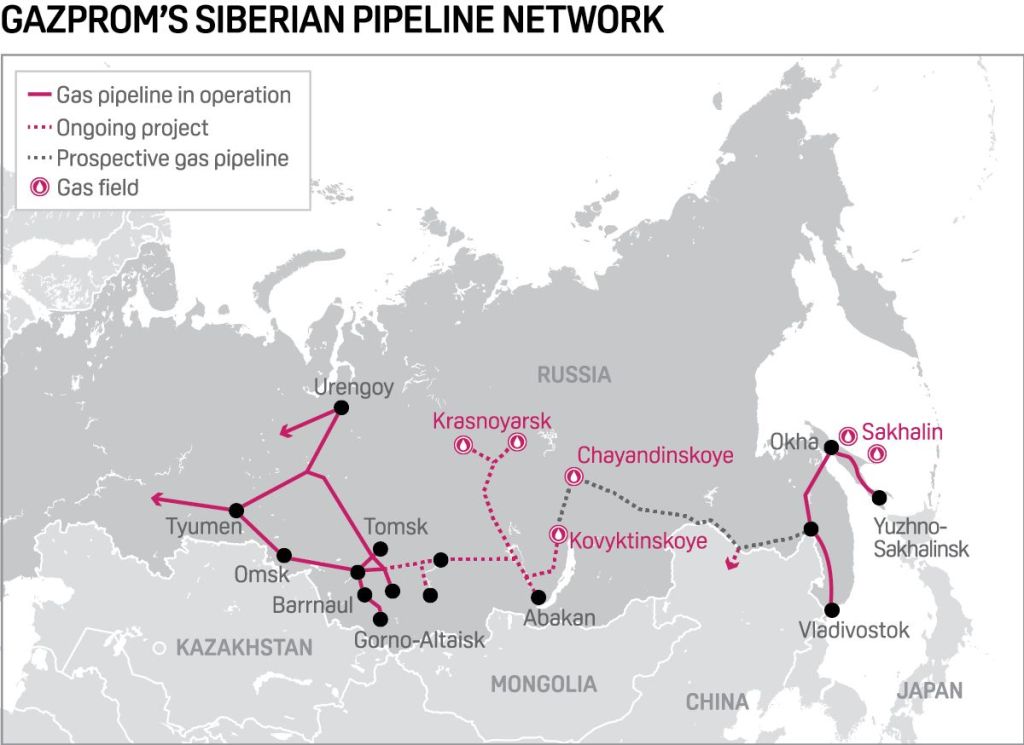
Siberian pipelines:
spglobal.com
Melting Permafrost in Siberia is Threatening Russia’s Energy Industry
Permafrost and Climate Change
As the world becomes increasingly warmer due to anthropogenic climate change, the effects of climate change grow more apparent. Human activities, such as the burning of fossil fuels, deforestation, and livestock farming, have led to irreparable damage to our climate. One such result is the melting of permafrost. Permafrost is a frozen layer of soil, gravel, and sand bound together by ice that remains at or below 0ºC (32º F) for at least two years, primarily found in the Arctic and sub-Arctic regions of the globe. This ‘permanent frost’ acts as a carbon sink, storing up to 1,500 billion metric tons of organic carbon, almost twice as much as is currently in the atmosphere. These layers contain high concentrations of carbon as the permanently low temperature prevents dead animals and plants from decomposing. Unlike regular frozen ground, permafrost reaches from one meter up to more than 1,000 meters deep. With a heavy reliance on Arctic resources, as rising global temperatures accelerate permafrost thaw, the release of greenhouse gases, infrastructure collapse, and economic instability pose environmental and geopolitical challenges for Russia.
Permafrost and Russia’s Energy Sector
Two-thirds of Russia rests on permafrost, namely in the northern province of Siberia. However, as climate change causes global temperatures to rise, permafrost thaws, releasing stored greenhouse gases (GHGs) like carbon dioxide and methane into the atmosphere. Methane, in particular, is more potent than carbon dioxide at trapping heat in the atmosphere, resulting in higher ground temperatures. The release of GHGs exacerbates global warming, which furthers permafrost thawing—creating a dangerous positive feedback loop. Thus, Russia is warming 2.5 times faster than the rest of the world, contributing to devastating climate disasters in the region.
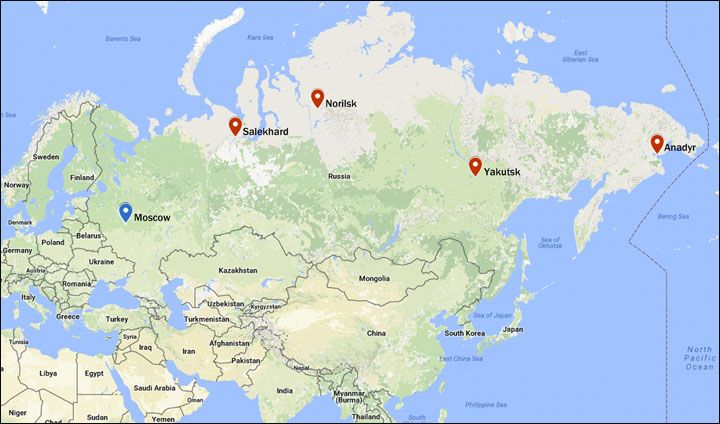
The permafrost study examined four Siberian towns and cities: Salekhard, Norilsk, Yakutsk and Anadyr. It concluded that several of them are at risk of collapsing infrastructure within the next decade. (Image: The Siberian Times)
China is famous for its global road building (as were the Romans). The problem for China in its own territory in mountainous areas, is the depletion of permafrost which is now damaging existing roads:
Abstract
Express highways are roads of high speed, large capacity, and transportation flexibility. The network of express highways in China has been developed over the last 30 years to accommodate the needs of a growing population and to facilitate economic development. Part of the network is in permafrost regions, where the construction and maintenance of these roads present significant engineering challenges due to permafrost degradation induced by climate warming and by construction. This paper summarizes the engineering problems encountered in the construction and maintenance of these express highways, and the mitigation techniques used to overcome them on new transportation projects in permafrost regions. Ten types of engineering problems along the Qinghai-Tibet Highway, the oldest and longest highway in the permafrost regions of China are identified. Their main cause is related to permafrost degradation in the subgrade beneath the road subbase. Settlement of the highway embankment due to thaw consolidation of degrading permafrost is the dominant mechanical distress observed. Mitigation techniques, mainly for enhancing heat convection beneath express highways, are discussed along with their effects. Research in China related to transportation projects may provide a reference for future express highway design and construction in permafrost regions around the world
From the Internet I gathered this list of lands going under now or will do over the next couple of decades.
The island of Tuvalu
artofit.org
The Maldives
Bangkok, Thailand
Jakarta, Indonesia
Jamaica, Caribbean
The island of Kiribati, Pacific Ocean
The Marshall Islands
Bangladesh
Venice, Italy
Netherlands
The Mekong Delta, Vietnam
Gardj Sugdub are the first of 63 communities living along Panama’s Caribbean and Pacific coasts to be relocated due to their island sinking beneath sea levels.
Sunday 2 June 2024 16:51, UK
Solomon Islands
Pilau, South Pacific
Micronesia, Pacific
Fiji, Pacific
Seychelles, off east coast of Africa
Cook Islands, off New Zealand
French Polynesia
Made up of popular tropical retreats like Bora Bora, Tahiti and the Society Islands, French Polynesia
Tangier Island, Virginia
Even the United States is affected by rising sea levels. Tangier Island, about 12 miles off the east coast in Virginia’s Chesapeake Bay
Despite sophisticated flood control infrastructure, large parts of the Zhuhai-Macau area are projected to be below sea level by 2100. Sea level rise of 65 centimeters, together with high tide, would flood 3400 km2 of the Zhuhai region.
And the exponential construction of datacentres and bit mining energy centres will intensify the warming of the planet – whereas we should be dialling back our fossil fueled energy productions:
Climate risks, which are considered at a very high level of concern by the report, include riverine flooding, which risks severe damage to electronics, walls, roofs, and power systems from water ingress, and coastal inundation, which risks buildings being flooded, leading to water damage to cabling.
The report notes that by 2050, major data center hubs such as New Jersey, Hamburg, Shanghai, Tokyo, Hong Kong, Moskva, Bangkok, and Hovestaden are expected to face significant climate risks, with 20 to 64 percent of facilities in these areas likely to be highly vulnerable to physical damage from climate-related events.
The Asia-Pacific region, while leading global data center expansion, is also among the most exposed. In 2025, more than 10 percent of data centers in APAC are considered high risk, a figure projected to rise to more than 12 percent by 2050.
As fires rage around this increasingly hotter world, we know our excessive use of fossil fuels is adding to the continual destruction of our once beautiful world.
Fort McMurray fire nbcnews
Wildfires live and die by the weather, but “the weather” doesn’t mean the same thing it did in 1990, or even a decade ago, and the reason the Fort McMurray Fire trended on newsfeeds around the world in May 2016 was not only because of its terrifying size and ferocity, but also because it was a direct hit—like Hurricane Katrina on New Orleans—on the epicenter of Canada’s multibillion-dollar petroleum industry. That industry and this fire represent supercharged expressions of two trends that have been marching in lockstep for the past century and a half. Together, they embody the spiraling synergy between the headlong rush to exploit hydrocarbons at all costs and the corresponding increase in heat-trapping greenhouse gases that is altering our atmosphere in real time. In the spring of 2016, halfway through the hottest year of the hottest decade in recorded history, a new kind of fire introduced itself to the world.
From the book, Fire Weather by John Vaillant
Here the author describes how human activity (anthropocene) – here petroleum industry within a boreal forest (!!!!) – is an anomaly……
Fort McMurray is an anomaly in North America. Located six hundred miles north of the U.S. border and six hundred miles south of the Arctic Circle, the city is an island of industry in an ocean of trees. Without the lure of petroleum, this part of Alberta would resemble Siberia in even more ways than it already does: sparsely populated; its rivers spun like compass needles toward the Arctic Ocean; its trees low, short-lived, and prone to fire.
At the time of writing, Vaillant pointed out:
Canada is the world’s fourth-largest oil producer and the third-largest exporter. Nearly half of all American oil imports—around 4 million barrels per day, come from there—the equivalent of one ultra large crude carrier ship every twenty-four hours. Of this vast quantity, almost 90 percent originates in Fort McMurray.
Many populations who have survived wildfire damage often get flooding after drought.
Rain on wildfire burn scars can trigger damaging debris flows − a geologist explains how
Published: January 23, 2025 1.47pm GMTUpdated: February 12, 2025 1.42pm GMT
As a consequence of climate change, conditions in previously safe areas to live in the world have become impossible to survive in. So people are on the move to flee to safety. But not all receive open arms and comfort when they reach somewhere which could have been safe.
People fleeing impacts of climate change suffering physical and mental health crises
Issues range from anxiety and depression to addiction and domestic violence.










You must be logged in to post a comment.