ICE agent shoots and wounds man at traffic stop in Austin, Texas, officials say
Anti-ICE protests break out in push for transparency as unnamed man is in serious but stable condition
Emiliano Tahui Gomez in Austin and agencyMon 21 Sep 2026 06.00 BSTShare
A US Immigration and Customs Enforcement (ICE) officer shot and wounded a man on Sunday afternoon in Texas’s capital city of Austin, local authorities said, as protesters demonstrating against the Trump administration’s hardline anti-immigration campaign quickly gathered at the scene.
The man was initially reported to be in serious but stable condition at a hospital after being shot once in the torso on the city’s north side, Austin’s police chief, Lisa Davis, said at a news conference with the mayor and other city officials.
The Department of Homeland Security, which oversees ICE, did not participate in the news conference and didn’t immediately respond to requests for details.
A woman who visits Dilley ICE detention centre claims children face 24-hour lights and harassment from guards for laughing as families struggle with basic needs @AllSidesNow/X
Trump’s Dilley ICE facility has come under renewed scrutiny after Casey Revkin, a co-founder of the nonprofit Each Step Home, described children living under 24-hour lights and claimed some are even harassed by guards for laughing.
Speaking on The Katie Phang Show, Revkin said she has seen families struggle with food, water, heat and other basic needs at the Texas detention centre, while her organisation now sends more than $10,000 (£7,400) a week to help detained families buy essentials.
Children Face 24-Hour Lights at Dilley
Revkin, who has visited the Dilley Immigration Processing Center in South Texas, described the facility as a harsh environment for families with young children.
She said the centre is made up of trailers in a hot, dusty area and claimed the lights remain on around the clock for security reasons, making it difficult for children and parents to sleep properly.
Her most striking allegation concerned the way children are treated when they behave like children.
‘Children in ICE detention in Dilley get in trouble for laughing,’ Revkin said during the interview.
When asked to explain, she added, ‘They get harassed by their guards for laughing.’
ProPublica separately reported that children detained there described missing school, friends and ordinary comforts while being held with their families.
Is This Happening to Us?’ Daily Number of Kids in ICE Detention Jumps 6x Under Trump
As the Trump administration detains large numbers of kids, advocates worry ‘it’s only a matter of time before we see a child die.’
Families detained at the Dilley Immigration Processing Center in Texas wave signs during a demonstration on Saturday, Jan. 24, 2026. Brenda Bazán/Associated Press
She said Garces Perez was then transported to an ICE processing center, where he was held overnight. According to Lincoln-Goldfinch, he told her the facility was very cold, and he was unable to sleep.
Saudi-Houthi war: ‘Won’t attack US, Israeli ships’; report claims Houthis held secret meet with US officials, agreed to uphold ceasefire deal; what exactly happened?
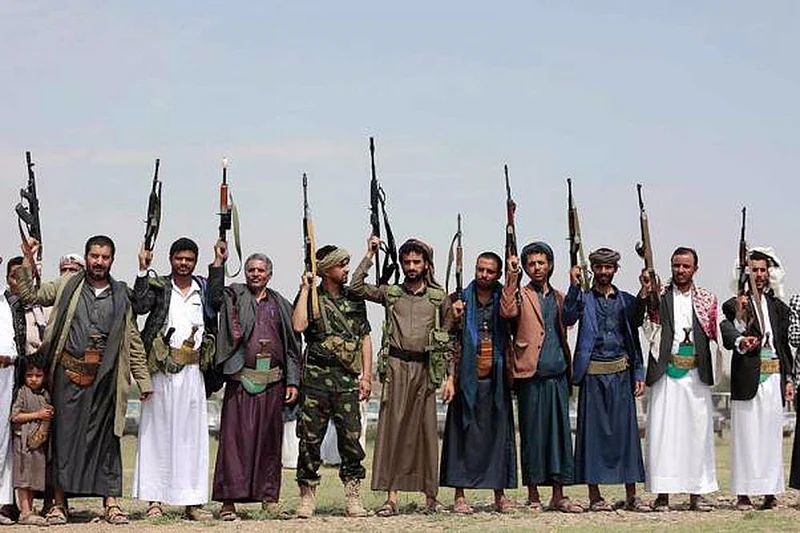
Donald Trump on Saturday claimed the Houthis contacted his administration, urging Washington to stay out of the Saudi-Houthi war.
Posted about 15h agoabout 15 hours ago, updated about 12h agoabout 12 hours ago
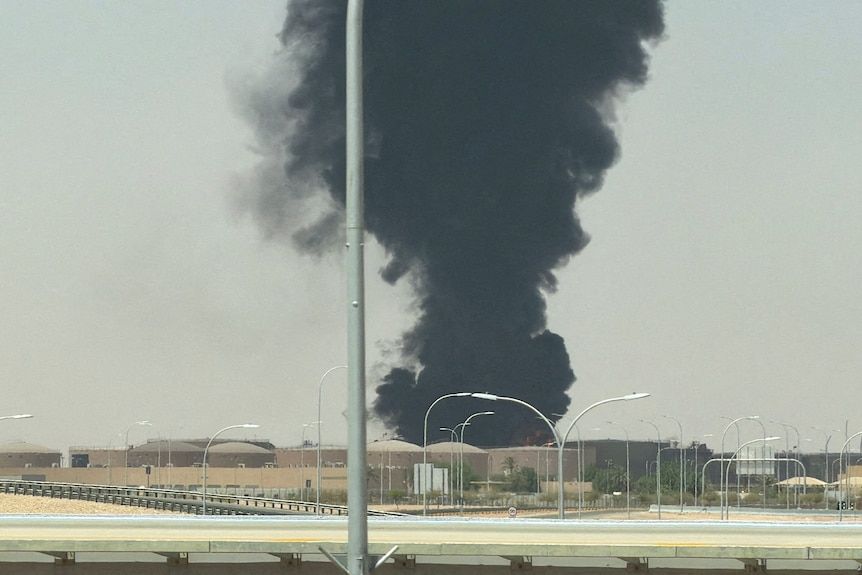
A large plume of black smoke was seen rising from the fuel storage area at King Khalid International Airport in Riyadh. (Reuters)
In short:
Smoke and flames have been seen near Riyadh’s international airport as Yemen’s Houthis claim to have attacked “sensitive” sites in the Saudi capital.
Saudi Arabia had sent alerts warning of potential danger around Riyadh but has not yet confirmed the Houthis’ claims.
The Iran-backed Houthis have been launching attacks against Saudi cities, energy infrastructure and shipping, creating new threats to global oil supplies.
………
Reuters video and photographs showed a huge pillar of black smoke rising in the area, with the airport highway, main terminal building and other facilities in the foreground. At one point in the video, flames were visible rising from behind what appeared to be fuel tanks.
Large plume of black smoke rises from the fuel storage area at King Khalid International Airport, in Riyadh, Saudi Arabia, September 19, 2026. Picture taken with a mobile phone. (Reuters)
And Trump family have received $bns from Saudi, eg:
In 2022, Saudi Arabia’s Public Investment Fund (PIF) invested $2 billion in Affinity Partners, a private equity firm founded by Jared Kushner, Trump’s son-in-law, after he left the Trump administration.
A House committee opened an investigation into claims that Kushner leveraged his position in his father-in-law’s administration to land the $2 billion Saudi investment. In October, House Democrats requested that a special counsel be appointed to investigate whether Kushner was acting as an unregistered foreign agent.
Saudi Arabia Reports Significant Decrease in US Treasury Holdings
The Kingdom’s holdings decline by $10.6 billion, reflecting market dynamics and investment strategy.
Saudi Arabia’s holdings of US Treasury securities were recorded at $126.9 billion in January, a decrease of $10.6 billion from the previous month, according to the latest data from the US Treasury.
This represents a month-on-month decline of 7.71 percent.
Saudi Arabia maintains its position as the 17th largest holder of US Treasury securities and remains the only member of the Gulf Cooperation Council in the top 20 holders.
This was a week which crystallized a number of things. When you add them all together, however, the key thing is that it demonstrated just how important the USA has become, through the Trump administration, in aiding the Russian war effort. This might have been hidden in all the distracting stardust being thrown in the air about the Graham Tariff Bill, or the recently announced (extremely weird) possible sale of some motley air defense capabilities to Ukraine (arrival uncertain and unknown). However, behind the stardust which the press seems too out of its depth to properly interrogate the reality is that the war has entered into a fascinating contrast.
Phillips’s Newsletter is a reader-supported publication. To receive new posts and support my work, consider becoming a free or paid subscriber.
………
On the land, where the Ukrainians were less reliant on the USA, it is the Ukrainians who are showing the initiative and dealing some substantial blows to Russian military strength. If what we are hearing about Operation Vivaldi is only partially true, the Ukrainians are continuing to advance in the combined operations of infantry and UAVs.
In the ranged war, relying on Ukrainian sources, the Ukrainians are also showing some important strengths—when they concentrate on the right targets. However it is in their ranged campaign against the Ukrainians, aided enormously by the USA starving Ukraine of air defense (a great example of why relying on the weapons of another power is always so dangerous) that the Russians are being their most effective—and almost certainly will continue to be so for the upcoming winter.
Add it up, and what we see is that Russia’s area of initiative in the war has been enormously abetted by the USA and Donald Trump.
………..
“In addition to the advance itself, we can say that during this operation a fairly large number of enemy officers were also destroyed and a fairly significant number of enemy personnel were taken prisoner. Perhaps, in recent years, this is the largest replenishment of the exchange fund that came from the Ukrainian side,”
………..
The Ukrainian General Staff claimed 11,090 Russian personnel losses in the seven daily reports from 14 to 20 September 2026, an average of about 1,584 a day. Here is a breakdown.
Russia Batters Ukraine At Range
The last week was actually a lighter week than the one before when it came to Russian ranged attacks on Ukraine. They launched attacks every night, but with a smaller number of systems than the seven days previously. Here is a table of the number of units attacking—mostly drones (which means Geran/Shaheds) from Sept 14-19. We do not have last night’s figures yet.
…………
The reality of the ranged war, even with these reduced attacks, remains the same however. Ukraine can do little to intercept Russian ballistic missiles. The attack on 17 September, for instance, the only example of the Russians making a large ballistic missile assault last week, saw the Ukrainians claiming that they could not intercept one of them. The Ukrainian Air Force listed only Shahed/Gerans and Banderols as being neutralized that night.
Indeed, this slower week could be a sign of the Russians stocking up for larger attacks in the fall and winter. They have a track record of doing that.
This is the reality. Ukraine, because of the US depriving it of Patriots. Even in the announcement yesterday that the US might be selling some air defense capability to Europe to pass on to Ukraine, there was no mention of Patriots. What was announced was some “possible” sale of deficient systems. Indeed, the press did not even know how to report what happened—as in this CBS report.
Trump, Diesel And Ukrainian Energy Strikes
Another area where the Ukrainians confirmed that they can be effective when not impeded in the USA, is their ongoing campaign against Russian fuel production. We have confirmation of that this week because Donald Trump came out and pleaded with the Ukrainians to do Putin a favor and stop attacking Russian refineries.
Things were so bad, that Trump begged once and lied twice—before the Ukrainians made it clear exactly what their position is. It was a fascinating “exchange” that started last Sunday (13 September). Then Trump said this to the press:
“Mr. Zelenskyy has to do one thing. He has to stop knocking out diesel fuel in Russia…We spoke to Mr. Zelenskyy about it. There are plenty of other targets. Don’t hit diesel fuel, because that’s hurting, that’s hurting the world.”
However, Trump decided to blame the Ukrainians and help Putin when discussing the issue publicly. And this was not all. On September 14, Trump doubled-down on his claim that the rise in diesel prices was Ukraine’s fault but, miraculously, claimed that he had gotten the Ukrainians and the Russians to agree to stop all energy attacks. He tweeted:
“Ukraine has agreed not to hit Russian Energy targets. Russia has agreed to do, likewise!…The World’s Diesel price rise is mostly caused by the Russia/Ukraine War, not Iran.”
It is still shocking how the President of the USA can just make up nonsense, spew it out, and some people will believe him.
Zelensky even openly contradicted Trump, in denying any deal had been reached. He said Ukraine might consider a deal, but as of now“Russia hasn’t stopped striking our energy sector… And our responses to them for this are tangible.”
It was a revealing exchange. As always for Trump, Ukraine is the baddies and Russia is to be protected. That will never change.
The more interesting thing is the confirmation of the seriousness of the Ukrainian campaign on Russian oil production. It is why this must be the key target of the Ukrainian ranged campaign. If the Ukrainians have no ability to defend themselves against Russian ballistic missiles because of the USA, the least they can do is not listen to the USA when the American president pleads with them to stop their most effective strategic campaign.
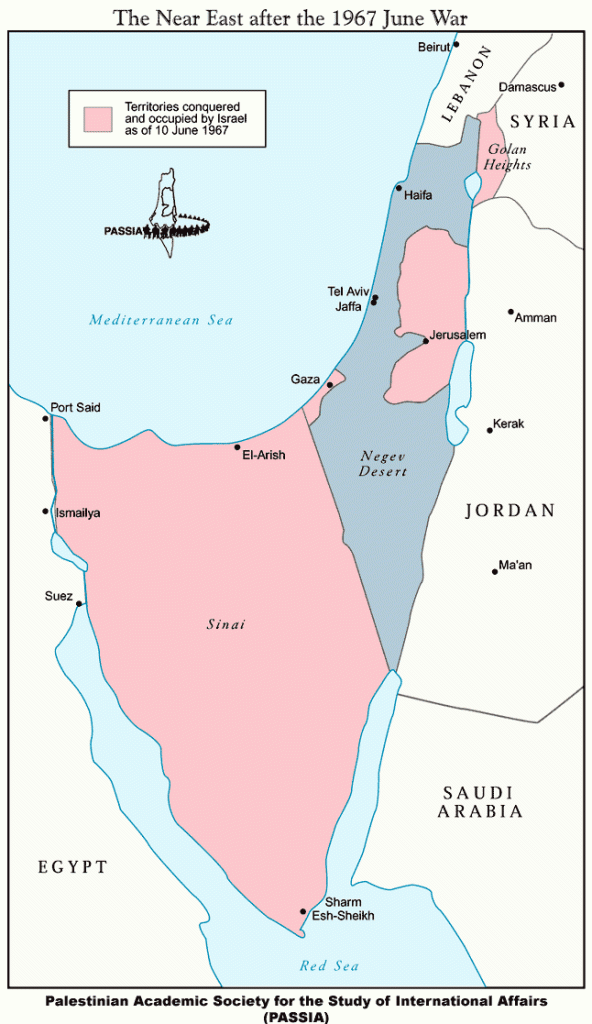
Above: The war of June 1967 began with a pre-emptive air strike by Israel in which it destroyed the air force fleets, while they were on the ground, of three neighboring nations, Jordan, Syria and Egypt. Without air capability these nations had little ability to defend their territories and this war ended quickly: it is known as the Six Day War. At the end of this war, Israeli forces had occupied all the areas in pink on this map: the West Bank, Gaza, the Golan Heights which belonged to Syria (at the northeast/upper right corner of Israel) and the Sinai Peninsula which belonged to Egypt (large area to the left/southwest of Israel).
The Camp David Accords, mediated by U.S. President Jimmy Carter, were fulfilled in 1982, at which time all of the Sinai Peninsula was again under Egyptian control.
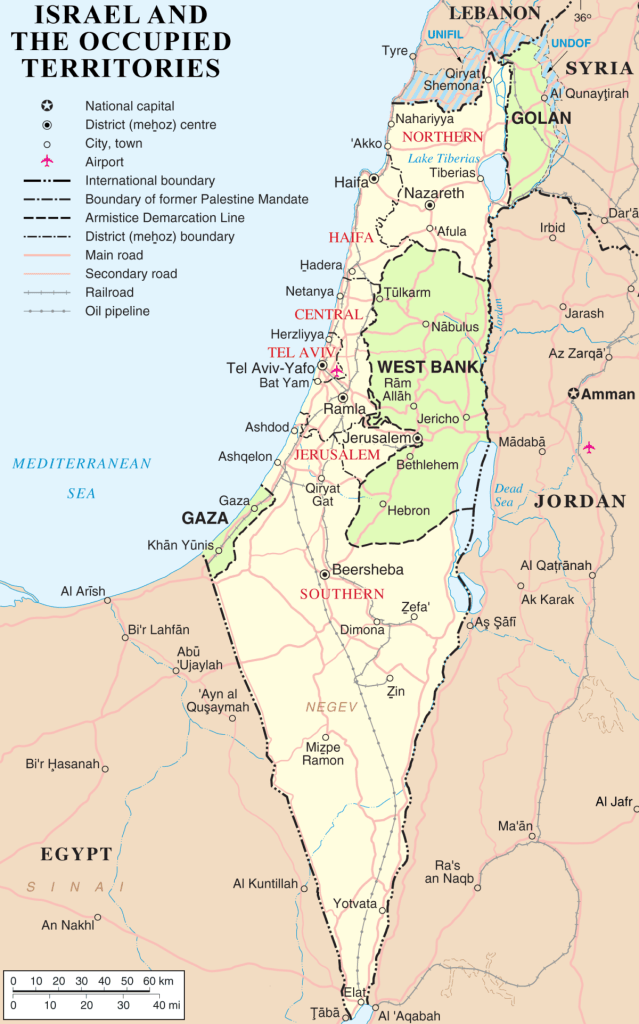
Above: This map shows in green the areas that Israel has had under military occupation since 1967. As noted in the previous map, the Sinai Peninsula was returned to Egyptian control by 1982.
In November 1967, the same year as the Six Day War, the UN Security Council unanimously adopted UN SC Resolution 242, which required the “withdrawal of Israeli armed forces from territories occupied in the recent conflict.” As of 2017, Israel has refused to comply with this UN Security Council resolution for fifty years.
Spike in red diesel prices as Middle East conflict continues
Jenni Green 09 September 2026
Red diesel prices have soared into three-figure territory again, putting extra cost pressure on farmers and growers looking to run their machinery during the busy autumn period.
Two weeks ago, red diesel was ticking along at about 95-97p/litre – a level it has been at for much of the summer.
But last week it jumped to 105p/litre according to the Farmers Weekly average collected from farm suppliers across the country, and this week it was quoted at more than 107p/litre – up almost 70% on last year’s price.
This is despite the fact that in June, following pressure from the NFU, the Treasury cut duty on red diesel from 10.18p to 6.48p/litre, its lowest rate in 20 years.
The upturn reflects developments in the Middle East, with signs of the US-Iran conflict widening, including a recent attack by Houthi rebels based in Yemen on Saudi Arabian oilfields.
Brent crude oil prices soared to nearly $100/barrel (£74) this week, a level not seen since May.
With the Ukraine/Russia war also rumbling on and oil vessels being targeted in the Black Sea, the outlook remains volatile.
above 4pc, driving up prices on supermarket shelves and forcing the Bank of England to raise interest rates.
The crunch is already inflicting fresh pain on motorists. Diesel prices at British pumps are averaging almost 192p a litre, back to the highs of early April.
The diesel squeeze has been exacerbated by Ukrainian drone attacks on Russian refineries. Reuters reported on Tuesday that half of Russia’s top six diesel producers had significantly cut back or halted output in September.
Moscow recently extended its own diesel export ban until Sept 30.
Saudi Aramco will halt all crude deliveries to European refiners next month after a pipeline attack.
The East-West pipeline has been shut since September 10 and could take up to six weeks to repair.
Brent crude has swung between $104 and $108 a barrel this week on the disruption.
Saudi Aramco has informed at least two European oil refining customers that they will receive no crude deliveries next month, after an attack on the kingdom’s key pipeline to the Red Sea, Bloomberg reported citing people familiar with the matter.
European customers normally receive Saudi crude through term contracts, guaranteeing steady monthly supply.
The report said those deliveries under long-term contracts will not happen in October.
The decision applies to all European buyers, the people cited in the report said.
The pipeline at the center of the crisis
Saudi Arabia’s East-West pipeline, a 1,200-kilometer route carrying up to 7 million barrels a day from the kingdom’s eastern oil fields to the Red Sea port of Yanbu, has been shut since a September 10 drone attack damaged at least one pumping station.
Reuters reported on September 17, citing satellite imagery and industry sources, that three pumping stations were actually damaged, one more than initially assessed.
The pipeline had become Saudi Arabia’s critical alternative export route after Iranian attacks brought tanker traffic through the Strait of Hormuz to a near standstill.
Repair estimates range from a partial restart within days to full recovery taking five to six weeks, the report said.
Europe scrambles for alternatives
European refineries typically receive Saudi crude via Egypt’s Mediterranean port of Sidi Kerir, linked to the Red Sea by pipeline.
With that route now cut, refiners are racing to secure replacement barrels from the North Sea and elsewhere.
Poland’s Orlen, which relies on Saudi Arabia for roughly 40% of the crude feedstock across its three refineries, has issued more than ten tenders since last Friday to secure alternative supplies.
At least three European refiners have already had September cargoes canceled or delayed as far out as November, according to market sources cited by Argus, with two more expected to receive similar notices.
European OECD countries imported 577,000 barrels a day of crude from Saudi Arabia in June, according to the International Energy Agency’s monthly Oil Market Report.
Oil prices swing on the outage
Brent crude climbed as high as $108 a barrel this week before easing to around $104.84 by Friday morning, as Saudi Arabia moved to reroute some exports through the Strait of Hormuz to offset the pipeline outage.
WTI crude traded near $103.
Physical crude cargoes in Europe told a starker story, with some prices reported above $130 a barrel and North Sea Forties crude reaching $136.75, a sign of how tight the actual deliverable market has become even as futures prices moved more modestly.
Consultancy Rapidan Energy expects Saudi crude exports to fall by 400,000 barrels a day this month because of the outage, partly offset by higher flows through Hormuz.
“Risk remains skewed toward a larger disruption if the pipeline outage extends past September or Iran, the Houthis, or other proxy groups escalate attacks,” the firm told clients in a note.
The disruption adds to a broader energy shock already unfolding this month, as elevated oil prices feed into inflation concerns that helped push the Federal Reserve to raise interest rates for the first time since 2023.
‘We make the world go ‘round. When we stop, it stops’: Truck drivers speak out as diesel prices reach record highs
Truck drivers say cost of diesel is having a negative impact on their work
Owner-operators say fuel costs cut into pay
Yahathan, a truck driver for 28 years, said diesel prices are having a negative impact on his work because he travels long distances, sometimes for months at a time.
“We’re going to automatically spend over $2,000 a week on fuel,” Yahathan said. “Because in order to make money, the truck has to keep moving, has to keep rolling. So that’s using up fuel every time you roll.”
Yahathan said speed affects how much fuel is used, but drivers who need to reach a destination quickly can spend $70,000 or more. He said he just finished a load and was waiting to hear from a broker about his next one, likely toward Chicago.
Yahathan, who is an owner-operator, said the rising prices are affecting his business.
“I feel that diesel for truck drivers, you know, it shouldn’t go up at a high rate because we make the world go ‘round,” Yahathan said. “Now, without us, no companies wouldn’t even exist.”
Yahathan said company drivers are not responsible for fuel costs, but owner-operators like himself have to manage fuel spending closely to sustain their business. He said the increase is causing him to cut down on loads because of the distances he has to travel. He said he pays for fuel out-of-pocket because he owns his truck.
September 18, 202610:13 PM GMT+1Updated 10 hours ago
………..
EXTENT OF AGREEMENT REMAINS UNCLEAR
The Danish prime minister’s office said on Friday that the agreement would strengthen North Atlantic and Arctic security.
Greenland’s prime minister, Jens-Frederik Nielsen, said in a statement that the agreement recognized Greenland’s interests and the Arctic island’s place in international cooperation. “This benefits us all,” he said.
Much was unclear as of Friday night, including whether any new US bases would be constructed as a result of the agreement. Trump’s Truth Social posts about negotiations or agreements often lack context or specifics.
Imran Bayoumi, a former Pentagon official now with the Atlantic Council think tank, said it would be new if the US can build bases without the approval of Greenland or Denmark but that largely “it seems that Washington could have achieved a lot of these objectives through diplomacy and dialogue without straining the broader US-NATO relationship.”
It was also unclear how the agreement would be received in Greenland, an autonomous territory of Denmark. The island’s residents aspire to independence and have bristled at US attempts to assert control.
In a separate statement, US Secretary of State Marco Rubio said that the deal “permanently and completely” addressed Washington’s national security concerns with respect to the island.
“Greenland will forever be part of the strategic defense area of North America and exclude any adversary from it and the surrounding area,” he wrote.
A State Department official, speaking on condition of anonymity to discuss specific terms, said the deal prohibits non-NATO countries from building a base in Greenland and will allow only the US and its allies to make unspecified “sensitive investments.” The official said the agreement grants the US permanent access, basing and overflight rights, and would continue to apply even if Greenland becomes independent.
September 19, 202611:09 AM GMT+1Updated 2 hours ago
……….
Denmark and Greenland expressed hope that a deal, which is expected to be signed during the UN General Assembly next week, would end months of uncertainty triggered by Trump’s threats to seize control of Greenland
………
“The US should not control Greenland. I think it’s better if we have cooperation with NATO,” said Jakob Ludvigsen, 65.
“Trump should stay far, far, far away from Greenland,” Marianne Hansen, a 71-year-old retired chef, told Reuters in Nuuk. “He should not expect our children and grandchildren to become Americans in the future.”
There is no indication that the new agreement grants the U.S. any sovereignty over any part of Greenland, and does not transfer property or territory to the U.S.
Danish Prime Minister Mette Frederiksen and Greenlandic Prime Minister Jens-Frederik Nielsen confirmed the agreement in a joint statement.
Frederiksen said the agreement will strengthen the security of the Arctic and the North Atlantic, and recognizes “the sovereignty and territorial integrity of the Kingdom and the Greenlandic people’s right to self-determination.”
Nielsen added that the deal reflects “Greenland’s interests and its place in the international cooperation. It is to the benefit of us all.”
A 1951 agreement between the U.S. and Denmark already gave Washington wide latitude to expand military bases and deploy troops to the island, something that NATO diplomats have pointed out with some frustration since the start of the Trump administration. It is not clear how this new agreement changes that agreement which already gave Washington much of what Trump has been demanding.
While the U.S. military footprint in Greenland is small, it has fluctuated in size depending on the threat picture throughout the Cold War and after. American warships can dock at a deepwater port there and radar systems feed data back to the Pentagon.
US military nearly intercepted a Chinese ship this spring after an AI chatbot fabricated an intelligence report claiming it was carrying nuclear weapons components: According to four sources familiar with the episode that spoke to CNN, the false report, generated with AI help by a special operations command analyst, set off alarm bells across the military during the ongoing Iran war, with armed personnel preparing to board the vessel and military planes already in the air. Officials only discovered the report was “entirely false” just before the operation was set to launch, tracing it back to a chatbot that had inaccurately identified the ship’s cargo. One source said the incident “almost started a war,” since any US action against a Chinese vessel risked spiraling into armed conflict between the two countries. The chatbot had fused open-source intelligence with classified signals intelligence to reach its false conclusion, and the analyst then used AI again to package the findings into a standard, trusted-format intelligence report before disseminating it. US Special Operations Command Pacific and the Pentagon did not respond to CNN’s request for comment.
Chen Yixin, head of China’s Ministry of State Security, called for tighter government oversight of AI, warning that rapidly advancing technology could be exploited for disinformation, cyberattacks, espionage and military competition. His assessment puts political security at the centre of Beijing’s AI concerns, rather than focusing solely on the broader question of whether advanced AI could eventually escape human control.
A new Wall Street Journal report claims the Pentagon is reassessing its military posture after Iranian missile and drone attacks reportedly damaged key U.S. facilities during the recent conflict. The report says the U.S. Navy’s Fifth Fleet headquarters in Bahrain—one of Washington’s most important military hubs in the Gulf—was among the sites hit, raising fresh questions about the vulnerability of American bases near Iran. The report also says U.S. officials are considering relocating some military functions, moving command facilities underground, and reducing America’s footprint in parts of the Gulf.
August 2026:
The Pentagon is considering reducing its military footprint in the Persian Gulf following the scale of destruction caused during Operation Epic Fury reported Washington Post. The consideration remains in the initial phase between the Pentagon’s policy wing, alongside the joint staff and the US Central Command. They are considering a potential configuration of the US military, once the hostilities cease, whether to repair and reconstruct these severely compromised bases in their current form. The deliberations are yet to reach US Secretary of Defence Pete Hegseth.
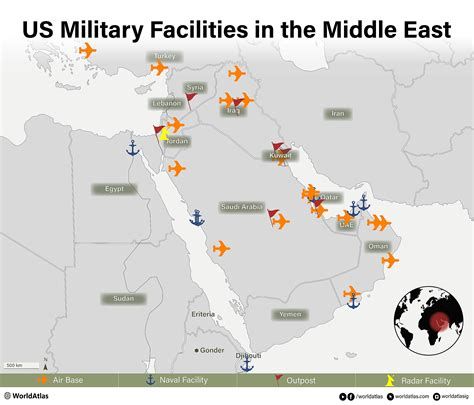
US military positions in the Persian Gulf
The US maintains over 40,000 personnel in the region across nearly 20 installations, from Jordan to Oman. Roughly 20 major sites are spread across the region.
Bahrain is the Naval centrepiece, as the official headquarters for the US Navy’s Fifth Fleet and US Naval Forces Central Command (NAVCENT). It coordinates all the maritime corridors from the Persian Gulf and Arabian Sea to the Red Sea. Other US Army and Air Force assets are stationed across Kuwait, Qatar, and neighbouring Gulf nations. Situated in Doha, Qatar, is the Al Udeid Air Base, the largest US military base in the Middle East, and it acts as the forward headquarters for US Central Command (CENTCOM).
The recent “special military operation” in the Gulf has exposed the vulnerabilities of these US facilities, with incoming Iranian missiles targeting a total of 200 US military installations, and six American service members killed in March. The Pentagon has expended over 1,000 advanced air-defence interceptors, severely straining global stockpiles of Patriot and THAAD systems. The Pentagon projects that the Iran war will tally approximately $37.5 billion by late September, excluding the cost required to reconstruct heavily compromised complexes
Trending Stories
The scale of damage has made the Pentagon official reconsider the deployment and positioning of the assets. A section of the Pentagon is considering repositioning military personnel and hardware further westward towards Jordan, Israel or Saudi Arabia’s Red Sea coast. Some discussions centre on the closure of bases in Kuwait, while transferring forces from the UAE, Jordan, and Bahrain to safer zones outside the range of Iranian missiles and drones. A separate recommendation envisions relocating additional US military capabilities to Israel’s Ovda Airbase, though there are concerns about Israeli espionage and exposure to counterintelligence.
What does it mean for Tehran?
The Gulf nations have been substantially dependent on the US capability to provide security. Some of them are unorthodox cities with no domestic capabilities and possess no traditional source of food and water. They depend heavily on the trade routes to maintain the illusion of being safe financial hubs in the desert. Now, a US reduction of troops will not explicitly strain the relationship, but pragmatically they would turn towards the next bigger power in the region, Iran, for security. So the war might allow Iran to emerge as one pole of power in the Gulf, while Israel might absorb the US military capability, entangle itself within the US military-industrial network and emerge as another pole.
Key House Democrat refuses to clear $2.8 billion bomb sale to Israel
Top Foreign Affairs Democrat Gregory Meeks has “questions” about how these munitions could be used in densely populated areas of Gaza and Lebanon.
U.S. Rep. Gregory Meeks (D-NY) speaks to members of the media at the U.S. Capitol Building on May 21, 2026 in Washington. (Photo by Andrew Harnik/Getty Images)
All of us who are white skinned know of historical abuses committed during colonisation of non-white nations. But we continue to abuse non-white people who live within our communities, even though the majority contribute massive benefits to our way of life as our fellow human beings.
I just learned of historic atrocities committed within the United States as a white supremacy backlash against the growing success and prosperity of black communities.
Drowned Towns: The Black Communities Erased by Water
Mar 27, 2025
Throughout history, Black communities in America have built thriving towns—only to have them stolen, destroyed, and erased. In five such cases—Oscarville, GA; Ferguson, SC; Little Egypt, NC; Vanport, OR; and Kowaliga, AL—entire Black towns were forcibly emptied and submerged under water, often under the guise of “progress” or public works projects. What were once bustling communities filled with homes, businesses, schools, and churches now lie buried beneath lakes, their histories nearly forgotten.
These were not accidents. Whether through violent racial expulsions, unfair eminent domain seizures, or deliberate neglect, the residents of these towns were forced from their land with little to no compensation. Their loss meant more than just the destruction of homes—it was the theft of generational wealth and culture.
Today, these lakes serve as recreational spots, their dark past hidden beneath the surface. But the stories of the families who lived, worked, and built their lives in these places must not be lost. This is their history.
Oscarville, GA → Lake Lanier
Oscarville, Georgia, was a thriving Black community in Forsyth County, home to farmers, shopkeepers, and skilled laborers. However, in 1912, white mobs terrorized the town after a white woman named Mae Crow was allegedly assaulted. Two Black men, Ernest Knox and Oscar Daniel, were lynched, and white residents launched a campaign of racial violence.
The Black residents were driven out at gunpoint, their homes burned, and their land stolen. Many were forced to flee in the middle of the night, leaving behind farms, churches, and schools.
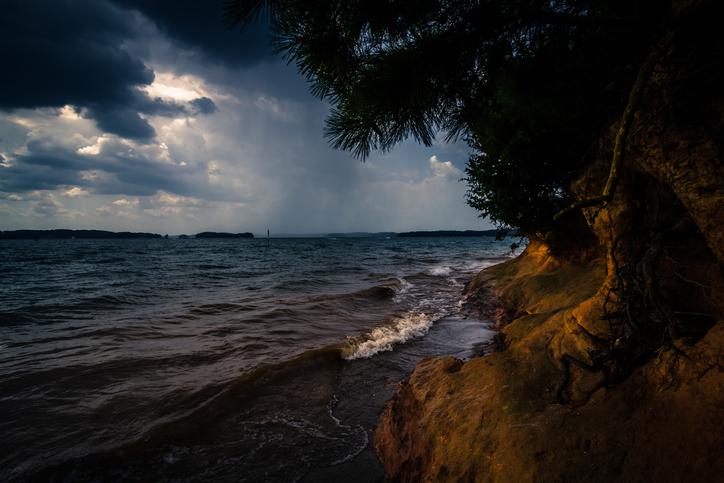
Decades later, the U.S. Army Corps of Engineers flooded the land in the 1950s to create Lake Lanier, erasing the remnants of Oscarville. Families who had owned property for generations received little or no compensation, and the descendants of those displaced still struggle to reclaim their stolen land.
Survivor Account:
One survivor’s descendant, George Rucker, recounted the fear his grandmother felt as a child when her family had to leave Oscarville. “She remembered the night the men came to their home, torches in hand, telling them they had to go or they’d be killed. They left with just the clothes on their backs.”
Lake Lanier has a notorious reputation for unexplained drownings and accidents, which some believe are tied to the violent history of Oscarville.
All of the human race originated in Africa. We are one people – each has equal value. Our ancient ancestors did not strive to survive in order to destroy one another over artificially created belief systems, motivated by greed and desire for power over one another.
There’s a city buried under Lake Lanier (Georgia’s biggest lake), and submerged with it is a secret: An American horror story filled with terror, death, genocide, and ghosts.
If you spend any time in or around Atlanta, you’ve heard tales of Lake Lanier. There are eerie accounts of fishermen seeing ghostly kayaks floating on the water, or women with no hands roaming the Jerry D. Jackson Bridge. Every so often, someone loses their life at the lake and leaves behind stories of good swimmers being snatched under the water, unexplainable boating accidents, or vehicles crashing into the lake without cause.
Many folks who live close by will tell you straight up, “Don’t go to Lake Lanier.” And its death toll certainly validates their point. There have been well over 500 deaths since the lake’s inception and more than 200 since 1994. Whether the lake is cursed or not is entirely up to you. But, one thing’s for certain, its horrifying past adds a much-needed perspective to understanding its haunting present.
Long before Central Park became New York City’s most iconic green space, its land was home to a thriving, self-sufficient settlement known as Seneca Village. Founded in 1825 by free African Americans, the community represented one of the first significant concentrations of Black property ownership in Manhattan. At its height, it was home to about 225 residents, multiple churches, schools, and cemeteries. But by 1857, the entire village was destroyed through eminent domain to make way for Central Park. For more than a century, Seneca Village was all but erased from history.
Seneca Village was established on land purchased from John Whitehead, a white farmer who began selling off lots in 1825. The first recorded African American buyer was Andrew Williams, a 25-year-old shoeshiner who purchased three lots for $125. That same week, trustee Epiphany Davis of the African Methodist Episcopal Zion Church acquired twelve lots, and soon after, the church itself purchased additional land. These early acquisitions laid the foundation for a settlement where Black New Yorkers could own property, vote, and escape the intense racial hostility of downtown Manhattan.
Following the abolition of slavery in New York State in 1827, more African Americans moved to Seneca Village. By the 1830s, displaced residents from nearby areas, also joined the community. Later, waves of Irish and German immigrants, many fleeing famine and economic hardship, settled alongside Black residents, creating a rare example of a racially and ethnically mixed community in the mid-19th century.
By 1855, Seneca Village had 52 houses, with some built on stone foundations. Archaeological evidence suggests that the homes were well-built and stable, contradicting claims that the area was a “shantytown.” Many residents grew vegetables in gardens, raised livestock, and relied on natural resources like Tanner’s Spring for fresh water and the Hudson River for fishing.
Artificial intelligence has advanced rapidly in recent years, but the technology’s potential long-term risks are also drawing fresh warnings from some of its pioneers.
Geoffrey Hinton, referred to as the Godfather of AI, has said it is ‘not unreasonable’ to predict that it could wipe out humanity within the next decade.
Speaking to the BBC’s Newsnight, the Nobel Prize-winning computer scientist put the probability at around 10%, while stressing that there was no reliable method for calculating such a risk.











You must be logged in to post a comment.