The Mole Rat

I noticed a series of mole hills on my walk today. We don’t get many signs of moles as they have to find land with plenty of worms in, so they help me identify where that land is. I usually gather their beautifully tilled soil and add it to the top soil of my garden, which has a shortage of depth of soil, since it is full of rocks. That also means I welcome the mole in my garden as I have no precious lawn to protect. Yes, some of the roots of my plants do get eaten, so I lose a few plants. But, as my garden is full of prolific cottage garden plants that is no problem either.

I always thought this underground beastie was blind, even eyeless. Now I know so much more since researching this creature, I will share what I have found with you.

The mole rat evolved during the Pleistocene Epoch (around 2.6 million years ago). Europe had about the same climate as it does today. It was wild and untamed, with vast forests, teeming with wildlife. There were huge herds of herbivores hunting for prey, the scene was like Africa today. Amongst the wild animals were lions, cheetahs, jaguars, and hyenas. Around 1.8 million years ago, the climate began to cool down until the Arctic ice cap expanded. The forests died back, replaced by open tundra, killing off the animals which could not survive the colder temperatures. The ‘European’ animals such as bears, wolves, foxes, and lynxes survived along with our little mole rat.

As with all Pleistocene animals they differed across the planet. In the UK we have the European Mole (Talpa europaea). Talpa europaea is found throughout temperate Europe, from Great Britain in the west to the Ob and Irtysh rivers in the east in Russia. It is a mammal of the order Soricomorpha. It is also known as the Common Mole and the Northern Mole.

It has a cylindrical body and is around 12 cm (5 inches) long. Females are typically smaller than males. The eyes are small and hidden behind fur, while the ears are just small ridges in the skin. European moles with white, light grey, tan, taupe, and black fur have all been reported. The nose is bare with the exception of sensory whiskers. They have well-adapted front limbs for digging. The front feet have 5 strong claws and are permanently turned outward. The teeth are designed for the predation of worms and insects, so the upper jaw and lower jaw are full of incisors and molars to do the job. The long snout of the animal is supported by a special bone developed from the plate of gristle which separates the two nostrils from each other.

In a study of the mole eyes it was found that Talpa withdraws when exposed to a flashlight and it can also perform light/dark discrimination tasks. It can identify if its tunnel has been damaged by a predator. The ears, well protected by fur, can pick up a range of low frequencies and it is thought they act as balanced, pressure-difference receivers.

Talpa europaea individuals live solitary lives except during breeding season, and actively defend their territory. European moles are nocturnal, hunting prey and remaining active only at night. Moles usually have three periods of rest and three periods of activity every 24 hours.

Mating occurs during a short breeding season in the spring (March to May). Gestation lasts four weeks. The young are born around mid to late April. Usually there is a single litter per year. Each litter has two to seven young, born blind and hairless. The mother nurses her young for about a month. The breeding nest of the female is usually located under a smaller soil mound than that of the main nest and has fewer galleries. Fur starts to grow at 14 days, and eyes begin to open at 22 days. Talpa europaea young grow rapidly and reach their adult size in about three weeks. The young begin to leave the nest at 33 days, and disperse from their mother’s range around five or six weeks after birth. Moles are sexually mature during the breeding season in the spring following birth. At five or six weeks after birth, the young disperse above ground to find their individual territories. This is the part of the mole life cycle at which they are most vulnerable to predators.

At this time of year, with the weather getting colder,the moles build their burrows deeper in the ground to find warmth. However, they do not hibernate and remain active throughout the winter.

Female and male moles have different systems of constructing burrows. Females build an irregular network, where males tend to build a long, straight tunnel with others branching off of it. European moles are known to build “fortresses,” structured mounds containing more than 750 kg of soil at times. Internally, the fortresses contain one or more nest chambers and a network of tunnels.. The nest consists of an enlarged section of the burrow, filled with dry grass or dead leaves which fill the nest chamber. The nest has no regular entrances and if used in successive seasons then it will be replaced by another one built on top of the old one. The leaves are connected from the surface by the mole pushing its head through the roof of shallow runs, seizing any within reach and dragging them down. Moles injure the front end of worms to the point that they cannot crawl away, then store them in the nest until needed. The speed with which the mole can get itself below ground is astonishing. A rooting action with the head and snout along with some tearing actions of the front feet, get the head and shoulders down, then with two or three strong heaves the rest of the body follows.

Here is a description of the burrowing technique of this amazing creature:

From http://hedgerowmobile.com/mole.htm

When it burrows near the surface where the ground is loose, much of the earth is not thrown out but compressed into the sides and roof first with one fore foot then with the other. The roof being slightly raised causing a surface ridge that marks out the course of the burrow. When digging deeper then the feet are brought forward on each side of the snout alternatively and the earth is pushed, with the help of the hind feet, back behind the body. When a plug of loosened earth has accumulated behind the mole, it performs a kind of cramped somersault which turns it around and begins the soil to the nearest up shaft by holding one forefeet in front of itself and walking on the remaining three legs, changing its pushing foot every now and then. The powerful muscles of the shoulders and fore limbs allowing the mole to push a load of soil that weighs much more then the mole itself. The soil that is pushed up the up shaft creates the typical mole hill with the latest being pushed out through the centre and spilling out over and cascading down the sides.

Despite their subterranean and solitary lifestyle, these moles seem to be aware of the presence and behavior of their neighbors. Moles usually remain within the confines of their own tunnel system except during mating season. However, experiments have shown that if a mole is removed from its territory, neighboring moles will rapidly take over this area. If two moles encounter each other during a time other than the breeding season, a fight usually occurs, and this can be savage. But moles try hard to avoid one another.

There are three methods used by moles for obtaining food. These include 1) digging in the soil, 2) walking through the burrow system, and 3) searching on the surface of the ground. Like many creatures, the daily preoccupation is in search of food. Earthworms are the main target, yet there is no evidence to show they cause a decline in earthworm numbers leaving the land devoid of them.

Moles also eat both larval and adult insects and I find plenty of these when I am digging over the garden, so there is no shortage of food for underground living creatures.

Humans remain the number one threat to moles, however, as they are considered agricultural pests and are actively persecuted. Poison is still one method of killing them in a slow and painful death. Alternatively traps.

European moles are hosts for a number of parasites, including fleas, ticks, and worms. Moles are hosts to the largest British flea and can measure as much as 6mm long. But if we eradicated moles we humans would find many insects which are dangerous to us if they multiply, would overwhelm us.

Of course, just as the soil is aerated by worms, so the mole eats the worms but also aerates the soil. The soil benefits from the impact of both the insectivore and the great builder, the earthworm – a builder of fertile topsoil, itself the sustainer of all civilization. A subject of a later blog to be sure.

Posted in anthropocene | Tagged , , | Leave a comment

Red-Legged Partridge

Our annual visitors, the Red-Legged Partridges came pecking by outside our window last week. They were pecking the grass seeds and we had a good close-up view from our low set windows with deep window sills. Any movement from us would startle them, but all my plants in the window area conceal our presence. On I go to the Internet and gather information from various sites, then use my old trusty nature books. Gradually I piece it all together to help me record and understand these delightful birds.

The Red-legged Partridge (Alectoris rufa) is a gamebird in the pheasant family Phasianidae of the order Galliformes, gallinaceous birds. It will have likely developed, like the pheasant, during the glacial periods of the Pleistocene era.

It is sometimes known as French Partridge, to distinguish it from the Grey or English Partridge. It was brought here from France in the 1770s and has become a successful breeder in the UK. Unlike the pheasant it cannot be farmed easily in preparation for the shooting season. Instead it flourishes in the wild. It is a popular gourmet bird for the restaurants, but I prefer to think our local birds are not easily spotted by the hunters.

This is a charming, amusing bird.and extremely handsome like the pheasant, its relation. It has bright red legs and red bill. The body is marked with shades of grey and brown broken by distinct cream and black. There are bold bars on its flanks with a chestnut coloured tail.

This bird is a successful breeder because the female lays two separate clutches of about 10 eggs, and the female incubates one nest and the male incubates the other. Within a month they hatch and the young birds fly two weeks later.

It is as if they know the shooting season has ended as between September and February they get busy breeding. They hide their nests in dense bracken or other thick cover. Partridges roost together. facing outward to watch for predators. They fly off at the earliest sign of trouble. Their group is called a ‘covey’. They run along together, pecking at what grass seeds and roots they can find.

The game bird rearers have found this bird difficult to breed, unlike the pheasant. Instead it has a reputation for increasing numbers around the UK being left to its own devices. The RSPB thus list it as a UK wild bird, unlike the pheasant (see earlier blog).

Posted in anthropocene | Tagged , , , | Leave a comment

The Language of the Watershed

I was relaxing watching ‘The Lord of the Kings’ Trilogy this past week whilst wintry weather raged around our cottage. It seemed to me that Tolkien was using the landscape of Scotland to invent his mythological Hobbit landscape. I then watched the documentary about Tolkien and it became apparent he never referred to Scotland as an inspiration. Nevertheless, the last time I watched this film I was in England. Now I am in Scotland it seems incredible that he did not draw on the 300 years of violent warfare in the Scottish Borders during the Medieval Period. James 4th of Scotland was the last Scottish King to speak Gaelic. To quote http://www.undiscoveredscotland.co.uk,
An Act of Parliament in 1597 was typical of James’ approach to “civilising” the Gaelic areas of Scotland. This leased the Island of Lewis to lowland nobles called the Fife Adventurers and authorised them to use all means necessary, including what would today be called genocide, to “root out the barbarous inhabitants”.

As Scots replaced Gaelic, and as Gaelic became a forbidden and considered ‘backward’ language, all evidence of Gaelic words slipped away from use in the Borders during the didactic reign of James 6th of Scotland, 1st of England. But Gaelic remains to describe this ancient landscape because, I think, they could not use Scots to describe it any more poetically, nor accurately.

Reading the wonderful travels of Peter Wright as he describes his journey across the Watershed of Scotland, I decided to pick out all the landcape descriptive words which remain the names of landmarks along the Watershed. None is repeated. Each one defines the shape and often past historical use of the land. To me the language is very beautiful. Tolkien invented his own language for the Elves to speak. He used his knowledge of countless languages he had learned. Surely the end result sounds more Gaelic than anything else?
Borders words

Bucht: a sheepfold

Carlin Tooth: witch’s or old woman’s tooth

Causey: crown or prominent place

Cote: a house or cottage

Dean: a small valley or defile, sometimes shortened to ‘den’ as on Dryden or Frogden

Fell – from Fjall: Viking word meaning a mountain

Gill: a ravine with a stream running at the bottom

Hart: deer

Hass: a narrow place

Haugh: an open, often flattish parcel of land, sometimes by a river or stream.

Hope: a hollow found amongst the hills

Knowe: a kind of hummock

Law: a rounded hill of somewhat conical shape, and frequently conspicuous among others

Mains: from the French ‘demesne’ (originally from the Latin ‘mansio’) meaning home or central farm.

Pap or Ciche or cioch: hills resembling breasts

Peel: boundary or border

Pow: head

Rig: a ridge, but also used for old style cultivation areas and often found in farm names

Shaw: a flat piece of ground at the foot of a hill

Sheils: a permanently occupied hill farm or holding

Sheiling: temporary huts for shepherds

Swire: a sheep pass between two hills, as in Redeswire

Sike: a marshy bottom where several small streams rise

Whiteyard Head: hill of the old white mare

Highlands

Aonach Eagach ridge: notched ridge

A Cruach: the heap or stacks

A Chailleach: the old woman

Allt Synbaich: rough stream of the broom

Bealach Cumhain : narrow bealach

Bealach Dubh Leac: bealach of the black slab or grave

Bealach na h-Imrich: bealach of the flitting or moving house

Beinn Achaladair: mountain of the soaking field

Beinn Chabhair: mountain of the antler or hawk

Beinn a Chreachain: mountain of the clam shell

Beinn Dorain: hill of the streamlet

Beinn nan Ramh: hill of the oar

Beinn Liath Mhor Fannaich : the big grey mountain of Fannaich

Beinn Dearg: red mountain

Beinn Direach: the straight or upright mountain

Beinn an t-sithein: the sharp pr cone shaped mountain or the fairy mountain

Beinn Tharsuin: transverse hill

Ben Alder: mountain of the rock or water

Ben Arrow : the long mountain (also known as Beinn Fhada)

Ben Dubhchriag: mountain of the black rock

Ben Hee: fairy hill

Ben Griam Beg: small dark hill

Ben Lui: mountain of the calf

Ben Oss: mountain of the stag

Bidein a Choire Sheasgaich: little peak of the corrie of the barren cattle

Bidein Clann Raonaild: the pinnacle or boundary of Clan Ronald

Biggar: soft land

Braemore: big upper part

Breabag: hill with cleft or little kick

Cadha Dearg: red pass

Carn Liath: grey hill

Cloich Bheag: peak of the little breast

Cnoc Biodaig: hill of the dirk

Cnoc na Moine: hill of peat

Cnoc na Ghlas Chlille: hill of the green forest

Cnoc na Saonhaidhe: hill of the fox’s lair

Coire Gaothach: windy corrie

Colan: the companion’s nose

Creag nan Damh: rock of the stags

Creag an Duine: crag of the man

Creag Ghrianach: sunny craig

Creag Megaidh: bogland crag

Dirrie More: the great ascent

Eididh nan Clach Geala: covering or web of white stones

Fionn Bheinn: white mountain

Garbh Chloich Mhor: big rough place of the breast

Glen Docherty: place of scouring

Glen Douchary: the black and broken moor

Gobernuisgach: branching river of the waters

Groban: top of a rock hillock or a mugwort

Guilann: the shoulder

Iorguill: the uproar or skirmish

Knockfin Heights: heights of the fair hill

Loch Braigh na h-Ainhne: the loch of the hill of the river

Loch a Chroisg: loch of the crossing

Loch an Daimh: loch of the connection

Loch an Droma : loch of the ridge

Loch an Laogh: loch of the calf

Loch Mhadaidh: loch of the dog

Meall a Bhuird: hill of the roaring

Meall a Bhuirdh: hill of the roaring

Meall a Bhuirich Rapaig: hill of the bellowing stags

Meall nam Bradham: hill of the salmon

Meall nan Ceapraichean: hill of the lumps or little tops

Meall a Charra: hill of the friend

Meall na Feith Faide: hill of the longest bog

Meall an Fheur Loch: loch of the hill of the cattle grazing

Meall Liath na Doire: hill of the grey thicket

Meall nan Ruadhag: hill of the young rose

Meall nan Uan: hill of the lamb

Mhaoraich Beag: little peak of the shellfish

Moine Mhor: big morass

Moss maigry: moss of the big paw

Rappach: the noisy place

Rhidorroch: the dark hill slope

Sail Riabhach: brindled or grizzled heel

Scaw’d Law and Meall Oldhar: dappled hill

Seana Bhraig: the old mountain or old upper part

Sgonnan Mor: the big lump

Sgurr a Bhealaich Dheirg: peak of the red pass

Sgurr Breac: speckled mountain

Sgurr nan Ceannaichean: peak of the merchants

Sgurr nan Ceathreamhnan: peak of the quarters

Sgurr nan Chaorachann: peak of the field of the berries

Sgurr Choinnich: mossy peak

Sgurr na Ciche: peak of the breast

Sgurr nan Clach Geala: peak of the white stones

Sgurr nan Coireachan: peak of the corries

Sgurr an Doire Leathain: peak of the broad thicket

Sgurr nan h-Eige: of the file or tooth

Sgurr an Lochain: peak of the little loch

Sgurr Mhurlagain: hill of the wool basket

Sgurr Mor: the great peak

Skein dubh: Knife

Sron Leachd: nose of the grave

Stob a Choire Oldhair: peak of the dun corrie

Stob Ghabhar: peak of the goat

Stob nan Losgann: post of the toad or wretch

Stob Poite Coire Ardair: peak of the pot of the high corrie

Strath nan Lon: strath that is worthy

Stronend: end of the nose

Tomtain: hill of fire

Toman Coinnich: little meeting or assembly

Tom nan Broc: hill of the badger

Uisge Labhair: loud water

Posted in anthropocene | Tagged , , , , , , , , , , , , | Leave a comment

Fungi, Lichens and Mosses

We have endured heavy winds and rain here in the Scottish Borders for a few days. All is calm tonight, with a bright moon lighting up the fells around us. The Forestry gamekeeper will be out looking for deer to kill tonight, before midnight. I hope he does not see them.

Today the sun shone with winter fierceness, low in the blue clear sky. I used the opportunity to take photos of the beautiful lichens and mosses which grow everywhere here, on rocks and trees. Our dry stane walls are crammed with lichens and mosses which have taken hold since they were built, back in the mid 1800s.

I have spent many hours researching these wonderful life forms and now have a better understanding of the differences and purposes they contribute to the environment.

It seems best to start with Fungi as they have inhabited our planet for millions of years and have survived the two great extinctions. They are a constant in our world. Fungi are life giving and life taking. We would not exist without them; yet they can kill us.

Fungi began as simple organisms existing in lake and river water then worked with plants also in the water to interweave their fine threads around their roots. That relationship encouraged the plants to grow in the land using ‘fungus roots’ or ‘mycorrhiza’.

DSCF0022
What we see above the ground, such as toadstools and mushrooms is only a tiny part of what lies below ground. Mushrooms and the like are the spore bearing bodies produced by the mycellum which is the hidden parts of fungi below ground. The mycellum is a mass of filaments which are known as hyphae and their bunching together is called the mycellum. The spores are the result of the reproductive process which fungi are constantly working toward.

Fungi work imaginatively. A single mushroom sheds millions of spores, which are usually dispersed by wind, rain or contact with insects and other animals. The ‘Stinkhorn’ mushroom, emits a smell of rotting flesh. Attracted by the smell, carrion flies and beetles visit it and the spores are embedded in mucus which sticks to the visitors’ feet. Spores are then deposited wherever the insect lands and so are widely dispersed. In Brazil, there is a fungus which can infect ants such that their filaments extend out of the ants brains. Only when they have controlled that brain and directed the insect to a suitable location for fungi to grow do they kill their mobile carrier and develop their own progeny on the chosen location.

Fungi can take many forms above ground such as coral-like shapes, puffballs, brackets, cups, flat sheets of tissue or gelatinous blobs. They may also be a single-celled yeast fungi, so tiny these are known as ‘micro-fungi’. All forms are the resultant reproductive manifestation.

Anyone who want to make their own fungi (yeast) for making bread could try this (which I took from a bread making forum)

Ingredients

1/2 teaspoon honey
1/2 cup whole wheat flour
1/2 cup non-chlorinated water (such as bottled)

1/2 cup whole wheat flour
1/2 cup non-chlorinated water (such as bottled)

Directions

1 In a glass or ceramic bowl, mix together the honey, 1/2 cup whole wheat flour, and 1/2 cup of water. Use a wooden spoon to stir. Cover lightly, and place in a warm place. Stir twice a day for 5 days.

2 On the 6th day, mix in 1/2 cup of water and 1/2 cup of flour using a wooden spoon. Don’t worry about lumps, for the yeast will eat them! Cover and let stand in a warm place to ferment for 1 day. When you get lots of bubbles and foam on top, you know the starter is active and ready to use. The starter will separate with the flour on the bottom and ‘hootch,’ a yellow liquid, on top. Just mix well before using or feeding.

3 Store starter in a wide mouth glass jar. I use waxed paper and a rubber band in place of a lid, as metal utensils or containers will contaminate the starter. Once refrigerated, the starter only needs to be fed once a week. Use half, and feed the remaining half to keep it alive for the next time

This describes the need for fungi to be kept alive in order to multiply.

Outside, wherever I look, I now know fungi are busy.

Fungi fulfill an important role breaking down dead material. Also, as they cannot photosynthesise, they scavenge instead, absorbing mineral salts and other
nutrients such as organic phosphate from the surrounding soil, which they in turn make available to their host plant. Fungi can also protect host plant roots from grazing by invertebrates. In exchange the fungi receive sugars, carbohydrates and vitamins created by their host plants during photosynthesis.

Fungi provide food and shelter for many insects and other creatures. One creature, a human forager who knows what he or she is doing, can collect mushrooms for food and create appetising meals.

In researching fungi, I found, to my horror that my recently planted Rhododendron. ponticum (the common rhododendron) was carrying a harmful fungus as well as itself being an enormous threat to so much I hold dear in my environment.

It grows particularly well in this climate and acidic soil and we often have high humidity. These elements are found predominantly on the west of Britain and Ireland. An association with a mycorhizal fungus enables it to assimilate nutrients more effectively than associated species.

Now there is a new concern that the plant is host to two deadly new plant diseases from the phytophthora fungus – known as the plant destroyer. Phytophthora ramorum was blamed for a plague of sudden oak death in California in the 1990s. “It has been estimated that within twenty years phytophthroa could be in every garden in the UK and have a severe impact on our lowland and upland heath.”

I have had to dig out my rhododendron. Another danger this toxic plant threatens to do is to potentially grow and extend itself down into the nearby burn. Over the years it could cause the death of water voles, trout and river bank creatures, flora and fauna. I could not have had that on my conscience. Understanding about fungi has made me think of the Chinese concept of the two opposing principles in nature: Yin and Yang.

“Yin and yang are opposite in nature, but they are part of nature, they rely on each other, and they can’t exist without each other. The balance of yin and yang is important. If yin is stronger, yang will be weaker, and vice versa. Yin and yang can interchange under certain conditions so they are usually not yin and yang alone. In other words, yin can contain certain part of yang and yang can have some component of yin. It is believed that yinyang exists in everything.”
From Jun Shan

Lichen

No wonder I never saw Lichens when growing up in Leeds, a city of black soot which dirtied clean washing on the line and made most of the population ill with respiratory disease. Here I see plenty of lichens. Wherever pollution increases so the lichens reduce and die. Well, I can’t imagine Leeds before pollution. Here in the Scottish Borders the air is clean and I know so, because lichens are wonderful indicators of air quality. My asthmatic condition has virtually cleared up since we came to live here, though I have to manage it still with inhalers.

A Lichen is fungi and alga in a symbiotic relationship.

First, an alga is like a plant, but not a plant. It is able to photosynthesise, but it is not as complex as a plant. Each has a nucleus surrounded by a membrane in which are organelles which manufacture and store important chemical compounds used by the cell – these are named plastids. The plastids are responsible for photosynthesis. Plastids are thought to have originated from endosymbiotic cyanobacteria. The symbiosis evolved around 1500 million years ago and enabled eukaryotes to carry out oxygenic photosynthesis.

We know fungi cannot photosynthesise.

Lichens are a mutualism formed between fungi and blue-green alga. Alga (called the photobiont or phytobiont) and fungus (called the mycobiont), result in a form called a thallus (plural: thalli) that is completely unlike either of the two.

There are three types: crustose, foliose or fruticose. The first cannot easily be removed from the bark or rock it is attached to; the second is a leaf-like structure, often found growing on a forest floor; the third is like a tiny tree.

One way they reproduce is to separate a piece of the thallus containing both alga and fungus and send it off by wind or water to develop in a new place. This kind of reproduction is common among lichens and generally effective. Those with structures known as ‘fruit bodies’ forcibly discharge tiny spores to a height of a few millimeters where they have a good chance of becoming airborne. Reproduction by spores is a risky business as, on landing and germination, they need to meet the right algal partner before they can form a new lichen.

The oldest certain fossil lichen is Early Devonian (about 400 million years old) from the Rhynie Chert, near Aberdeen, Scotland (Taylor et al. 1995). Scotland has an amazing diversity of lichens, with just over 1500 species. Clean air, diverse habitats, relatively cool summers and mild winters all contribute to this diversity and abundance. Scotland is important for lichens on a European and even global scale.

The West of Scotland has a unique climate. The land is influenced by the surrounding seas, the warmth of the Gulf Stream and results in a combination of extreme humidity, abundant rainfall, persistent cloudiness, cool summers and mild winters. These conditions are ideal for lichens and many rare types are found only in Scotland.

We face the west and that is an ideal position for the lichen to flourish. We are also close to the edge of glades and woodland margins, so lichens are growing on ground, trees, rocks, fences – everywhere I look.

Some crust-like lichens on rocks have a ‘legendary slow’ growth rate, sometimes as little as 0.1 mm per year. If left undisturbed some of our rock-dwelling lichens may be many hundreds of years old. Even when we have had droughts, though they love wet places, they can survive extremes of heat and cold. We know they can survive ice and snow, and are therefore able to grow here in the mountains.

Scottish lichens are many colours: white, grey, black, yellow, orange, sulphur, apple-green, pink or scarlet. They are completely different from the mosses and liverworts with which they often grow. The majority of mosses and liverworts are green, leafy and photosynthesise their own food.

DSCF0019
Lichens find an opening, however, where there has been disturbance perhaps associated with peat cutting, drainage or fire. Drier faces, ridges and baulks of peat are rapidly colonised by a range of attractive species. Particularly noticeable are a suite of red-fruited Cladonia species with common names such as Scarlet cups, British soldiers or Bengal matches. Others have brown fruits and are branched like deer’s antlers, coral, or have fantastic ‘Disney-world’ shapes. Another series, the cup-lichens, again Cladonia species, have fruit bodies resembling trumpets or goblets. These Cladonia are common here.

The Thallus foliose, the pale grey variant, forma herinii, dominates our walls and sycamore bark.

Mosses

Most level ground in the west of Scotland is naturally covered with a deep layer of peat, known as blanket bog.The surface vegetation, a mixture of Bog Moss (Sphagnum). Around here, Sphagnum moss grows with other mosses on the walls creating wonderlands of landscapes in their own right. Close up viewing in the bright sunlight are utterly spellbinding. Amongst them grow lichens too, all adding to the richness of delicate shape and contours, finely integrating, incredibly alive and vibrant, no matter what the weather.

Within a few miles of our cottage, up on top of North Mid Hill and across to the Queen’s Mire, lie upland bogs. Bog mosses are always found where there is plenty of water which is mildly acidic. The bog moss grows to about 20 cm producing simple leaves. As the plant grows taller it dies at the bottom and eventually becomes a material called peat. Bog mosses are exceptional in the amount of water they absorb. Dry bog moss can absorb 20 times its own weight in water. Studies suggest that blanket peat began developing 5000 – 6000 years ago. Upland blanket bogs, like lowland raised bogs, are now protected through their designation as Special Areas for Conservation.

Mires exist as a result of a complex peat-forming system which lie over a particular landform. The rainfall supplies the water directly, and this is known as Ombotrophic. Peat bogs that are ombotrophic have less nutrients and more acidity because of it. Acid rain, caused by pollution containing higher than normal amounts of nitric and sulfuric acid caused by burning fossil fuels, will damage the sphagnum moss development. Every living thing which depend on the mire quality will suffer if polluted water falls in the form of rain, snow, fog, or mist. Britain is internationally recognised for its rare areas of Blanket Mire. Strange, then, that the Scottish Borders Council are even considering a wind farm to be built on the Queen’s Mire, famous historically for where Mary, Queen of Scots fell from her horse in the pouring rain as she tried to ride from Hermitage Castle back to her home in Jedburgh.

Upland raised bog is habitat to a wide variety of flora and fauna. Notable plant species include Bearberry (Arctostaphylos uva-ursi), Dwarf birch (Betula nana), Bilberry and Cowberry (Vaccinium spp), Sundews (Drosera spp) and the sphagnum mosses (Sphagnum spp).

Moss is a valuable addition to the forest floor: as it rots down, it creates a thin layer of peat in which other plants can germinate. It can also provide a habitat for insects and even amphibians: in a dry summer frogs and toads can survive deep down in the damp tussocks of moss.

Every part of the moss is permeated with minute tubes and spaces, resulting in a system of delicate capillary tubes, having the effect of a very fine sponge. The cells readily absorb water and retain it. The water can be squeezed out, but the Moss does not collapse and is ready to take in fluid again. The plant is not dependent on soil water, but also absorbs moisture from the atmosphere, and is laden throughout with water retained in its delicate cells.

DSCF0011
Mosses cover our dry stane walls surrounding our cottage, over the old stells (sheep folds or pounds), and on our sycamore and ash trees which stand tall by the burn. I cannot be sure of their names as I need a Hand Lens to look closely at their structure. I have sent for one today so that I can learn more about the mosses in my vicinity.

Posted in anthropocene | Tagged , , , , , , , , , , | Leave a comment

Bats around our cottage

As the winter draws in, Autumn having not been the golden wonder this year, we know our local Bat population will be in a state of near hibernation.

Researching this topic, as I do each one I write about in this blog, I am shocked to learn that Wi-Fi is a threat to the survival of Bats. I suppose I ought to not be surprised. They depend on echolation to hunt their prey, and our modern array of SMART devices are hungry for multi media carrying frequencies. 4G is coming on stream next, and we are familiar with masts for 3G, sited on ridges along the Watershed. Even the Wi-Fi router in our house may upset the Bats when they fly around our cottage.

I used to think Bats were flying mice. They are not. They are mammals and more closely related to humans than they are to mice. They are of the order Chiroptera. They are not blind either, although do not have sharp visual acuity. They do have a good sense of smell. In flight they flap their spread-out digits, which are long and covered with a thin membrane. They have receptor cells which are concentrated in areas of the membrane where insects hit the wings when the bats capture them. It is flight which has enabled bats to become one of the most widely distributed groups of mammals.

Where they have been found in fossils, they have been dated from the early Eocene period, 52.5 million years ago as in Icaronycteris found in 1960. They are so delicate it is not easy to find their remains in fossils.

Bats in the UK eat only insects, and insect eating bats tend to be smaller than other types of bat found elsewhere in the world, the largest of which can be the size of a small dog,

At this time of year they have begun their periods of torpor which last longer as the sun’s warmth moves farther away. Some begin hibernation, using stored fat as fuel, in a cool quiet place, hoping they won’t be disturbed.

Their call, produced from their larynx or voice box, is known as echolocation. It is on a frequency beyond human hearing. Some scientists believe that echolocation was used by a common ancestor of all the bats that exist in the world today. Some bats do not use this ability to navigate and hunt, instead they use the sense of smell and vision. But UK Bats do use echolation. Bat echolocation is a perceptual system where ultrasonic sounds are emitted specifically to produce echoes. By comparing the outgoing pulse with the returning echoes, the brain and auditory nervous system can produce detailed images of the bat’s surroundings. This allows bats to detect, localize and even classify their prey in complete darkness. At 130 decibels in intensity, bat calls are some of the most intense, airborne animal sounds.

Bat ears are sensitive to the fluttering of moth wings, the sounds produced by tymbalate insects and the movement of ground-dwelling prey, such as centipedes, earwigs, etc. because of the ridges in their ears helping to sharply focus the echolocation signal.

Tiger moths produce ultrasonic signals to warn the bats they (the moths) are chemically protected or aposematic, whilst the moths Noctuidae have a hearing organ called a tympanum, which responds to an incoming bat signal by causing the moth’s flight muscles to twitch erratically, sending the moth into random evasive maneuvers.

The small greater horseshoe bats and lesser horseshoe bats, which live in the UK are genetically more closely related to the families of fruit bats. There are at least nine species of bat to be found in Scotland whereas the United States is home to an estimated 45 to 48 species. The most numerous and familiar of the nine species in Scotland are pipistrelles, which can be seen flitting about near woodland or open water at dusk, in search of midges and other flying insects. A single pipistrelle can consume up to 3,000 midges in one night! I think it is the pipistrelles which populate our banks and burn, with moorland and forests to create a good source of insects. As someone who gets badly bitten by midges, living by water and woodland as we do, I welcome the strenuous hunting by night of the bats flying in crowds around our cottage. The swallows and house martins do their bit for me during the warm summer days. Thus by hunting at night, they are not in competition with birds, and travel large distances of up to 800 km in their search for food.

Bat roosts can be found in hollows, crevices, foliage, and even human-made structures, and include “tents” the bats construct by biting leaves. The conditions must meet the bats’ social and reproductive requirements. Most years we see them in their social groups but we are not sure where the maternity roosts are located. Maternity roosts are set up late May to early June for the adult female bats to give birth and rear their babies. Female bats nurse their young until they are nearly adult size, because a young bat cannot forage on its own until its wings are fully developed. As soon as the young start to fly these maternity colonies begin to break up and the bats move to other roosts.

We don’t know enough about our bat population. They may not be breeding here, merely passing by in colonies to eat. Any major disruption during the summer breeding site could potentially wipe out all the females from the area. The male bats typically prefer to live alone or in small groups in cooler sites. During late summer male bats set up territories around a mating roost, to which they attract females. We can’t say whether we have male or females, or if breeding has been going on. But we do see plenty of bats most years. This year, due to it being exceptionally wet and often unseasonal frosty weather we have not seen so many. Bats rarely fly in rain, as the rain interferes with their echolocation, and they are unable to locate their food. It has therefore been a bad year for their survival chances here in the Scottish Borders. Hopefully they found better conditions elsewhere in the UK.

Some bats only live in large woodlands, and a large forest within view of our cottage was felled a couple of winters ago displacing much wildlife. Perhaps we get fewer bats due to that catastrophic event.

Bats are pest controllers eating thousands of insects every night. They suffer if pesticides kill off insects which they would have fed on, so I do not use pesticides of any kind. One of the downsides for food supply is when farmers make hay into silage and that kills larval insects resulting in less flying adults available.

Bats drink by skimming the surface of a body of water, and lowering its jaw to get just one drop of water. They then skims again to get a second drop of water, and so on, until they have had enough. Its precision and control is very fine, and it almost never misses. They do this over our burn, catching water and the many insects which hover there too.

A couple of National Trust properties in the south west of Scotland have identified seven species at Threave and eight at Culzean . The former is known to support at roosts of two Scottish rarities – noctule and whiskered bat. The latter supports all but one of the nine species that regularly occur in Scotland.

But there are continuing signs of a decrease in bat numbers as natural habitats such as hedgerows, woodlands and ponds have been declining and fragmenting.

Bats are under threat from building and development work that affects roosts, loss of habitat, the severing of commuting routes by roads and threats in the home including cat attacks, flypaper and some chemical treatments of building materials. Other potential threats include lighting, radio waves from Wi-Fi or mobile phone masts.

Wind turbines have been the likely cause of deaths of bats too. Evidence suggests barotrauma is causing bat fatalities around wind farms. The lungs of bats are typical mammalian lungs, and unlike the lungs of birds, they are thought to be more sensitive to sudden air pressure changes in their immediate vicinity, such as near wind turbines, and are more liable to rupture. Bats suffer a higher death rate than birds in the neighborhood of wind turbines. Since there are no signs of external trauma, the cause has been hypothesized to be a greater sensitivity to sudden pressure fluctuations in the mammalian lung than in that of birds. In addition, it has been suggested that bats are attracted to these structures, perhaps seeking roosts, and thereby increasing the death rate.

We are fighting against a massive windfarm being built along the wild area of the high fells close to where we live. But the final decision is probably going to rest with the Ministry of Defence and the Eskdalemuir Listening Station, than to our cries of protest to protect the wild landscape.

Posted in anthropocene | Tagged , | Leave a comment

Fast flowing water; Grey Heron and White Throated Dipper

We live to the south west of Cauldcleuch Head, a 619 metres high ridge which is near the start of the Scottish Watershed (see Peter Wright’s ‘Ribbon of Wilderness’). It is a significant goal for many hardy hikers to aim for, they hope to be rewarded with clear views described by Peter Wright as looking:

“north over Hawick and into the mid part of the Tweed valley are inviting. The Eildon Hills still stand sentinel, and the northern rim of of this wide basin is marked with the flowing lines of the Lammermuir Hills, pointing tantalisingly towards the North Sea. Looking south, the Lake District fells maintain a familiar presence on the skyline. The view back over Wauchope Forest to the start of the journey leads to the familiar outlines on Deadwater Fell and the Larriston Fells, which mark the border with England. And, to the west, the clutch of steeply rounded hills on either side of the A7 at Mosspaul offers an inviting prospect.”

Madly, at this point I must tell you that an enormous number of wind turbines are being planned to be sited close to Cauldcleuch Head and Wauchope Forest.

The burn which flows by our cottage is a tributary to the Liddel Water and it is fed by smaller tributaries which trickle down from the higher slopes. The Liddel flows past (and often floods) the village of Newcastleton, a clearance village built on the flood plain.

This river then runs through southern Scotland and northern England, for much of its course forming the border between the two countries, and was formerly one of the boundaries of the Debatable Lands.

Liddel Water’s source is beneath Peel Fell in Roxburghshire, in the Scottish Borders, where it is formed by the confluence of Caddroun Burn, Wormscleuch Burn and Peel Burn (burn is the Scots term for a stream). Soon afterwards, the nascent Liddel Water is fed by Dawston Burn near the village of Saughtree.

Our burn runs close to our cottage but we are high enough above it not to get flooded. When heavy rains fall, or deep snow thaws and sends masses of water tumbling down the fells, the roar of the burn is so loud you can’t hear ordinary conversation. The burn changes shape year on year. It has become wider, eroding the banks dramatically, since we first came here 5 years ago. Chunks of grassy banks fall into the burn and expose rocky areas which also break and fracture. New banks form, others disappear. The winding curves change their path, cutting through new ground and silting up previously fast flowing areas.

All high points will one day erode to be flat; mountains will be silt in the sea. The skin of the earth changes and leaves little evidence of what went before unless it is a sun scorched area which has not been swept by water for millions of years. This area is more water than land already. The Watershed significantly delineates the East or West water directions to either the Atlantic or the North Sea. There are many bogs and water courses which have been tamed a little by strategically placed ditches to retain what roads there are from being broken and swept away each winter. Still, the potholes are something to be seen (or rather, we wish we did not have to see them!) but they add to the stresses of travel each winter and spring before they are fixed.

The Liddel makes a southwesterly course, through Newcastleton and on to Kershopefoot, where the burn begins to mark the Anglo-Scottish border.

The Liddel Water then flows into the River Esk at Willow Pool, beneath the earthwork castle of Liddel Strength near Carwinley, Cumbria in north west England.

Having water on the doorstep provides me with two familiar birds to see most of the year round – the Grey Heron and Dipper.

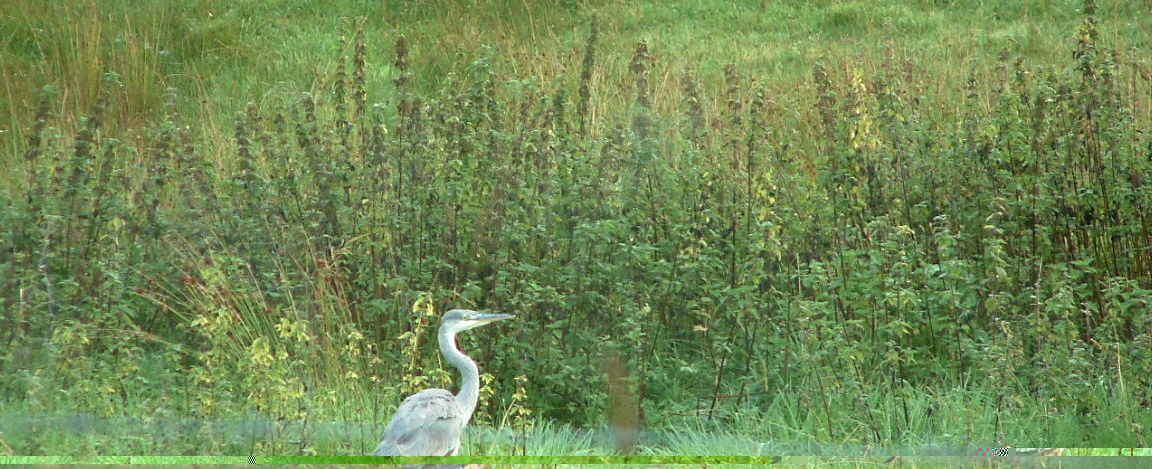
Heron viewed from our kitchen window

When my middle aged son (raised in a city) first saw the Heron, he gasped with shock and thought it was a pre historic creature, along the lines of a pterodactyl!

These long-legged freshwater and coastal wading birds are of the family Ardeidae. They are classed as a medium to large bird. To my son it was huge! When my Canadian relatives visited they were so used to seeing many Great Blue Herons they were unimpressed with our single Grey Heron; but it is the largest heron in Europe.

The Grey Heron’s bill is long, thick and dagger like. Its legs are yellow. So often my dogs arrive and disturb its vigil by the water. Then it will lift off displaying its up to 175 cm wingspan. Once in flight, unlike other long necked birds like storks, ibises and cranes, it will fold back its neck and bow its wings.

The discovery of feathers trapped in ancient amber suggests that some species of dinosaur may have possessed down-like feathers. These are the type of feathers (Powder Down) which the Grey Heron boasts. They offer a fine thermal insulator and padding.

The Grey Heron is a partial migrant, some arriving to winter here from Scandinavia. When they do migrate it is at night. Recently we heard a few at night making an incredible noise; perhaps these had just flown in.

After breeding they will sensibly disperse so as not to crowd the feeding areas for the colony. Being carnivorous, they wait patiently for aquatic animals such as fish, crustaceans, reptiles, molluscs and aquatic insects.

Once high on a fell I can watch the Herons on the burn below me, without disturbing them. They will sit motionless on the edge of or standing in shallow water and wait until prey comes within range. Having seen prey the head is moved from side to side, so that the Heron can calculate the position of the prey in the water and compensate for refraction, and then the bill is used to spear the prey.

They do have other techniques, but this is the only one I have observed. For example, the Grey Heron have been known to use bait in order to lure prey to within striking distance.

Dipper perching on a rock in the Billhope Burn

Except for rare drought periods here, the burn is usually a fast flowing rocky upland water tributary. It is ideal for Dippers as there are plenty of rocks and boulders which are constantly being dragged down from the high fells by the strong, sometimes furious, flow. The bird is a passerine, part of the order of Passeriformes, also known as perching birds. It is the skilful art of perching which strikes the observer. If you or I tried to perch on the slippery rocks we would be there for only a fraction of a moment before we fell in the burn.

The White-throated Dipper is Norway’s national bird. It is no wonder they love it. This charismatic bird is such a joy to have around. The Dipper (Cinclus cinclus) is a strong looking, small plump aquatic bird with a short tail. The head of the adult (gularis and aquaticus) is brown, the back slate-grey mottled with black, looking black from a distance, and the wings and tail are brown. The throat and upper breast are white, followed by a band of warm chestnut which merges into black on the belly and flanks. The bill is almost black, the legs and irides brown.

Dippers are not supposed to like acidic water yet the burn which flows by our cottage is most likely acidic as it flows from peat bog areas high on the fells. Completely dependent on fresh fast-flowing water, accessible food and suitable nest sites these birds are susceptible to problems such as water pollution, acidification and changes to the overall habitat. I have noticed their numbers increasing on our burn since the sheep and cattle were removed from the higher glen.

Dippers breed early in the year, and will often have laid eggs before the end of February, but may do so as late as May. They may even rear two broods if conditions permit. I could imagine the severe flooding we had earlier in the year could have destroyed an earlier nest.

The male has a sweet wren-like song. During courtship the male sings whilst he runs and postures, exhibiting his snowy breast, and when displaying he will take long and high flights. The breeding pair build a dome shaped nest out of straw and moss, and place it in a crevice below a bridge, behind a waterfall or in a stone wall. All these locations and materials are plentiful here. Four or five eggs are laid and incubated for around 16 days. The young will have fledged after 20 to 24 days. I saw a family of four fly together recently, with the parents flying back and forth to them. It is always a relief to see a success story.

The Dippers can be seen foraging for aquatic invertebrates (mayfly and caddisfly larvae in particular, which are still hatching out on warmer November days). They can disappear as they hunt underwater, staying down for as long as 30 seconds if necessary. Dippers hunt by sight, and have a third white eye-lid known as a nictitating membrane, which protects the eye when they are submerged. Some say they hold their wings outstretched to stabilize their weight and walk along the bottom of the burn. Other ‘experts’ say this is rubbish, they simply swim underwater. I have no way of telling you who is right, but they certainly disappear underwater.

Dippers are named for their habit of ‘curtseying’ when perched. They constantly chirp happily, cheering me on my daily walks up the glen. Their distinctive white throat and breast against their dark brown-black plumage is so distinctive they can be spotted immediately, but their song alerts me first to their presence. I try to photograph them but rarely catch them as they soon fly on because my dogs are running nearby. My young labrador particularly likes to run in the burn behind them as they fly along teasingly.

In winter, Dippers tend to stay in their breeding areas, but when we get very harsh conditions here they are more likely to go off to the Solway coast. Just now I see them all the time but if another severe winter hits us, I will miss my happy friends.

Posted in anthropocene | Tagged , , , , , , , , | Leave a comment

Buzzard Territory

The Buzzard is a medium to large sized raptor, and is as an effective killing machine as a Golden Eagle.

Geneticist Steve Jones suggests that the Buzzard is one of many creatures probably descended from a ‘segmented worm-like being in an ancient sea’. Its scientific species name is Buteo buteo. This formidable predator will drop down on rabbits and small mammals from slow or hovering flight or from a perch. It has incredible strength, and can even pick up a small dog. Since we have a miniature red-brown dachshund, we constantly keep an eye out for her, having had a few close calls. She wears a high vis coat in poor weather which must help disguise her from the buzzards recognition requirements.

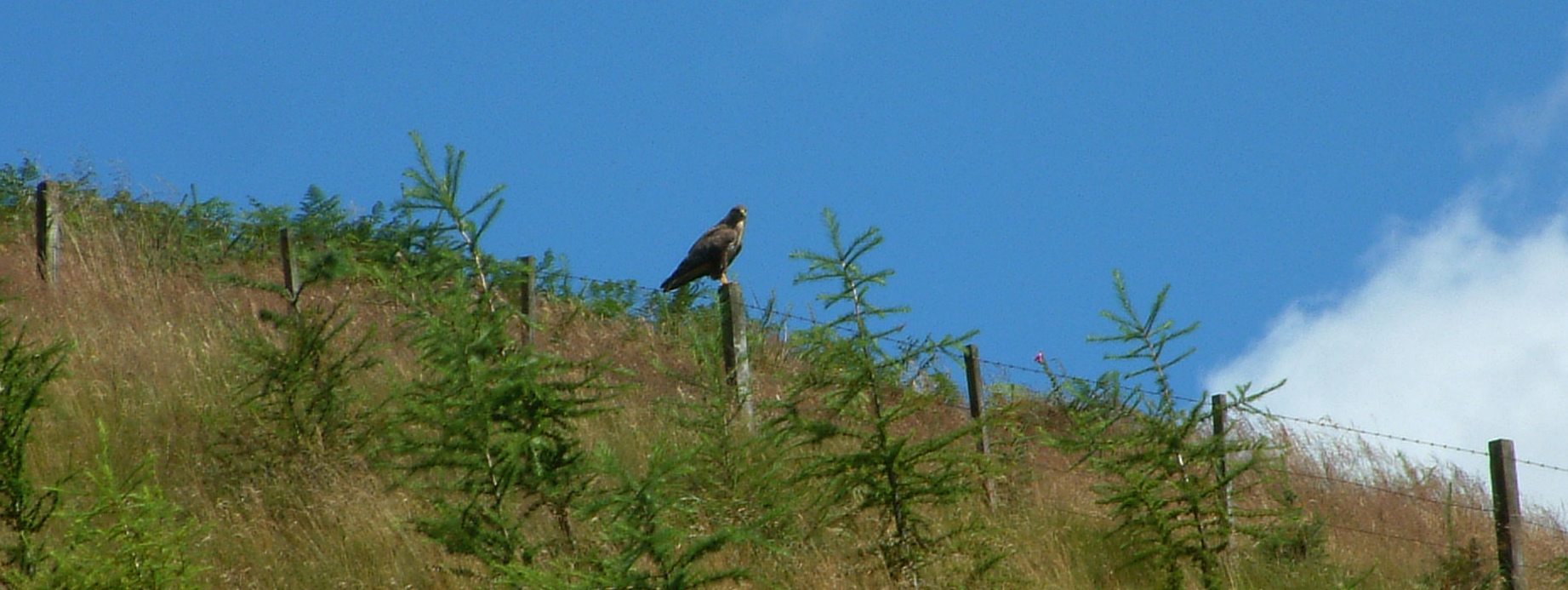
Around us we have fence posts and trees to spot these large birds readying to snatch their prey in powerful talons, then kill it on the ground.

Buzzard looking for breakfast

Our local all year resident buzzards are various shades of brown, with a pale ‘necklace’ of feathers. A magnificent appearance, especially if perched close by or gliding past at eye level. Their wingspan is 109–136 cm (43–54 in).

They call in a plaintive peea-ay, helping me to locate their acrobatic displays as they swoop around the high fells. It does not seem to help their potential prey keep out of sight.

When breeding they fly in spectacular aerial displays, circling high in the sky , then they do ‘the roller coaster’, from high up they start to turn and plummet downward, in a spiral, twisting and turning toward the ground. Then they repeat the exercise over and over as if exhilarated with their male prowess. As they pair for life, this may be for an existing mate or a new mate, but the female gets the same stylish performance annually. I have often developed neck ache watching them.

This year our local pair produced one successful juvenile, and we certainly knew about it. It demanded food almost 24/7 for several months, making a most harsh call such that I wondered if it was another kind of bird. I asked my raptor knowledgeable friend to call and advise. Yes, it was a juvenile buzzard but it was more noisy than one might have expected. Perhaps this was again due to the poor weather and lack of easy prey available. Usually the buzzard will hunt on a daily basis, not nocturnally, but that juvenile kept us all awake with its constant demands. One day I saw its parents take it high in the clear blue sky and they flew on the thermals. They seemed to kiss and separate as the young bird flew for a short while alone. Then only one parent would be hunting for food with it as they flew to different territory, though within range of the forest in which it was born. Now it flies alone, hunting alone, but always in a radius of the forest.

I hope it will find a mate next year.

The RSPB recently fought the UK Government suggested trial to destroy buzzard nests and imprison adults to protect pheasants during the hunting season. “A massive public outcry helped the RSPB to make the case that it was unacceptable to kill a native bird of prey to protect a non-native gamebird released for the purposes of recreational shooting.” The Hen Harrier was killed nearly to extinction for the same reasons and now we have a local project, trying, against the odds, to breed them, much to the chagrin of the hunting community.

The crows mob the buzzard on a regular basis, as they both nest in the same area and the crows fiercely protect their territory. They always succeed in steering the raptor away, as do the swallows and house martins. As with all carrion eaters, there will be a battle over dropped prey with all those seeking to take the opportunity of a free meal. Mobbing the buzzard can make it drop its kill.

The days are drawing in now and the sights of 2012 are drawing to a close as winter settles in, earlier than expected. Still, the aural and visual memories of this past year flash through my mind when I sit by a warm fire; the days getting shorter and darker. I can sit indoors and learn more about the wildlife around me, pre-armed to identify and understand more about my environment as it unfolds next Spring.

Three major ash trees edge our garden and the burn. I am terrified ash dieback might reach them. Scientist say it is now beyond containment. These ash trees are a major feature of this locality, only two sycamores even more ancient along the track to our cottage. The pine forest is home to so many birds, but the ash trees are where the large birds fly to reconnoitre. Will these trees still stand so proud and strong in 2013 out of the UK’s population of 80 million ash trees? Many will be lost and it will be a devastation to lose them after the Dutch elm tree disease of the 70s, when 25 million elm trees were lost.

As life forms have evolved they face many threats and so often become extinct or near extinction. From analysis of fossil pollen in peat samples, it is apparent that elms, an abundant tree in prehistoric times, all but disappeared from northwestern Europe during the mid-Holocene period about 6000 years ago, and to a lesser extent 3000 years ago. This roughly synchronous and widespread event has come to be known as the ‘Elm Decline’.

The peak for Scotland’s woodlands was about 5,000 years ago, when tree cover and diversity was at its greatest extent. The ‘Caledonian Forest’ is from a Latin word meaning ‘wooded heights’. Elm and ash woods were amongst one type of woodland amongst many. The trees died away around 4,500 years ago, a period of cold, wet weather resulted in the spread of peat bogs. I only have to walk up a nearby fell to find the peat hags on the top, a dangerous place to spend much time. There are no mature trees beyond our cottage when walking up our glen. The pine forest is to the west of us where the buzzard and other wildlife make their home. It is a neglected pine forest sitting in bouncing peat. Hopefully it will never be felled for there are so few trees in this vicinity. The new pine and broad-leaved plantings will mature over the next decades, but before then, the juvenile buzzard may have to go further afield to find a mate and suitable territory.

Posted in anthropocene | Tagged , , , , , , | Leave a comment

The Beauty of Owls

One of the lasting memories of my first night at our cottage was to be looking out of the rooflight window on a magnificent starry night, when a white apparition flew past. I was so shocked, it seemed supernatural. It was all white and the local farmer told us it would be a Barn Owl. He had Barn Owls nesting in his barn, and so it was probably one of the parents hunting for food for its young. It was such a beautiful sight. That vision summed up the beauty of this wild area in its iconic form as it flew silently by.

The owl is an example of one of the earliest hunters of mammals. Fossils have been found in the USA and France. The Ogygoptynx and Berruornis dated to the late Paleocene era show that owls were already present as a distinct lineage some 60–57 mya (million years ago), and, hence, possibly also some 5 million years earlier, at the extinction of the non-avian dinosaurs. This makes them one of the oldest known groups of non-Galloanserae landbirds. To think, humans nearly wiped them out in the UK through dangerous farming methods and a deliberate desire to kill them.

A month ago, another amazing sight. A Long Eared Owl settled in the ash tree by our garden. It was only there for a brief rest, then flew to the forest nearby. I had never seen one before. But I quickly checked my ‘Bird ID App’ and learned this particular owl is rarely spotted as it is super secretive. It may have been a tired immigrant resting in the open as they arrive from Scandinavia to spend the winter. This species is attracted to the large conifer forests in Scotland. They are more common in Scotland and according to a fellow bird lover, the one I saw had bred here in the summer (he found the nest at the top of a tree in the forest) but the wet weather seems to have drowned the young in the nest.

The weather this year was exceptionally wet in England and Wales. By June 12th more than 75mm of rain had fallen. At that time of the year, the jet stream should have made a more northerly track, steering the wind and rain towards northwest Britain, Iceland and Scandinavia. We got torrential rain here on the 22nd June. On 28th June 3 supercell storms hit Newcastle on Tyne, the first ever event of this kind, causing flash floods. The next day we had a violent storm, but not as serious as the one in Newcastle, but resulting in flooding in Scotland. Maybe that storm coincided with the hatching out of the Long Eared Owl chick. According to Philip Eden, writing in the Sunday Telegraph, “the first half of June across the UK was the wettest for 150 years – and let’s not forget April was the wettest on record too.”

Melting sea ice and accelerating Arctic warming are causing changes in the jet stream that are bringing more extreme weather. Recent research, including studies by Georgia Institute of Technology and Rutgers University, has linked Arctic warming to increased risk of a variety of extreme weather events.

The Times said: “The Western Isles, which have so far escaped their usual July downpours, will be reunited with the weather that they have lent to the South for the past few weeks.” The Met Office told the BBC to pass on that “there are now signs that the unsettled weather will become more focussed towards northern and western parts of the United Kingdom.” And so it did. Mid July was wet in Scotland.

Paul Hudson, who presents the weather for the BBC, said in his blog “The jet stream is a fast moving zone of winds high up in the atmosphere, caused by the temperature contrast between cold air to the north, and warmer air to the south. It’s along this boundary, where warm and cold air constantly battle each other, that most of our rain bearing weather system form……. Recent research has also pointed the finger at weak solar activity as a possible explanation for the cold, dry winters that Europe and the UK has experienced in the last few years. These were caused by the jet stream being unusually far south, and the research conducted by Reading University concluding that such winters could become more common in the next decade or so as a result of expected weaker solar activity.”

Barn Owls originally evolved in a warmer and drier climate than we have in the UK. They are poorly insulated and need extra energy (food) during cold weather to make up for an increased loss of body heat. Increased winter rainfall is a problem too. Barn Owl feathers are very soft (an adaptation for silent flight) but not very water resistant so hunting during rainfall is avoided. Prolonged rainfall (which prevents hunting) alternating with periods of intense cold (which suppresses small mammal activity) can prove deadly.

Barn Owls are not particularly territorial. The direction in which individual juveniles disperse seems to be random. The local landscape here is ideal for this owl as it is mountainous, with dense forests (which are being gradually logged) and open water. Young barn owls will seek out temporary roost sites (or clusters of closely-spaced sites) that are occupied for between 3 and 15 weeks and are up to 1km apart. Eventually they will settle when they are content.

The dispersal period ends in late November. Birds that haven’t established a permanent home range by this time are probably forced to do so: reduced prey availability and deteriorating weather making survival the highest priority. Survival is linked not only to food supply but to the species’ highly sedentary behaviour. Barn Owls that stay in one place and get to know the landscape in great detail stand a better chance of survival than those which keep moving on. This is due, in part, to the sensory limitations of nocturnal foraging.

Numbers of Short Eared Owl also arrive in October/ November with the Long Eared from Scandinavia to join those who have remained resident in the UK. This is the least common owl in the UK so I am not sure if I have seen one, though if I play its call on my App I think I may have heard one at night.

But I hear the Tawny Owl most of all, it is the most common owl in the UK and likes being close to people. A very vocal bird, particularly during Autumn and Winter. I can also hear them in early Spring on clear calm nights. In the mating season I have heard the female answer the male’s hoot with ‘kewick’ in a duet. Tawny Owls remain within their nesting territory all the year round and pair-bonds last for life. Tawny Owls are dependent on their parents for food up to three months after leaving the nest. As the young owls gradually learn to fend for themselves they also establish territories. The Tawny Owl defends its territory vigorously against neighbours with ‘song’, with threatening behaviour or in flying skirmishes. Predatory mammals, too, such as cats, foxes and dogs, are driven from the vicinity of the nest. Occasionally a Tawny Owl female with nestlings may attack a human approaching the nest, even in daylight, and may even draw blood with its talons. In Britain at least two people are known to have lost an eye from attacks. (Eric Hosking, the famous bird photographer, had this happen to him quite early in his career.)

The Tawny roost in our sycamore trees which stand by our cottage, tall aroboreal sentinels guarding the approach. In the warmer months, when the bats fly around, this fascinating hunter has plenty of opportunities to catch bats and take its pick of the rodents which live in the vegetation and dry stone walls. Before winter sets in the Tawny Owl will eat incubating birds, such as Blackbirds, Woodcocks and Pigeons, picking them off their nests. It will catch rabbits, moles, mice, shrews, voles, and other rodents. It is happy to eat earthworms, insects (beetles especially), birds, frogs, fish, lizards, molluscs, and crustaceans. This diversity abounds around our cottage and this food chain has improved since the farmer stopped dipping the sheep on the land which I have now turned into a garden. The fish have increased since sheep and cows no longer contaminate the water in the immediate vicinity.

In the past, Tawny Owls have been severely persecuted, dying from poisoned bait or pesticide use in agriculture. Their numbers struggle to remain stable, and Scotland is losing them faster than in the rest of the UK. The most common fatalities connected with man are collisions with vehicles, trains or wires, and getting trapped in buildings. Our new landowner is planting broadleaved trees throughout her estate, and as these get established, owls will use that habitat to hopefully increase in numbers in this territory.

Posted in anthropocene | Tagged , , , , , , , | Leave a comment

Weasel Family

There are many badger setts around and beyond our cottage. This is the European Badger (latin name Meles meles), part of the Weasel family. It evolved over 2-4 million years, since the end of the Pleistocene era. Researchers have speculated that the ancestor of the Eurasian badger was Meles thorali, which had a Palaearctic distribution during the late Pliocene (about 3.6 to 1.8 million years ago).

The bear, wolf and lynx were killed to extinction to keep livestock safe; now the largest carnivore left is the badger and it tops it’s food chain.

The badger doubles its weight from around 7.25 kgs in spring to 14.4 kgs in autumn, and measures just under a meter in length, nose to tail. So just now it is heavier as it rummages around the landscape turning over the ground with sharp claws to find earthworms in the main, and insects and grubs. They also eat small mammals, amphibians, reptiles and birds, as well as roots, fungus and fruit. Badgers rarely drink; instead they obtain most of their water from their food. There is a plentiful source of food around just now but winter will test their survival chances (but then, winter tests all of us).

The only threat to badgers is man and his activities. In the south of England populations are at their greatest while in Scotland their frequency varies from common to scarce the further north you go, and as the altitude increases and the availability of food decreases. We live nearly 900 ft above sea level which does not seem to worry the local community of badgers. They are members of the stoat and weasel family, and there are plenty of them running around too.

At night we know they are busy using their keen sense of smell and excellent hearing. Their eyesight is poor, as might be expected for the animal who lives below ground sleeping all day. We have seen them through the day though, no doubt searching for food in the spring when their cubs are born. These will stay underground from around mid February until a couple of months later. Like the fox cubs, they will then learn to

The sandy soil and trees around us are ideal for them to construct
tunnels and chambers. As they can make a home over 10 meters long from the entrance we can never know how near or far from us they are at any one time. We can quite expect they are digging the foundations of our cottage away, but nature will always take back what is hers.

Badger territories, the area of land collectively defended by a clan, are determined by the quality and quantity of foraging in any given area. Good quality – small territory, poor quality – large territory.

The latrine areas around badger setts provide favourable habitat for Elder bushes (Sambucus nigra) and nettles (Urtica dioica) because as the badger dung decomposes it releases nitrogenous components into the soil; elder and nettles have a preference for nitrogen-rich soil. We have elder trees and plenty of nettles around our cottage!

Like the deer, has delayed implantation and the fertilized egg develops into a blastocyst which isn’t fully implanted into the uterus until mid winter when badger activity is at its lowest. Badger life is hard and less than 50% survive to their second year.

The badger has no natural predators (which in itself is unnatural) and has only man to fear, and generally speaking it is through ignorance rather than design that most persecution occurs.

It is estimated that road traffic accidents account for up to 30% of badger mortalities. Insensitive developments do much more damage to wildlife than first thought which is where knowledge of clans, territories, foraging areas, and in fact all wildlife movement are most important.

Another member of the Weasel family is the Otter. There are two sections of the burn, which runs north by our cottage, where otters are known to be active. I have never seen one myself, but again, they are nocturnal. We have trout in the burn which the Dipper and Heron are often seen in position waiting to snap up their prey. The otters will be similarly engaged at night in the clear waters, which, the further you go north reach high into fells with various tributaries feeding into the burn. The more isolated the land, the safer the otter will feel.

There is scientific evidence to suggest Otters have been on Earth for the past 30 million years. In order to survive that long though they have had to evolve in a variety of ways. It is speculated that the Otter as we know it today may have evolved significantly about 7 million years ago. The European otter (Lutra lutra) can be located by its ‘spraints’, or droppings. These are left under bridges (which have recently been built over the burn in three places up the glen) and footprints are often found along the banks of the burn. When the otter shelters in daylight it finds a ‘hover’ which, as it sounds, will only suit whilst it is safe.

Otters have been hunted for centuries for their pelts, but now mostly to remove competition for fish. Today the hunting of Otters is severely limited by law.

However, people continue to hunt them for sport. They are small enough to conceal and following a river course can lead to their presence. If caught, these hunters may be prosecuted and either go to jail or have to pay a huge fine for their barbaric act.

Gavin Maxwell endeared us to the Otter when he wrote ‘Ring of Bright Water’ in 1960. It was Maxwell’s own story and was made into the film of the same name which I saw many years ago. Of course, it was a tear jerker as he made a pet of the otter which he purchased from a pet shop (what a terrible thought that a wild animal could be for sale). Whilst away from home he leaves the pet with his partner who is exercising the animal and a ditch digger kills it. I always fear something will happen to my pets if I leave them. Indeed, when I have had no option but to leave them, more often than not something awful has happened.

I am happy to know there are otters where I live and do not wish to see them or disturb them if I can help it. I used to see the deer and now they are shot by the gamekeeper. I feel superstitious that if I see an otter someone will kill it. The hunting fraternity killed the fox cubs when chased by the hounds, vehicles hit the badgers on the roads. I hope I never see a dead otter.

Posted in anthropocene | Tagged , , , , , , , , | Leave a comment

Insects around me

Living in countryside with no living dwelling within sight of our cottage makes for an interesting life. Day and night we are presented with an array of insects. My favourite book as a child was ‘My Family and Other Animals’ by Gerald Durrell. The closest I got to his collection of every living thing he could bring to study when he was a boy, was tadpoles in a bowl outside and my caterpillar ‘house’ which I constructed out of a box and a sheet of glass to prevent their escape. My mother did try and rescue injured birds and she brought them indoors, but nothing else was allowed over the threshold.

Each day I am confronted with the ground I walk on knowing it was once the floor of the Iapetus Ocean. I cannot help but think of how ancient it is. I want to know how ancient are the creatures which inhabit the landscape.

I am a novice about so many matters but the Internet and books help me try and understand what I am seeing around me. I have learned the evolution of insects dates back to the Devonian period, and this Neolithic Period reminds me of a notice not far from where we live which points to the ‘Neolithic Route’. I have never had the chance to follow it, but one day I will.

The National Geographic tells me

When the Devonian period dawned about 416 million years ago the planet was changing its appearance. The great supercontinent of Gondwana was headed steadily northward, away from the South Pole, and a second supercontinent began to form that straddled the Equator. Known as Euramerica, or Laurussia, it was created by the coming together of parts of North America, northern Europe, Russia, and Greenland.

Red-colored sediments, generated when North America collided with Europe, give the Devonian its name, as these distinguishing rocks were first studied in Devon, England.

The Devonian, part of the Paleozoic era, is otherwise known as the Age of Fishes, as it spawned a remarkable variety of fish.

Apparently, the oldest definitive insect fossil is the Rhyniognatha hirsti, thought to be living around 407 to 396 million years ago. Maybe fossils of it lie beneath my feet but I would never know.

Whilst the UK has suffered the wettest summer since records began in 1912, there have also been soaring temperatures which led to mosquitos infecting penguins in London Zoo, killing 7 of them. These extremes, including early frosts then great heat, followed by heavy rain, have hit fledgling birds and insects. The slugs and snails have done well, and in Scotland there are 77 species of land snail.

During major radiation periods in the Carboniferous and Permian periods, winged insects or Pterygotes and their subclass Endopterygota (those which progress through larval, pupal, and adult stages) almost died out. Somehow a few survived until they evolved in the Triassic to become what we see today. The Triassic extended from about 250 to 200 million years ago.

Insects diversified in a relatively brief 100 million years. In Scotland alone there are around 14,000 species. Perhaps our human species will also nearly all die as climate change ravages our planet. It is possible that a few humans will survive and maybe evolve like the insects of the past.

The conifers, mosses, flowering plants, insects, mollusks, birds and mammals I see around me look much the same as they did during the Pleistocene, the time period that spanned from 2.6 million to 11,700 years ago. The mammoths, longhorned bison, saber-toothed cats, giant ground sloths, and many other large mammals became extinct, but no-one really knows why.

Many species of butterfly are in decline in the UK, but wildlife is being driven northwards. Butterflies are recognised as sensitive indicators of environmental change, including climate change, and of the health of the countryside. By recording butterflies and moths it is possible to plot movements of those who seek cooler or those who seek hotter temperatures. The Pearl-bordered Fritillary, Marsh Fritillary and Chequered Skipper, which are becoming rare in the rest of the UK, are moving north into Scotland in response to climate change.

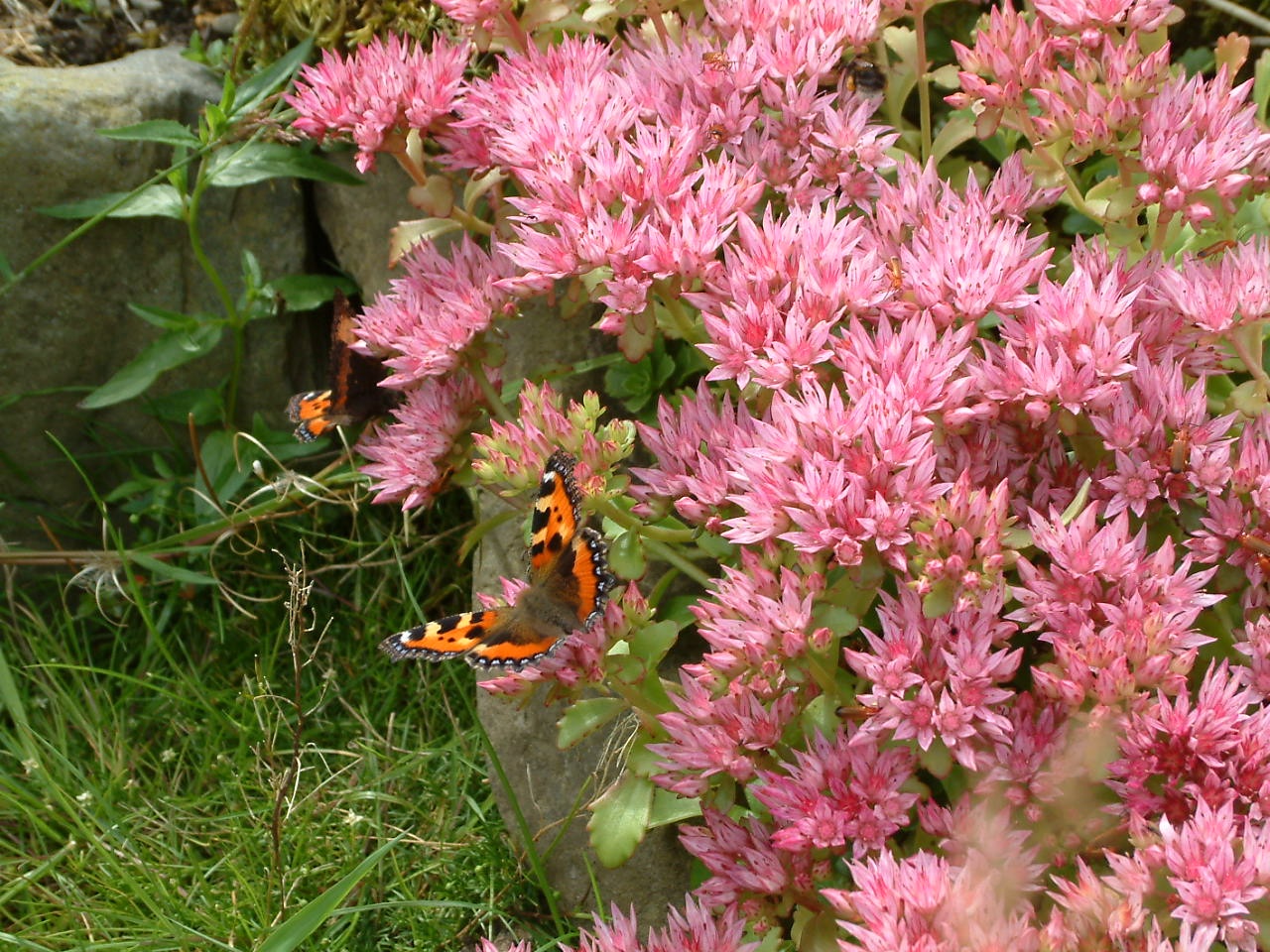
Small Tortoiseshell butterfly on a sedum

Small Tortoiseshell butterfly on a sedum


This year was my first as a member of Butterfly Conservation. I had never been able to confidently identify the range of butterflies I was seeing, and certainly never knew about moths. The dreadful weather has harmed their breeding and numbers are drastically down for sightings around the UK. But I was rewarded for my sightings, such as they were, being told no-one has ever reported from the remote location in which we live.

I never saw the Pearl-bordered Fritillary, Marsh Fritillary and Chequered Skipper. So I wondered why not. It seems all butterflies seek out particular grasses and wildflowers and are sensitive to types of environment. Agricultural methods have gradually destroyed many of these habitats.

By trying to find the wildflowers each butterfly required I realised how poor my knowledge was of the phenomenal range which grew in my environment and I have only begun to spot them growing. Then I have had to be sure of identifying them correctly. Here are an example of what these three butterflies, recently having moved to Scotland, have been said to require:

The Pearl-bordered Fritillary caterpillar only lives on violets and as a butterfly needs edges, or open spaces within, south-facing woodlands with a mosaic of light bracken and, more particularly it must have Bugle, a small plant that produces a ring of blue flowers on top of each set of leaves. This is the most rapidly declining butterfly in the UK.

Marsh Fritillary requires Devil’s Bit Scabious which also attracts Tortoishells and Red Admiral. Currently the Marsh Fritillary has only found ideal conditions in Scotland in south Lochaber, Argyll and the Argyll Islands. The Chequered Skipper.

Chequered Skipper is confined to north-west Scotland where it was first discovered in 1942, and where its distribution is centred on Fort William and where the larval foodplant is Purple Moor-grass. First, this grass is not purple, though its flower heads are a pale purple.

Silver Y moth on autumn glory sedum

Silver Y moth on autumn glory sedum

The same applies to Moths. I had never taken in these equally wonderfully marked and colourful insects. Where had I been? Now I was seeing them everywhere and photographing them and asking a contact at Butterfly Conservation to tell me their names. Then I had another shock. Their names were so special too. `Beautiful Golden Y’ was the first I spotted. Then there was a number of them all appearing the same month (July). Silver Y, Gold Spangle, Clouded Bordered Brindle, Silver Ground Carpet, Small Magpie, Gold Spot.

Beautiful Golden Y moth on cranesbill geranium

Beautiful Golden Y moth on cranesbill geranium


There are thick growths of nettles around the garden and this is where most of the caterpillars develop until they become moths or butterflies. The Silver Y moth and the Red Admiral butterfly had their last feeds in early October from the flowers of my Autumn Glory sedum before they set off for warmer climes in the Mediterranean. The Peacock Butterfly did the same but will hibernate despite the bitterly cold winters we usually get here. The Small Tortoishell was drinking up the nectar too before going to southern areas of England.

Red Admiral in yellow ligularia daisy

Red Admiral in yellow ligularia daisy

It is easy to destroy nettle beds thinking it will improve the garden, but I realise through Butterfly Conservation that they are hugely important to many moths and butterflies as a vital habitat and for other wildlife too.

In the Bronze Age burial grounds fabric woven from nettle has been found.

An old Scots rhyme about the nettle offering advice to harvest nettles first thing in the morning and to cut them back hard:

“Gin ye be for lang kail coo the nettle, stoo the nettle
Gin ye be for lang kail coo the nettle early
Coo it laich, coo it sune, coo it in the month o’ June
Stoo it ere it’s in the bloom, coo the nettle early
Coo it by the auld wa’s, coo it where the sun ne’er fa’s
Stoo it when the day daws, coo the nettle early.”
(Old Wives Lore for Gardeners, M & B Boland)

The many uses for nettles, such as a herbal tea or for medicinal purposes, explains why they grow so prolifically close to remote cottages and bothys. In the race to have manicured gardens, people destroy them with weed killer and destroy the wildlife which depends on them at the same time. The food chain is constantly being damaged by ludicrous ideas of radical gardening and farming methods until we find our own food supply is no longer secure or plentiful.

Peacock butterfly on autumn glory sedum

Peacock butterfly on autumn glory sedum


The nettles are dying down now and have been about 5ft high around the garden. We have had a poor weather year and I have seen battered butterflies struggling to survive. Wintry weather is already creeping in despite it being Autumn. I wonder if insects will have been so beaten up that it will be a few years before they recover. Or will the weather remain poor for the foreseeable future? Who knows? Perhaps we all have more adapting to do if climate change continues to shock us with extreme weather (as is very likely).

Posted in anthropocene | Tagged , , , , | Leave a comment