From Roman Empire to the New World

Thank you Wikipedia, illuminating my path of education as I search for understanding. Thank you also all the various sites on history and books of information on battles for control of areas of the known world which had previously been conquered by the Romans. 

I find this period so pivotal to the theme I am developing. I am asking myself, what kind of people conquered the New World? All this history culminates in Columbus setting off across the Atlantic with the unforeseen, devastating impact on the indigenous, still in Bronze Age mode, people of the Americas.

 It is amazing to me, to think in parts of the known world, humans were becoming sophisticated in battle; developing high levels of theology, science and maths; achieving amazing explorations and trading abilities, expressing high art in buildings and artefacts and displaying a huge range of cultural differences. 

The culmination of centuries of experience brought us to the point when Columbus left Italy and finally set foot on land as yet unknown to Europeans: The New World.

The impact is still reverberating today and that is why I am trying to get my mind round it, amateur as I am.

So here I go, putting together a timeline of some events which seem to show the seismic shift taking place over the centuries, up to the mid 1400s. I am focussing on the Byzantine Empire in this blog, in order to show how the last remaining Roman defence of the Empire was impinged by other empires until, as empires do, it was extinguished. Yet, throughout, whatever happened, the Christian religion spread and pervaded. Religion seems key to the true conquest of the minds of people, and what makes them embrace or reject ‘others’.

At 2010 statistics (see https://en.m.wikipedia.org/wiki/Christian_population_growth) suggest Christianity was estimated to be by far the world’s largest religion, with an estimated 2.2 billion adherents, nearly a third (31%) of all 6.9 billion people on Earth. 

Islam was second, with 1.6 billion adherents, or 23% of the global population.

Having written about the Roman Empire elsewhere, I am taking up at the point when the Empire was divided for administrative purposes:

Image of coin with the head of Diocletian stamped on it:


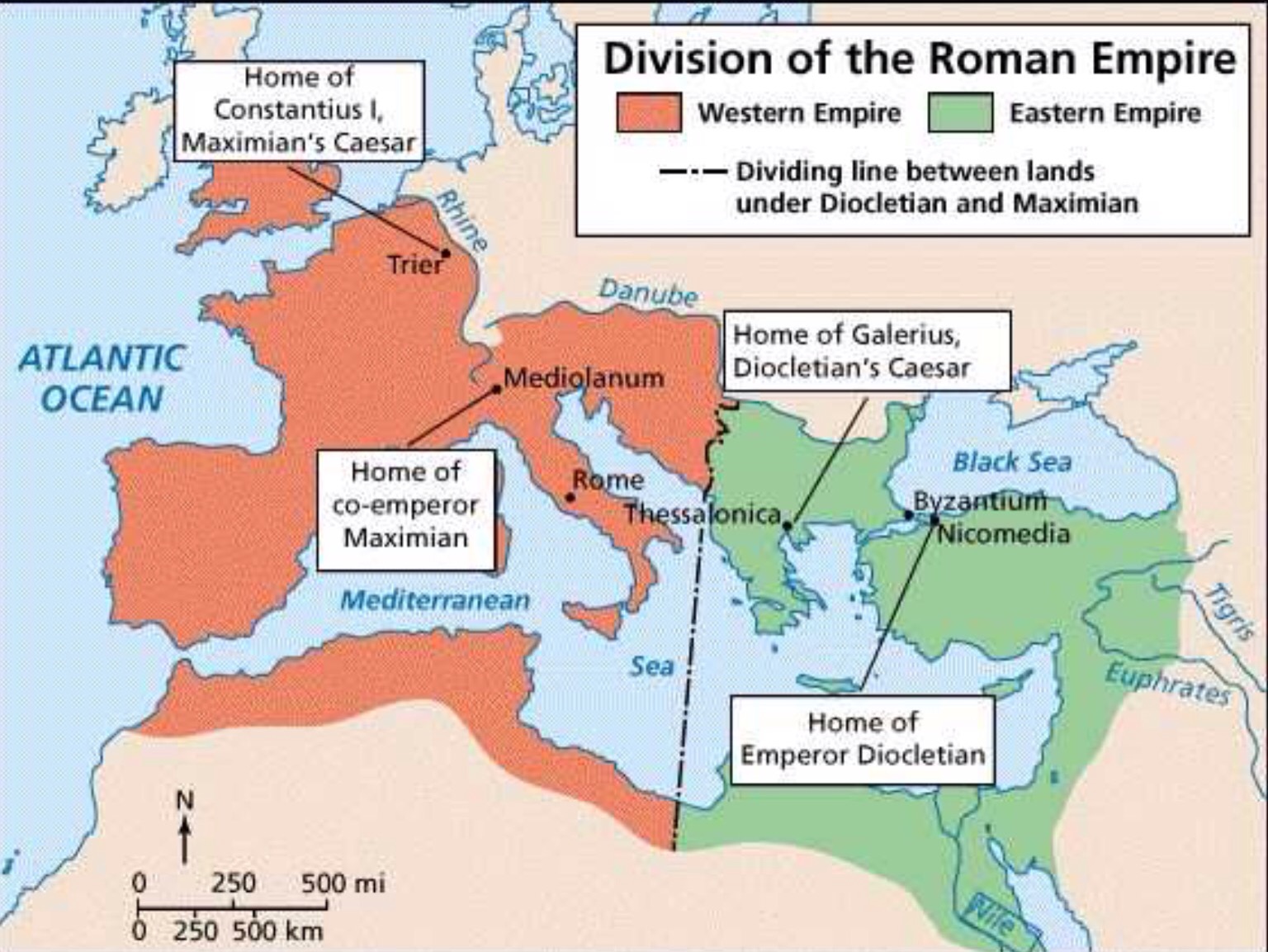
In 285 CE the Roman Empire had grown so vast that it was no longer feasible to govern all the provinces from the central seat of Rome. The Emperor Diocletian divided the empire into halves with the Eastern Empire governed out of Byzantium (later Constantinople) and the Western Empire governed from Rome.

Map of divided Roman Empire:
In 376, the Visigoths (a western Germanic nomadic tribe, named later as ‘visigoths’ by Roman Cassiodorus) invaded the Roman Empire beginning in 376 and defeated the Romans at the Battle of Adrianople in 378. 

Relations between the Romans and the Visigoths were variable, alternately warring with one another and making treaties when convenient. The Visigoths invaded Italy under Alaric I and sacked Rome in 410. After the Visigoths sacked Rome, they began settling down, first in southern Gaul and eventually in The Iberian Peninsula, where they founded the Visigothic Kingdom and maintained a presence from the 5th to the 8th centuries AD, until the Moors invaded.

After the Western Roman Empire fell in the 5th century AD, the Byzantine Empire remained for an additional thousand years (Late Antiquity) until it fell to the Ottoman Turks in 1453. 

During the Byzantine period, the people continued to think of themselves as Roman citizens belonging to Romania.

Below I have picked out significant battles and policies of notable emperors to plot the 977 years of the Byzantine expansion and then decline.

Some Notable emperors and events:

 • c. 330–337 Constantine I

Constantine I (r. 324–337) reorganised the empire, made Constantinople the new capital, and legalised Christianity. 

 • c. 375-395 Theodosius I 

Christianity became the Empire’s official state religion and other religious practices were proscribed.

410 The Visigoths invaded Italy under Alaric I and sacked Rome (Western Roman Empire).

 • 457–474 Leo I

A native of Dacia Aureliana near historic Thrace, he was known as Leo the Thracian. Ruling the Eastern Empire for nearly 20 years, Leo proved to be a capable ruler. He oversaw many ambitious political and military plans, aimed mostly for the aid of the faltering Western Roman Empire and recovering its former territories. He is notable for being the first Eastern Emperor to legislate in Greek rather than Latin.

After the fall of Rome, the papacy was influenced by the temporal rulers of the surrounding Italian Peninsula; these periods are known as the Ostrogothic Papacy, Byzantine Papacy, and Frankish Papacy. Over time, the papacy consolidated its territorial claims to a portion of the peninsula known as the Papal States. Thereafter, the role of neighboring sovereigns was replaced by powerful Roman families during the saeculum obscurum, the Crescentii era, and the Tusculan Papacy.

 • 527–565 Justinian I

Under Justinian I (r. 527–565), the Empire reached its greatest extent after reconquering much of the historically Roman western Mediterranean coast, including North Africa, Italy, and Rome itself, which it held for two more centuries. The population of the Byzantineb Empire in 565 AD est. 26,000,000c 

After his invasion of Italy, the Gothic War (535–554), Emperor Justinian I forced Pope Silverius to abdicate and installed Pope Vigilius, a former apocrisiarius to Constantinople in his place; Justinian next appointed Pope Pelagius I, holding only a “sham election” to replace Vigilius; afterwards, Justinian was content to be limited to the approval of the pope, as with Pope John III after his election. Justinian’s successors would continue the practice for over a century.

The Byzantine Papacy was a period of Byzantine domination of the Roman papacy from 537 to 752, when popes required the approval of the Byzantine Emperor for episcopal consecration, and many popes were chosen from the apocrisiarii (liaisons from the pope to the emperor) or the inhabitants of Byzantine Greece, Byzantine Syria, or Byzantine Sicily. Justinian I conquered the Italian peninsula in the Gothic War (535–554) and appointed the next three popes, a practice that would be continued by his successors and later be delegated to the Exarchate of Ravenna.

It was during this century that the term “Visigoth” was invented by Cassiodorus, a Roman in the service of Theodoric the Great.

(Theodoric, was king of the Ostrogoths (475–526), ruler of Italy (493–526), regent of the Visigoths (511–526), and a patricius of the Roman Empire. His Gothic name Þiudareiks translates into “people-king” or “ruler of the people”.

Theodoric was born in Pannonia, now northern Croatia in 454, after his people had defeated the Huns at the Battle of Nedao. His father was King Theodemir, a Germanic Amali nobleman, and his mother was Ereleuv.

Cassiodorus used his term of “Visigothic” to match that of “Ostrogothic”, in his mind signifying “western Goths” and “eastern Goths” respectively. The western–eastern division was a simplification (and a literary device) of 6th century historians; political realities were more complex. Further, Cassiodorus used the term “Goths” to refer only to the Ostrogoths, whom he served, and reserved the geographical term “Visigoths” for the Gallo-Spanish Goths. This usage, however, was adopted by the Visigoths themselves in their communications with the Byzantine Empire and was still in use in the 7th century.

 • 610–641 Heraclius

The Empire’s military and administration were restructured and adopted Greek for official use instead of Latin. Looking back at the reign of Heraclius, scholars have credited him with many accomplishments. He enlarged the Empire, and his reorganization of the government and military were great successes. His attempts at religious harmony failed, but he succeeded in returning the True Cross, one of the holiest Christian relics, to Jerusalem.

The Greek Popes (678–752)

Pope Agatho, a Greek Sicilian, started “a nearly unbroken succession of Eastern pontiffs spanning the next three quarters of a century”. Greek was the language of choice during this period as countless Easterners rose through the ranks of the clergy. According to Ekonomou, between 701 and 750, “Greeks outnumbered Latins by nearly three and a half to one”.

Although antagonism about the expense of Byzantine domination had long persisted within Italy, the political rupture was set in motion in earnest in 726 by the iconoclasm ( the social belief in the importance of the destruction of usually religious icons and other images or monuments, most frequently for religious or political reasons) of Emperor Leo III the Isaurian (Isauria was a rugged isolated district in the interior of South Asia Minor).

Pope Zachary, in 741, was the last pope to announce his election to a Byzantine ruler or seek their approval.

 • 976–1025 Basil II

The early years of his long reign were dominated by civil war against powerful generals from the Anatolian aristocracy (as, for example Eustathios Maleinos (Greek: Εὐστάθιος Μαλεΐνος) was a leading Byzantine general and one of the wealthiest and most influential members of the Anatolian military aristocracy during the late 10th century. He held senior administrative and military posts in the East, and was involved in the aristocratic rebellions against Emperor Basil II (r. 976–1025), fighting against Bardas Skleros but supporting the revolt of his nephew Bardas Phokas. After the failure of the latter, he was not punished, but his immense wealth caused his eventual downfall, as Basil II confined him to a mansion in Constantinople and confiscated his wealth after his death.)

Following their submission, Basil oversaw the stabilization and expansion of the eastern frontier of the Byzantine Empire, and above all, the final and complete subjugation of Bulgaria, the Empire’s foremost European foe, after a prolonged struggle. For this he was nicknamed the Bulgar Slayer (Greek: Βουλγαροκτόνος, Boulgaroktonos), by which he is popularly known. At his death, the Empire stretched from southern Italy to the Caucasus and from the Danube to the borders of Palestine, its greatest territorial extent since the Muslim conquests four centuries earlier. His reign is therefore often seen as the medieval apogee of the Empire.

800 – the papacy recognised Charlemagne as Holy Roman Emperor. This can be seen as symbolic of the papacy turning away from the declining Byzantium (Constantantinople) towards the new power of Carolingian Francia.

Charlemagne reached the height of his power in 800 when he was crowned Emperor of the Romans by Pope Leo III on Christmas Day at Rome’s Old St. Peter’s Basilica.

During the reign of Basil II, the Crescentii clan (in modern Italian Crescenzi) essentially ruled Rome and controlled the Papacy from the middle of the 10th century until the nearly simultaneous deaths of their puppet pope Sergius IV and the patricius of the clan in 1012.

 • 1081–1118 Alexius I

Alexios I Komnenos was Byzantine emperor from 1081 to 1118. Although he was not the founder of the Komnenian dynasty, it was during his reign that the Komnenos family came to full power. Inheriting a collapsing empire and faced with constant warfare during his reign against both the Seljuq Turks in Asia Minor and the Normans in the western Balkans, Alexios was able to curb the Byzantine decline and begin the military, financial, and territorial recovery known as the Komnenian restoration. The basis for this recovery were various reforms initiated by Alexios. His appeals to Western Europe for help against the Turks were also the catalyst that likely contributed to the convoking of the Crusades.(The Objectives of the crusades was at first to release the Holy Land, in particular Jerusalem, from the Saracens, but in time was extended to seizing The Iberian Peninsula from the Moors, the Slavs and Pagans from eastern Europe, and the islands of the Mediterranean. There were a total of nine crusades!)

Map at 1135 first and second crusades:


Michael VIII reigned as Byzantine Emperor 1259–1282. Michael VIII was the founder of the Palaiologan dynasty that would rule the Byzantine Empire until the Fall of Constantinople in 1453. He recovered Constantinople from the Latin Empire in 1261 and transformed the Empire of Nicaea into a restored Byzantine Empire.

Emperor Michael VIII Palaiologos, after re-establishing Byzantine Imperial rule, established an alliance with the Mongols, who themselves were highly favourable to Christianity, many of them being Nestorian Christians.

He signed a treaty in 1263 with the Mongol Khan of the Kipchak (the Golden Horde), and he married two of his daughters (conceived through a mistress, a Diplovatatzina) to Mongol kings: Euphrosyne Palaiologina, who married Nogai Khan of the Golden Horde, and Maria Palaiologina, who married Abaqa Khan of Ilkhanid Persia.

 • 1449–1453 Constantine XI

Constantine Palaiologos reigned 8 February 1405 – 29 May 1453) and was the last reigning Byzantine Emperor,reigning as a member of the Palaiologos dynasty from 1449 to his death in battle at the fall of Constantinople. Following his death, he became a legendary figure in Greek folklore as the “Marble Emperor” who would awaken and recover the Empire and Constantinople from the Ottomans. His death marked the end of the Roman Empire, which had continued in the East for 977 years after the fall of the Western Roman Empire.

So, in 1453 the capital, Constantinople, fell to the Ottomans who were commanded by the then 21-year-old Mehmed the Conqueror, the seventh sultan of the Ottoman Empire. The conquest of Constantinople followed a 53-day siege that had begun on 6 April 1453.

Posted in anthropocene | 1 Comment

Romans left us with Christianity in a Savage Britain

When the Romans left England in 410 AD the population had no understanding of how to govern, feed themselves or protect each other.  

420 – Pelagian heresy outlawed in Rome (418) but, in Britain, supposedly enjoys much support from “pro-Celtic” faction. Traditionalists (pro-Romans) support Roman church. During this time, according to Prosper, Britain is ruled by petty “tyrants”.

428 – In desperation, self styled King of Briton, Vortigern, a warlord, was thought to be responsible for inviting a number of Germanic warriors to aid him in consolidating his position according to the Historia Brittonum. This appears to have been an early use of German mercenaries, who probably settled in the Dorchester-upon-Thames area. 

500 AD Large influx of Angles and Saxons

600-700 AD Anglo-Saxon rule throughout much of Britain – Welsh kingdoms successfully resist.

This arrival of Angles and Saxons has resulted in present day research of rural white British people, who, having evidence of 4 grandparents living close to them to prove their genealogy, have been found to belong to a group of 30% of the British population with German ancestry.

Prof Peter Donnelly, director of the Wellcome Trust Centre for Human Genetics at the University of Oxford, co-led research back in 2015 and the resulting analysis shows that the Anglo-Saxons were the only conquering force to substantially alter the country’s genetic makeup, with most white British people now owing almost 30% of their DNA to the ancestors of modern-day Germans. (See https://www.theguardian.com/science/2015/mar/18/genetic-study-30-percent-white-british-dna-german-ancestry)

It is interesting to note the high percentage with an ancestry to Germany, higher than any other invader influence. This helped me to understand how a man from Devon should set off with missionary zeal to land in the Netherlands/Northern Germany and one day become famous for Christianising Germany. This man was Winfrid (Saint Boniface ) born c. 675 possibly Crediton, Devon. Died 5 June 754 (aged c. 79) near Dokkum, Frisia. He must have had the languages necessary to communicate with those in Fresia.

Winfrid was born in the kingdom of Wessex in Anglo-Saxon England. He became a leading figure in the Anglo-Saxon mission to the Germanic parts of the Frankish Empire during the 8th century.

Saint Boniface who was active in the area of Fulda (modern Hesse), establishing or re-establishing the bishoprics of Erfurt, Würzburg, Büraburg, as well as Eichstätt,  Regensburg, Augsburg, Freising, Passauand Salzburg, further to the south-east.

Saint Walpurga (Walburga) and her brothers Saint Willibald and Saint Winibald assisted Boniface,  Willibald founding the Heidenheim monastery.

Anglo-Saxon missionary activities continued into the 770s and the reign of Charlemagne, the Anglo-Saxon Alcuin playing a major part in the Carolingian Renaissance. By 800, the Carolingian Empire was essentially Christianized, and further missionary activity, such as the Christianization of Scandinavia and the Baltic was coordinated directly from the Holy Roman Empire rather than from England.

When Hitler expected us to be his allies in WWII, perhaps he knew a third of us had German ancestry.

Posted in anthropocene | Tagged , , , , , , , , , | Leave a comment

Debt as a Driving Force

Philip IV of France (born in Fontainebleau in 1268, the second son of Philip III. His mother (Isabella of Aragon) died when he was three and his stepmother, Marie de Brabant, allegedly preferred her own children to Philip and his brothers. It is even thought Marie de Brabant killed his elder brother by poison, but she was acquitted. No doubt he was not a happy child.

He grew to be tall, blonde and handsome (hence the nickname ‘Fair’) but aloof. 


Philip was said to be good at getting his own way and could be terrifying to those who crossed him.

Philip relied on skillful civil servants, such as Guillaume de Nogaret and Enguerrand de Marigny, to govern the kingdom rather than on his barons. Philip and his advisors were instrumental in the transformation of France from a feudal country to a centralized state. Philip, who sought an uncontested monarchy, compelled his vassals by wars and restricted feudal usages. His ambitions made him highly influential in European affairs. His goal was to place his relatives on foreign thrones. Princes from his house ruled in Naples and Hungary. He tried and failed to make another relative the Holy Roman Emperor. He began the long advance of France eastward by taking control of scattered fiefs. By virtue of his marriage with Joan I of Navarre, he was also Philip I, King of Navarre from 1284 to 1305. He briefly ruled the County of Champagne in right of his wife (jure uxoris) although after his accession as king in 1285 the county remained under the sole governance of his wife until 1305, and then fell to his son, Louis until 1314.

Edward I as Duke of Aquitaine was a vassal of the French King. He was in his fifties and Philip was in his twenties. Philip seemed to want to cause trouble for the elder man, so a raid by Gascon sailors in 1294 gave Philip the opportunity to go to war with England. Edward I sent his brother to dissuade Philip from war. Philip deceived the English over the terms for peace, one of which was he would send a token army to Aquitaine. In fact Philip sent a large army to the Duchy and would not give Edward safe conduct to go to Gascony and defend his interests. Edward renounced his allegiance to the French King and war broke out between both countries. 

Eventually a peace treaty of 1303 ended hostilities. It had unforeseen ramifications. Part of the treaty involved Philip’s daughter Isabella marrying Edward’s son and heir, the future Edward II. This led to a period of peace between the two countries but also gave their son Edward III a claim to the French throne, one of the major causes of the Hundred Years’ War.

To further strengthen the monarchy, Philip tried to control the French clergy and entered in conflict with Pope Boniface VIII. Pope Boniface could not gain respect from King Philip that he was rightfully Pope, and the King demanded he be replaced, the Pope responded by excommunication of the French King in 1303, but before it could be carried out, Philip arrived with troops and two recently deposed Colonnade cardinals and their relatives. They broke into the papal palace at Anagni and surrounded him. He shouted back at them and challenged them to kill him, but the troops backed off and citizens chased them out of the town. But the experience left the Pope distraught and a broken man. He died a month later. His successor was Benedict XI who only lived nine months as Pope, and so began the arguments as to who should be his successor.

The Conclave were divided between those outraged at how the French King had treated Boniface VIII and those who wanted reconciliation with France. They were in deadlock for eleven months, until the anti-French group split and some allied themselves with the reconciliation group.

The French made their own countryman Pope, Bertrand de Got, as Clement V in 1305, which is the same year the Queen of France died in childbirth. Philip and Joan’ s first child Margaret was born 1288 and died 1294. Blanche was born 1290 and she died 1294. Sons Louis X of France lived from 1289 to 1316. Philip V of France lived 1293 to 1322. Charles IV of France lived 1294 to 1328 and daughter Isabella, who married Edward II of England lived 1295 to 1358.

In 1306, Philip the Fair expelled the Jews from France – because he was in debt to them.

De Got had a close relationship with Philip and had never been a cardinal, but was a Bologna-trained lawyer and known for his diplomatic abilities.

In 1306, Philip made Clement dissolve the Knights Templar, a military order dedicated to the crusade. The Knights Templar were a religious order of unmarried men, formed around A.D. 1119 to defend the Kingdom of Jerusalem and protect Christian pilgrims during the Crusades. Over the next two centuries, Christians donated their land and their money to the order (as was common with religious societies), making the knights powerful financiers.

Against his better judgement, Clement V issued a Papal Bull which granted the lands of the Templars to the Knights Hospitalier, also known as the Knights of St John of Malta, and dissolved the Knights Templar, which took effect wherever they were. Thus in England and Scotland, they were not arrested but disbanded.

In 1307, Friday 13th October, Philip had members of the order of the Knights Templar (to whom he was in debt and believed them to be as a “state within the state”) arrested, many tortured to confess heresy, then burned at the stake.

Philip had now written off his debt to the Jews and Knights Templar.

Clement was already living in France and, due to the conflict in Italy, suggested the transfer of the papal court to the enclave of Avignon, which Clement chose. It was then the Kingdom of Aries, part of the Roman Empire, one of the Papal States, subject to the Kings of Sicily. It was closer to Europe and the sea, unlike Rome.

From Clement on, the papacy belonged to France and carried out the will of succeeding monarchs whilst it remained in Avignon. All the successors of Clement were French until the papacy moved back to Rome.

7 years after the Knights of the Templar had been burned at the stake:

Clement V died 20th April, 1314. The Pope’s body was placed in a church overnight and some said the church caught fire and the body turned to ashes, a sign of the curse of the Grand Master of the Knights Templar as he burned at the stake.

Philip died, aged 46, of a stroke whilst hunting in Fontainbleau, his birthplace, in November 1314. Rumours circulated that his sudden death was God’s revenge on his destruction of the Knights Templar.

Much has been made of the link with Knights Templar becoming a secret society, perhaps morphing into the Freemasons, but that could be because the Freemasons put that rumour about themselves. (See http://news.nationalgeographic.com/2016/05/160512-friday-13-knights-templar-superstition/)

Posted in anthropocene | Tagged , , , , , , , , , , , , , , , , , | Leave a comment

Human Vulnerability

There have been three major outbreaks of plague. The Plague of Justinian in the 6th and 7th centuries is the first known attack on record, and marks the first firmly recorded pattern of bubonic plague. From historical descriptions, as much as 40% of the population of Constantinople died from the plague. Modern estimates suggest half of Europe’s population died as a result of the plague before it disappeared in the 700s. After 750, major epidemic diseases did not appear again in Europe until the Black Death of the 14th century.

Catastrophes struck much of Europe during the 13th to 16th centuries. From Mongol inflicted suffering in China, to creating conditions which enabled the Black Death to arise and devastate the Chinese population and then spread across Europe and the Middle East, due to Mongol armies and trading routes carrying the disease. During the 13th century Mongol conquest, farming and previous trading practices were disrupted with the result of widespread famine in China. The population dropped from approximately 120 to 60 million. On top of all this misery came the 14th century plague – the Black Death. It is estimated to have reduced the remaining population of China by a third.

During the Medieval Warm Period (the period prior to 1300), the population of Europe exploded compared to prior eras, reaching levels that were not matched again in some places until the nineteenth century – indeed parts of rural France today are less populous than at the beginning of the fourteenth century. However, the yield ratios of wheat, the number of seeds one could eat per seed planted, had been dropping since 1280, and food prices had been climbing. After favourable harvests, the ratio could be as high as 7:1, but after unfavourable harvests it was as low as 2:1 – that is, for every seed planted, two seeds were harvested; one for next year’s seed, and one for food. By comparison, modern farming has ratios of 30:1 or more.

From 1315 to 1317 a catastrophic famine, known as the Great Famine, struck much of North-West Europe. It began with bad weather in spring 1315. Crop failures lasted through 1316 until the summer harvest in 1317, and Europe did not fully recover until 1322. The period was marked by extreme levels of crime, disease, mass death and even cannibalism and infanticide. The crisis had consequences for the Church, state, European society, and for future calamities to follow in the fourteenth century.

The European economy entered a vicious circle in which hunger and chronic, low-level debilitating disease reduced the productivity of labourers, and so the grain output was reduced, causing grain prices to increase. This situation was worsened when landowners and monarchs like Edward III of England (r. 1327–1377) and Philip VI of France (r. 1328–1350), out of a fear that their comparatively high standard of living would decline, raised the fines and rents of their tenants. Standards of living then fell drastically, diets grew more limited, and Europeans as a whole experienced more health problems.

Heavy rains in autumn 1314 began several years of cold and wet winters. The already weak harvests of the north suffered and the seven-year famine ensued. The Great Famine was the worst in European history, reducing the population by at least ten percent. Records recreated from dendrochronological studies show a hiatus in building construction during the period, as well as a deterioration in climate.

This was the economic and social situation in which the predictor of the coming disaster, a typhoid (Infected Water) epidemic, emerged. Many thousands died in populated urban centres, most significantly Ypres. In 1318 a pestilence of unknown origin, sometimes identified as anthrax, targeted the animals of Europe; notably sheep and cattle, further reducing the food supply and income of the peasantry.


Then came the Black Death

The continual wars, famine, and weather contributed to the severity of the Black Death, whose devastating impact massively reduced the populations which had previously flourished.

It is now thought there were two different plagues that formed the Black Death – Bubonic and Pneumonic. Bubonic is spread by fleas carrying plague bacillus, and Pneumonic is spread through coughing and sneezing the germs.

The Yersinia pestis bacterium, which exists in the fleas of several species in the wild and particularly rats in human society, may kill all its immediate hosts and thus die out. However, it can remain active in other hosts which it does not kill and thereby cause a new outbreak years or decades later. Of course, rats are carried on board ships or vehicles, fleas can be hidden in grain. An infected human can transmit the disease by blood and sputum to other humans.

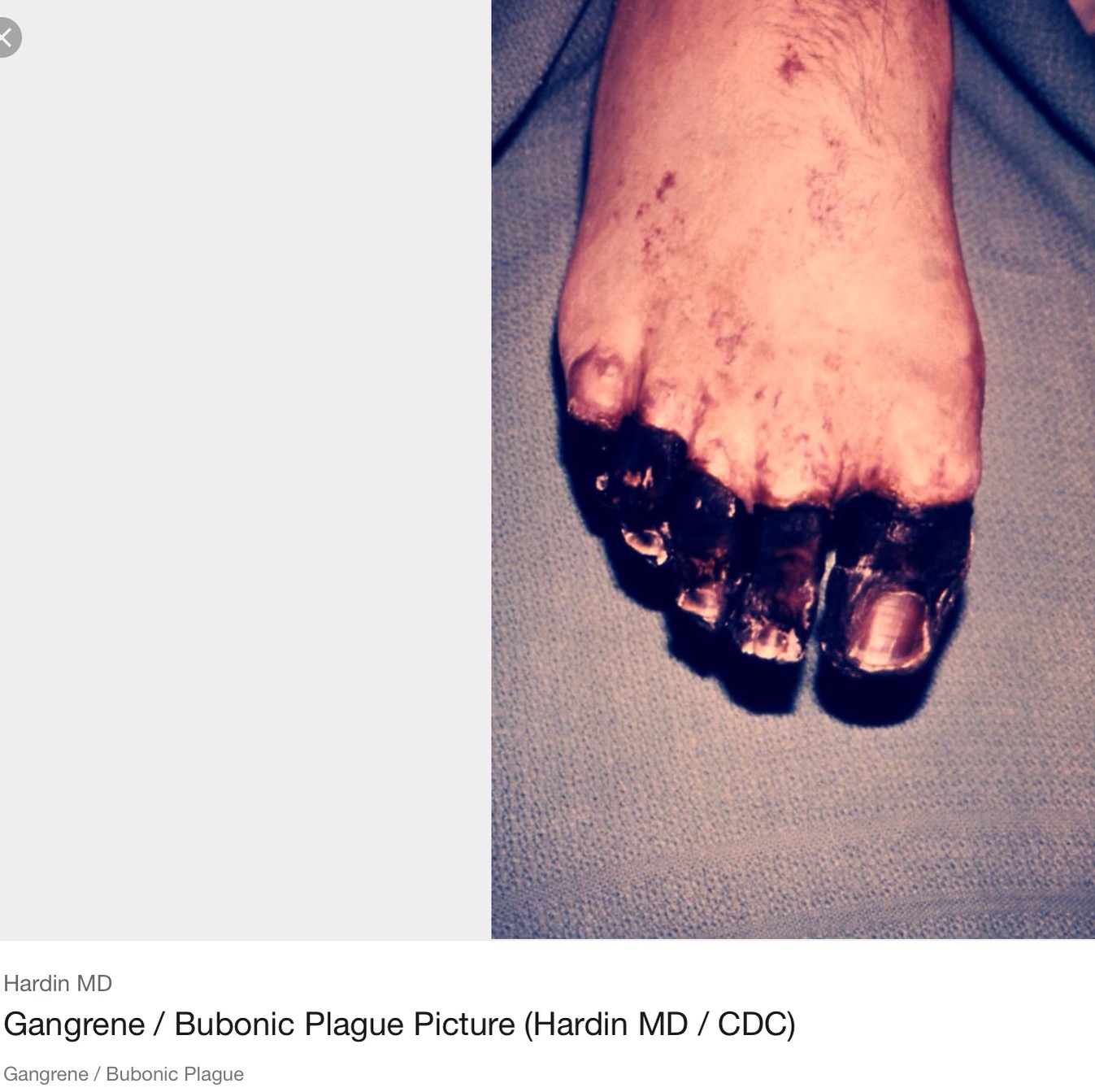
Bubonic plague infection causes tiny blood vessels in the feet and toes to clog up and cut off circulation. Without blood, the flesh dies and turns black (called “gangrene”). This is why in the Middle Ages bubonic plague was called “the Black Death.”

The Black Death, caused by Yersinia pestis, is enzootic (commonly present) in populations of ground rodents in Central Asia. Morelli et al. (2010) reported the origin of the plague bacillus to be in China. An older theory places the first cases in the steppes of Central Asia, and others, such as the historian Michael W. Dols, argue that the historical evidence concerning epidemics in the Mediterranean and specifically the Plague of Justinian point to a probability that the Black Death originated in Central Asia (not Africa – Africa (http://www.medicalnewstoday.com/articles/206309.php) where it then became entrenched among the rodent population.

Nevertheless, from Central Asia it was carried east and west along the Silk Road, by Mongol armies and traders making use of the opportunities of free passage within the Mongol Empire offered by the Pax Mongolica. During the early 1300s they were still expanding their empire.

1300 Mongol invasion of Myanmar

1300 Mongol invasion of Syria

1303 Invasion of Syria

1307 Mongol invasion of Gilan

1312 Mongol invasion of Syria

1324, 1337 Mongol raids against Thrace

1337, 1340 Mongol raids against Poland

The Mongols had divided into Hordes: The Golden Horde, the Blue Horde and the White Horde. Each Horde was led by a descendant of Genghis Khan. One of notorious fame was Jani Beg (who died 1357) also called Djanibek Khan and he was a khan of the Golden Horde from 1342 to 1357, succeeding his father Öz Beg Khan.

After putting two of his brothers to death, Jani Beg crowned himself in Saray-Jük. He is known to have actively interfered in the affairs of Russian principalities and of Lithuania. The Grand Princes of Moscow, Simeon Gordiy, and Ivan II, were under constant political and military pressure from Jani Beg.

Jani Beg commanded a massive Crimean Tatar force that attacked the Crimean port city of Kaffa in 1343. The siege was lifted by an Italian relief force in February. In 1345 Jani Beg again besieged Kaffa; however, his assault was again unsuccessful due to an outbreak of the Black Plague among his troops. It is thought that Jani Beg’s army catapulted infected corpses into Kaffa in an attempt to use the Black Death to weaken the defenders. Infected Genoese sailors subsequently sailed from Kaffa to Sicily, introducing the Black Death into Europe.

But Russia was very cold and the bacterium, fleas and rats would not survive. Once transferred to warmer conditions, the bacteria thrived, and from the start of the plague, only subsided when cold conditions occurred, then reappeared once it was warmer. Thus only pockets of infection spread in the required conditions.

In October 1347, a fleet of Genoese trading ships fleeing Caffa reached the port of Messina in Sicily. By the time the fleet reached Messina, all the crew members were either infected or dead. It is presumed that the ships also carried infected rats and/or fleas. Some ships were found grounded on shorelines, with no one aboard remaining alive.

Looting of these lost ships also helped spread the disease. From there, the plague spread to Genoa and Venice by the turn of 1347–1348.

At Siena, in central Italy’s Tuscany region, Agnolo di Tura wrote:

“They died by the hundreds, both day and night, and all were thrown in … ditches and covered with earth. And as soon as those ditches were filled, more were dug. And I, Agnolo di Tura … buried my five children with my own hands … And so many died that all believed it was the end of the world.”

Italy, returning in the 16th to 17th centuries:

The plague of 1575–77 claimed some 50,000 victims in Venice. 

Italian Plague of 1629–1631, which is associated with troop movements during the Thirty Years’ War.

In 1656 the plague killed about half of Naples’ 300,000 inhabitants. 

From Italy the disease spread northwest across Europe:

France reoccurred The Great Plague of Marseille was the last of the significant European outbreaks of bubonic plague. Arriving in Marseille, France in 1720, the disease killed 100,000 people in the city and the surrounding provinces.

Spain: the Crown of Aragon, the Crown of Castille, The Black Death in Aragon, 1348–1351.

Comparative neglect of the effects of the Black Death in Aragon makes a collection of documents published in 1956 by Dr López de Meneses particularly valuable. Over half the documents, mostly dating between 1348 and 1351, describe the disruption and disorder which occurred in the administrative and economic spheres, and it is on these that this study will focus. King Pedro IV showed flexibility and pragmatism in his treatment of the crisis, but normal administrative processes were only slowly restored, and people took full advantage of the shortage of officials and the loss and discontinuity of legal records. Economically, the royal treasury suffered an almost immediate drop in income. The king could not grant financial aid to his subjects, but lessened taxes and tributes, and frequently interceded on behalf of the Jews. The king also issued useless price and wage controls.The documents shed little light on the problem of mortality dates, but they vividly illustrate the confusion, fraud, and lawlessness which occurred in the aftermath of the plague. There is no indication that the epidemic caused changes in the fundamental character of any Aragonese institution, or that the king’s activities were paralyzed by the crisis. Though grave, the damages of this first plague were not irreparable. See http://www.tandfonline.com/doi/abs/10.1016/0304-4181(81)90014-2

The plague returned to Spain 1647 – 52, known as the Great Plague of Seville.

Portugal 1348-49, like the rest of Europe, Portugal was devastated by the Black Death which probably killed one third of the population.

England by June 1348 – and it recurred over centuries 

In England, in the absence of census figures, historians propose a range of pre-incident population figures from as high as 7 million to as low as 4 million in 1300, and a post-incident population figure as low as 2 million. By the end of 1350 the Black Death had subsided, but it never really died out in England over the next few hundred years: there were further outbreaks in 1361–62, 1369, 1379–83, 1389–93, and throughout the first half of the 15th century. The plague often killed 10% of a community in less than a year—in the worst epidemics, such as at Norwich in 1579 and Newcastle in 1636, as many as 30 or 40%. The most general outbreaks in Tudor and Stuart England, all coinciding with years of plague in Germany and the Low Countries, seem to have begun in 1498, 1535, 1543, 1563, 1589, 1603, 1625, and 1636.

The Great Plague of London in 1665–1666 is generally recognized as one of the last major outbreaks.

From England it spread east through:

Germany (and recurring In 1634, an outbreak of plague killed 15,000 Munich residents). The plague reoccurred in Austria in the Great Plague of Vienna in 1679. 

Scandinavia from 1348 to 1350. Norway in 1349 when a ship landed at Askøy, then proceeded to spread to Bjørgvin (modern Bergen). Oslo was last ravaged in 1654. Amsterdam was ravaged in 1663–1664, with a mortality given as 50,000.

The Black Death hit north-western Russia in 1351. It recurred in Moscow causing the deaths of 200,000, 1654 to 1656. 

Parts of Europe spared in the first spread of the disease:

Poland, isolated parts of Belgium and the Netherlands, Milan and the modern-day France-Spain border.

As it spread to western Europe, the disease arrived in:

Southern Russia

By autumn 1347, the plague reached Alexandria in Egypt, probably through the port’s trade with Constantinople, and ports on the Black Sea. 

During 1348, the disease traveled eastward to Gaza, and north along the eastern coast to cities in Lebanon, Syria, and Palestine, including Ashkelon, Acre, Jerusalem, Sidon, Damascus, Homs, and Aleppo. 

In 1348–49, the disease reached Antioch. The city’s residents fled to the north, most of them dying during the journey, but the infection had been spread to the people of Asia Minor.

Mecca became infected in 1349. During the same year, records show the city of Mawsil (Mosul) suffered a massive epidemic, and the city of Baghdad experienced a second round of the disease. 

In 1351, Yemen experienced an outbreak of the plague. This coincided with the return of King Mujahid of Yemen from imprisonment in Cairo. His party may have brought the disease with them from Egypt.

2017

Most recently, an outbreak of the plague started in Madagascar at the end of August, and has infected 138 people, killing 47. The body count is feared to grow as the disease has now reached Antananarivo, Madagascar’s capital city.  The disease is airborne and could reach the East African coast. See http://www.iflscience.com/health-and-medicine/bubonic-plague-outbreak-spreads-madagascar/

2018
Computer modelling carried out by a research team from the universities of Oslo and Ferrara suggests the first outbreak may not have been down to the rats, but instead can be “largely ascribed to human fleas and body lice”.

Posted in anthropocene | Tagged , , , , , , , , , , , , , | 1 Comment

Trade and Destruction

Trade is all we seem to think about nowadays, and securing trade so that people can go about their lives without fear of starving is a major activity.  Thus, when today we see Qatar blockaded, we see how quickly people suffer when normal trade routes are blocked.  The sanctions imposed on Iraqi citizens, See John Pilger article, leading to starvation of thousands of citizens, is engraved in our minds.  But it was back in the 13th century that European trade really took off, thanks to Mongol leader, Genghis Khan See Biography

One in every 200 men alive today is a relative of Genghis Khan. An international team of geneticists has made the astonishing discovery that more than 16 million men in central Asia have the same male Y chromosome as the great Mongol leader.  It is a striking finding: a huge chunk of modern humanity can trace its origins to Khan’s vigorous policy of claiming the most beautiful women captured during his merciless conquest.

In the time of Genghis, he was known for his powers generated from shamanism. Mongolian shamanism is centered on the worship of the tngri (gods) and the highest Tenger (Heaven, God of Heaven, God) or Qormusta Tengri. In the Mongolian folk religion, Genghis Khan is considered one of the embodiments, if not the main embodiment, of the Tenger. The Mausoleum of Genghis Khan in Ordos City, in Inner Mongolia, is an important center of this worship tradition.

 What is it that makes people rise up against their neighbours and slaughter innocents in such a massive killing spree? In the case of the young Temüjin, when he was 9 his father was killed by a nomadic Mongol tribe known as the Tatars. He would have been the next Khan. Another tribe, the Taichi’uts, exiled his mother and her family to prevent Temüjin’s succeeding in being the next Khan. His mother lived through great hardship trying to bring her young family up. As a young adult, the Taichi’uts took Temüjin prisoner and intended to keep him in lifelong captivity. But Temüjin escaped.

He then became the protege of Toghril, the ruler of the Kereits, a Christian tribe in central Mongolia. It was with the aid of Toghril and a young Mongol chieftain called Jamuka that Temüjin was able to rescue his newly married wife, who had been carried off by the Merkits, a forest tribe in the region which is now the Buryatiya in present-day Russia. For a time after this joint operation Temüjin and Jamuka remained friends, but then, for some obscure reason, a rift developed between them and they parted company. It was at this time that certain of the Mongol princes acclaimed Temüjin as their ruler, bestowing upon him the title by which he is known in history, Chingiz-Khan (Genghis Khan), which bears some such meaning as “Universal Monarch.” See Encyclopaedia

He will forever be a hero to his Mongol people, as he united his once disparate nomadic tribes and took the disjointed and languorous trading towns along the Silk Route, organising them into history’s largest free-trade zone.

But first he and his armies killed more people in 25 years than the Romans had killed in 4 centuries. His soldiers wore more sophisticated armour than their enemies wore.  The magnificent Mongolian horses wore sophisticated armour too.  The saddle on their horses enabled amazing movements of the rider whilst aiming their bows. Their sabres were designed well for slashing and cutting. Their trebuchet designs enabled successful devastation when they laid seige to walled cities.  Their triple crossbow designs fired three arrows vs the single arrow of their enemy. They had superior strategies.  They were inspired by the powerful shaman, Genghis Khan.

According to the works of Iranian historian Rashid-ad-Din Fadl Allah, Mongols massacred over 700,000 people in Merv and more than a million in Nishapur. China suffered a drastic decline in population as a direct result of the Khan: before the Mongol invasion, China had about 100 million inhabitants; after the complete conquest, 1279, the census in 1300 showed it to have roughly 60 million people. As the Mongol Hordes took over the Buddhist believing populations, their shamanism merged with Buddhism.

The invasions of Baghdad,Samarkand, Urgench, Kiev, Vladimir among others caused mass murders, such as when portions of southern Khuzestan were completely destroyed. Genghis’ grandson, Hulagu Khan destroyed much of Iran’s northern part. Hulagu’s army greatly expanded the southwestern portion of the Mongol Empire, founding the Ilkhanate of Persia, a precursor to the eventual Safavid dynasty, and then the modern state of Iran. Under Hulagu’s leadership, the siege of Baghdad (1258) destroyed the greatest center of Islamic power and also weakened Damascus, causing a shift of Islamic influence to the Mamluk Sultanate in Cairo. Genghis was furious about the destruction of Baghdad, but it is said that 800,000 of the inhabitants werekilled, including the caliph – who was executed by being kicked to death. The Mongol violence and depredations killed up to three-fourths of the population of the Iranian Plateau, possibly 10 to 15 million people. 

In much of Russia, Middle East, Korea, China, Ukraine, Poland and Hungary, Genghis Khan and his regime are credited with considerable damage, destruction and loss of population.  The legend about his conquering Nishapur, took a terrible turn when the husband of Genghis Khan’s daughter was killed at Nishapur in 1221, she or Genghis ordered the death of the entire population of the city, which was reputedly 1.7 million. Their skulls were said to have been piled in pyramids by the Mongols.

Nishapur is a city in the Khorasan Province, capital of the Nishapur County and former capital of Province Khorasan, in northeastern Iran, situated in a fertile plain at the foot of the Binalud Mountains. Their turquoise mines have supplied the world with turquoise for at least two millennia. The city was founded in the 3rd century by Shapur I as a Sasanian satrapy capital. Nishapur later became the capital of Tahirid dynasty and was reformed by Abdullah Tahir in 830, and was later selected as the capital of Seljuq dynasty by Tughril in 1037. From the Abbasid era to the Mongol invasion of Khwarezmia and Eastern Iran, the city evolved into a significant cultural, commercial, and intellectual center within the Islamic world. Nishapur, along with Merv, Herat and Balkh were one of the four great cities of Greater Khorasan and one of the greatest cities in the middle ages, a seat of governmental power in eastern of caliphate, a dwelling place for diverse ethnic and religious groups, a trading stop on commercial routes from Transoxiana and China, Iraq and Egypt.
Timelines of the Mongol Hordes:

The first tribe Genghis attacked were the Tatars who had killed his father.

This was the list of murder by the Mongols as they created their empire. (See http://pazhayathu.blogspot.co.uk/2010/11/mass-murderer-genghis-khan-he-took.html)

1202 — Genghis Khan manages to totally exterminate the Tatar tribe (responsible for killing his father)

1215 — Beijing besieged and sacked. (Full conquest of North China not complete until 1234 – after the death of Genghis Khan in 1227)

1219 — war with the empire of Khwarizm, ruled by Sultan Muhammad (covering the present-day countries of Turkmenistan, Uzbekistan, Tajikistan, Afghanistan, and most of Iran). Reaches Otrar. His forces lay siege and capture the town.

1220 — attacks and seizes Bukhara. Capture Samarqand. Finds and kills Sultan Muhammad. Crosses Caucasus mountains and defeats an army of Russians and Kipchak Turks in the Crimea.

1221 — crosses the Oxus into northern Afghanistan. His youngest son sacks towns in Persia. Sultan Jalal al-Din, the son of Sultan Muhammad, wins a battle at Parvan, north of Kabul, Afghanistan, but is then defeated on the banks of the Indus River. Genghis Khan starts back home.

Ghengis died in his sleep, 1227, aged 65. His descendants expand the Mongol Empire.

1231 — Mongols conquer Korea.

By 1235-Subodei had conquered as far as Georgia in 1221 and fought Russians in 1224- led an army of 50,000 Mongols and 100,000 allies north up the Volga River to Bulgaria. Mongke led a force south to take on the Kipchak Turks. Cities that did not agree to hand over ten percent of their wealth as tribute were attacked, and aristocratic rulers were put to death. Captives were enslaved and forced to fight at the front of the Mongol army and were killed if they did not. Kiev was taken in December 1240, looted, and then burned down. Mongol armies swept across Poland to Germany and through Hungary up to Vienna. 

A major battle was fought at Liegnitz on April 9, 1241 as the clever Mongols by retreating lured the German knights into swamps, where 25,000 were killed or captured. Prisoners were sold or put to work; miners helped develop the mineral resources in Dzungaria of western Mongolia. Hungarian king Bela IV retreated from the army of Subodei

The Mongols used burning oil and gun powder to cause panic, forcing the Hungarians to flee toward Pest. There Christian priests marched with bone relics, which offended the Mongols’ religion; two archbishops, a bishop, and many Templar knights were killed. In this war the Europeans lost nearly a hundred thousand knights.

December 1241-Ogodei died of excessive drinking-and the next year the Mongols withdrew from Europe to Russia. They sold their prisoners to Venetian and Genoese merchants, who distributed them in Mediterranean markets; most ended up in Egypt’s slave army.

1253, kept the Mongols out of southern Song China for a while. Mongke and his brothers ruled over an immense empire that was symbolized by a Silver Tree with four serpents that provided drinks

By 1274 the Mongols had assembled ships built in Korea to invade Japan; but after winning a battle on land, a storm destroyed the fleet, and 13,000 invaders were lost. When a large rebellion erupted in Jiangnan- China in 1279, the Mongol army crushed it in 1281 and beheaded 20,000 rebels.

Tibet-1285-The Brigung sect attacked his Saskya sect and the Mongols in 1285. Khubilai sent his son Temur Bukha with an army that destroyed the Brigung monastery and killed 10,000 men in 1290 in Tibet.

In 1281 a Korean fleet invaded Japan again and was to be joined by a Chinese fleet, which arrived late; but again a storm destroyed them, drowning about a hundred thousand. Southern Chinese merchants complained about building 500 more boats for a third invasion, and Khubilai cancelled the campaign in 1286.

 In 1287 the Mongols occupied Hanoi -Vietnam.

Khubilai sent an army to invade Burma in 1283, and in 1287 they occupied Pagan for a few months.

In 1289 Java’s Kertanagara branded the Mongol envoy on his face. A naval expedition with a thousand boats led by Gao Xing went to Java in 1293, but despite the current civil war in Java they fell into an ambush and retreated.

Italian traveler Marco Polo served Khubilai Khan from 1275 to 1291- he wrote that anyone encountered by the funeral procession of a Khan was killed, claiming that 20,000 were put to death when Mongke Khan died in 1259;Khubilai celebrated the religious feasts of all major religions, revering Jesus, Muhammad, Moses, and Sakyamuni (Buddha). He thought the Christian faith was best, because he found its teachings only good and holy. However, with so few Christians in his empire Khubilai would not accept baptism unless the Pope sent him a hundred religious scholars to teach the religion; but his repeated requests for this were ignored.

Marco Polo also described the incredible wealth and luxuries of Khubilai’s court and the speed of his postal messengers, who covered over 200 miles per day on horseback. Marco Polo praised the comfort of stations on the trade routes every twenty or thirty miles. Where possible Khubilai had trees planted along these roads, because his advisors told him those who plant trees live long. In addition to providing food and clothing for the poor, he also supported about 5,000 astrologers and soothsayers. Although the Mongols obviously dominated by using violent warfare, they contributed to world culture by promoting free trade, allowing open communication, sharing knowledge and technology, tolerating religious diversity under a secular state, and encouraging diplomatic immunity. Khubilai died in 1294 and was succeeded by his grandson Temur.

Khanbaliq

Zhongdu, the “Central Capital” of the Jurchen Jin dynasty, was located at a nearby site now part of Xicheng District. It was destroyed by Genghis Khan in 1215 when the Jin court began contemplating a move south to a more defensible capital such as Kaifeng. The Imperial Mint (诸路交钞提举司) established in 1260 and responsible for the printing of chao, the Yuan fiat paper money, was probably located at nearby Yanjing even before the establishment of the new capital.

In 1264, Kublai Khan visited the Daning Palace on Jade Island in Taiye Lake and was so enchanted with the site that he directed his capital to be constructed around the garden. The chief architect and planner of the capital was Liu Bingzhong, who also served as supervisor of its construction. His student Guo Shoujing and the Muslim Ikhtiyar al-Din were also involved

The construction of the walls of the city began in the same year, while the main imperial palace (大内) was built from 1274 onwards. The design of Khanbaliq followed several rules laid down in the Confucian classic The Rites of Zhou, including “9 vertical and horizontal axes”, “palaces in front, markets in back”, “ancestral worship to the left, divine worship to the right”.[clarification needed] It was broad in scale, strict in planning and execution, and complete in equipment.

A year after the 1271 establishment of the Yuan dynasty, Kublai Khan proclaimed the city his capital under the name Dadu although construction was not fully completed until 1293. His previous seat at Shangdu became the summer capital.

As part of the Great Khans’ policy of religious tolerance, Khanbaliq had various houses of worship. It even was the seat of a Roman Catholic Archdiocese of Khanbaliq from 1307 until its 1357 suppression; it was restored in 1609 as (then) Diocese of Peking.

See More on Khanbaliq


And from another source

The continuing timeline: 

1205, 1207–1208, 1209–1210, 1225–1227 invasion of Western Xia

1207 conquest of Siberia

1211–1234 conquest of Jin dynasty

1216–1220 conquest of Central Asia and Eastern Persia

1216–1218 conquest of the Qara Khitai

1219-1220 conquest of Khwarazm

1220-1223, 1235–1330 invasions of Georgia and the Caucasus

1220–1224 invasion of the Cumans

1222–1327 Mongol invasions of India

1223–1236 invasion of Volga Bulgaria

1231–1259 invasion of Korea

1235-1279 conquest of Song dynasty

1222, 1236–1242 Mongol invasion of Europe

1236–1242 invasion of Rus

1237-1238 invasion of eastern and northern Rus’

1239-1240 invasion of southern and western Rus’

1238-1239 invasion of North Caucasus

1238-1240 invasion of Cumania and Alania

1241 invasion of Poland and Bohemia;

1241 Battle of Legnica

1241 invasion of Hungary

1241 Battle of Mohi

1241 invasion of Austria and Northeast Italy

1241–1242 invasion of Croatia

1242 invasion of Serbia and Bulgaria

1240-1241 invasion of Tibet

1241–1244 invasion of Anatolia

1244-1265 invasion of Dali Kingdom

1251–1259 invasion of Persia, Syria and Mesopotamia

1253-1256 invasion of Yunnan

1257, 1284, 1287 invasions of Vietnam

1258 invasion of Baghdad

1258–1260 invasion of Galych-Volhynia, Lithuania and Poland

Sack of Sandomierz

1260 Battle of Ain Jalut

1260 Mongol raid against Syria

1264–1265 raid against Bulgaria and Thrace

1264–1308 invasion of Sakhalin Island

1271 raid against Syria

1274, 1281 invasions of Japan

1274 raid against Bulgaria

1275, 1277 raids against Lithuania

1277 battle of Abulustayn

1277 invasion of Myanmar

1281 invasion of Syria

1284–1285 invasion of Hungary

1285 raid against Bulgaria

1283 invasion of Khmer Empire

1287 invasion of Myanmar

1287–1288 raids against Poland

1293 invasion of Java

1299 invasion of Syria

1300 Mongol invasion of Myanmar

1300 Mongol invasion of Syria

1303 Invasion of Syria

1307 Mongol invasion of Gilan

1312 Mongol invasion of Syria

1324, 1337 Mongol raids against Thrace

1337, 1340 Mongol raids against Poland

Posted in anthropocene | Tagged , , , , , , , , , , , | 2 Comments

The Roman Catholic Church and the institution of Pope

I’ve dipped into Wikipedia, History.com, Brittanica and the book, The Life and Times of Rodrigo Borgia, by Arnold H. Matthew, to outline the process through which the Popes came into being. I wanted to understand the history of Christianity, the role of the Pope at the time Ferdinand II and his second cousin Isabella I were married, and what characteristics made the Conquistadors so determined and so dismissive of those natives of the New World.

Creation of the Roman Church

Since its inception, the Roman Catholic Church became powerful over 7 centuries during the Middle Ages.The struggles for power between kings and popes shaped the western world.

By the time the Roman Empire fell, the Catholic Church had already been created:

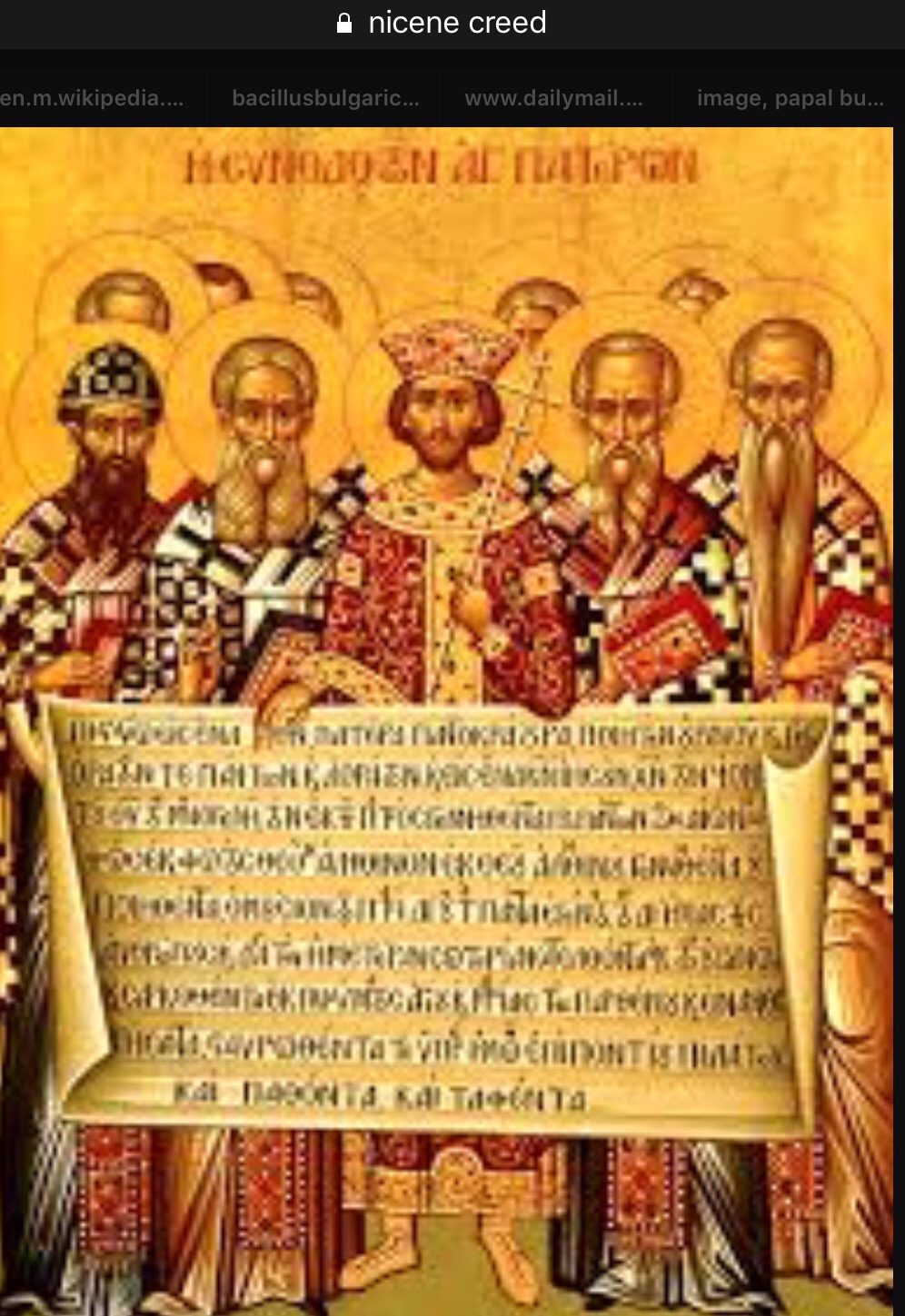
Constantine the Great was born in Naissus, Moesia Superior (modern day Serbia). Constantine was known as the first emperor to claim conversion to Christianity, and was baptised shortly before he died. Emperor Constantine issued the Edict of Milan in 313 proclaiming toleration for the Christian religion, and convoked the First Council of Nicaea in 325 whose Nicene Creed included belief in “one holy catholic and apostolic Church”. 


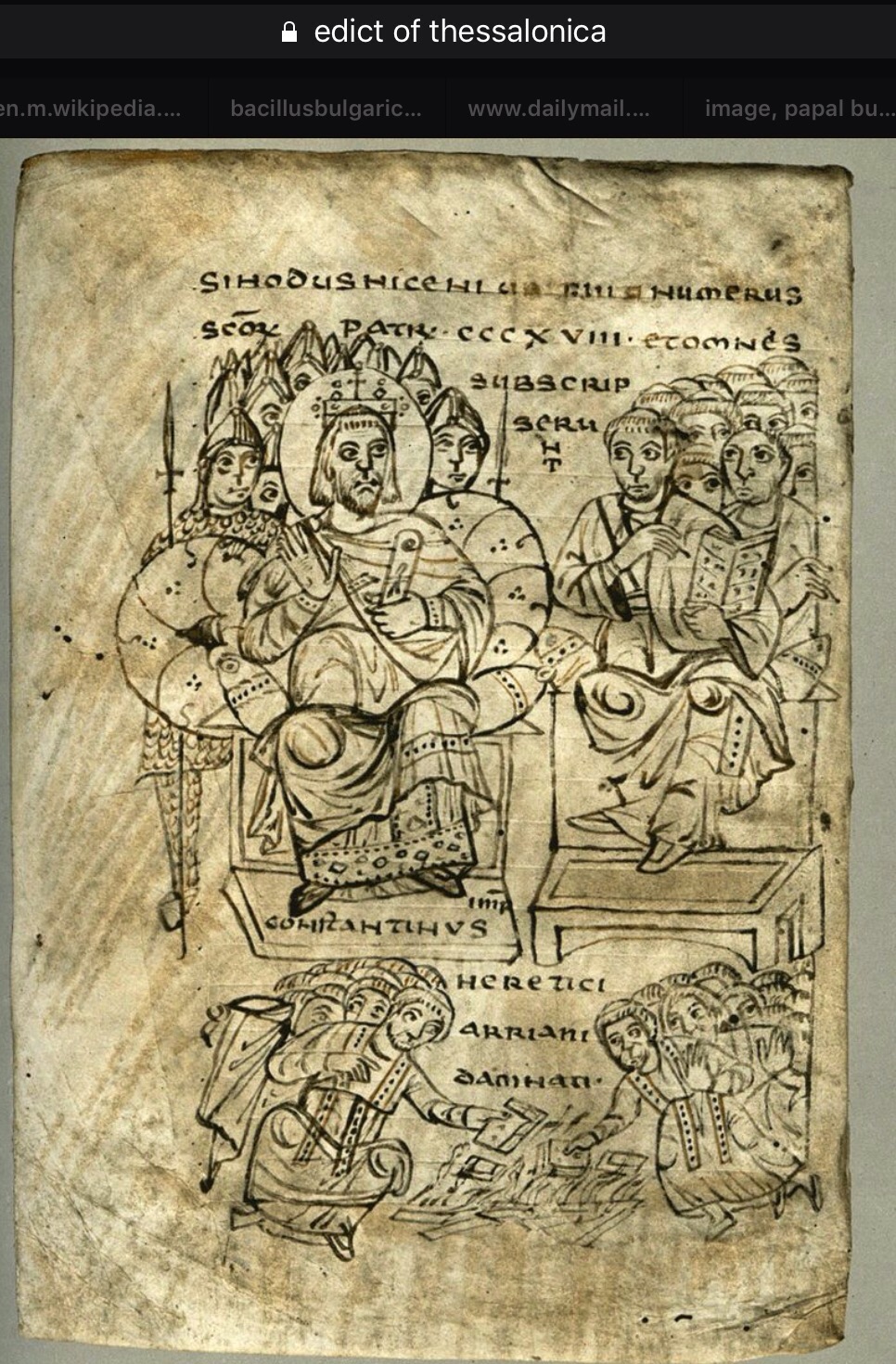
Emperor Theodosius I , born in Hispania, was a very devout Nicene Christian. Theodosius made Nicene Christianity the state church of the Roman Empire with the Edict of Thessalonica of 380.


When the Roman Empire fell in the 5th century, the Emperors were gone, but the Roman Church remained.
As the influence of the Catholic Church spread over the next 5 centuries, the clergy developed a model of church-state relations which was accepted by various Church and political leaders in European history until its eventual rejection by Martin Luther and Henry VIII.

During the Middle Ages, it was customary to classify the population of Christendom into laboratores (workers), bellatores (soldiers), and oratores (clergy). The last group, though small in number, monopolized the instruments and opportunities of culture, and ruled with almost unlimited sway half of the most powerful continent on the globe. This power created a hierarchy of institutionalised respect from workers and soldiers.

Major events were perpetrated when the Catholic Church’s authority peaked over all European Christians and the common endeavours of the Christian community. Examples include  the Crusades, the ejection of Muslims and Jews from the Iberian Peninsula and the conflict with Muslims of the Ottoman Empire. 

Creation of the institution of Pope

I found that the early popes retained their birth names, but after 533 they chose a new name upon their accession. Names are freely chosen by popes, and are not based on any system. Names of immediate or distant predecessors, mentors, saints, or even family members—as was the case with John XXIII—have been adopted.

Where the person-to be-pope was born was also was a factor, since the most powerful and influential position in Europe was sought by many ambitious families.

The Crusades

First Crusades 1095: Pope Urban II called on Christians from Western Europe to go to war against Muslim forces in the Holy Land. Urban denigrated the Muslims, exaggerating stories of their anti-Christian acts, and promised absolution and remission of sins for all who died in the service of Christ. As nobles and poor alike were usually squabbling, this plea focused their minds and they were inspired by Urban to believe they were to fight a righteous war to help their fellow Christians in the East and to take back Jerusalem. All told, between 60,000 and 100,000 people responded. 

Urban’s war cry caught fire, mobilizing clerics to drum up support throughout Europe for the crusade against the Muslims and to march on Jerusalem. Many European nobles saw their chance to increase land holdings and gain riches from the conquest. These nobles were responsible for the death of a great many innocents both on the way to and in the Holy Land, absorbing the riches and estates of those they conveniently deemed opponents to their cause. Although many of the untrained Christian peasants were hacked to death by professional Muslim soldiers, their superior numbers ensured that the Christians ultimately prevailed.

After the First Crusade achieved its goal with the capture of Jerusalem in 1099, the invading Christians set up several Latin Christian states, even as Muslims in the region vowed to wage holy war (jihad) to regain control over the region.

Deteriorating relations between the Crusaders and their Christian allies in the Byzantine Empire culminated in the sack of Constantinople in 1204 during the Third Crusade. 

Near the end of the 13th century, the rising Mamluk dynasty in Egypt provided the final reckoning for the Crusaders, toppling the coastal stronghold of Acre and driving the European invaders out of Palestine and Syria in 1291.

The fight against the Moors ( see  Overview ) in the Iberian Peninsula:

In 801, Charlemagne captured Barcelona and established Frankish control over the Spanish March, the region between the Pyrenees and the Ebro River. 

Asturian kings, presenting themselves as the heirs to the Visigothic monarchy which had ruled Spain prior to the Muslim conquest, capitalized on dissension within the Moorish ranks and expanded their holdings in the late 9th century. 

There was a resurgence of the Córdoban caliphate and a break between the Christian kingdoms of Castile and León in the 10th century.

Christian lands of northern Spain were briefly united under Sancho III Garcés (Sancho the Great), who greatly expanded the holdings of Navarre. Sancho created the kingdom of Aragon in 1035, and his successors there pursued the Christian reclamation of the peninsula in earnest. 

Alfonso I of Aragon captured the former Moorish capital of Zaragoza in 1118. 

In 1179 Alfonso II of Aragon and Alfonso VIII of Castile concluded the Pact of Cazorla, an agreement whereby the task of reconquering the Moorish kingdom of Valencia was reserved to the Aragonese crown. In exchange, Aragon relinquished all claims to other Moorish-held territory in the peninsula.

After suffering a crushing defeat at the Battle of Alarcos (July 18, 1195) at the hands of the Almohad caliph Abū Yūsuf Yaʿqūb al-Manṣūr, Alfonso VIII appealed to other Christian leaders.

In 1212 he won the support of Pope Innocent III, who declared a Crusade against the Almohads. Supported by the armies of Aragon, Navarre, and Portugal, Castilian forces routed the Almohad emir of Morocco, Muḥammad al-Nāṣir, at Las Navas de Tolosa (July 16, 1212) and so removed the last serious Islamic threat to Christian hegemony in Spain. The way was now open to the conquest of Andalusia.

The last king of León, Alfonso IX, was succeeded upon his death in 1230 by his son, Ferdinand III, who was already king of Castile. Castile and León were thus reunited, and the new sovereign at once embarked on a great series of campaigns to subdue Andalusia.

Those began with:

-the capture of Córdoba (1236) and culminated in 

-the surrender of Sevilla (1248). 

Influenced by the crusading zeal instilled into the Spanish church by the Clunia and Cistercian orders, Ferdinand at first expelled the Moorish inhabitants of the Andalusian cities en masse but was later forced to modify his policy by the collapse of the Andalusian economy that inevitably ensued. 

James I of Aragon completed Aragon’s part in the Reconquest:

– Occupied the Balearics (1235)

– Captured Valencia (1238). 

Unlike Ferdinand, James carefully worked to preserve the agricultural economy of the Moors and so established the final peninsular frontiers of Aragon.

In Portugal, Afonso III captured Faro (1249), the last Moorish stronghold in the Algarve. By the end of the 13th century, the Reconquest was, for all practical purposes, brought to an end. 

The last significant Muslim incursion into Christian Iberia culminated with the Battle of Río Salado (October 30, 1340), where Portuguese and Castilian forces administered a crushing defeat to the armies of Marīnidsultan Abū al-Ḥasan 

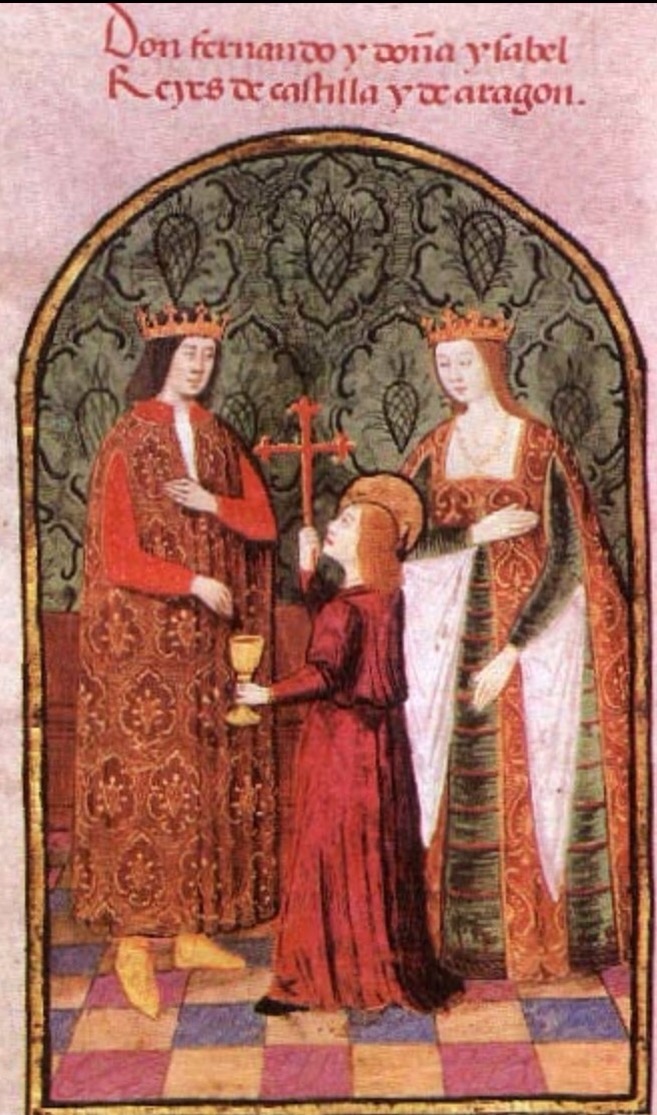
The kingdoms of Aragon, Castile, and Portugal spent the next century consolidating their holdings, until the marriage of Ferdinand II of Aragon and Isabella I of Castile in 1469 united the Spanish crown. 

The Catholic Monarchs, as Ferdinand and Isabella came to be known, completed the conquest of Granada in 1492.  In the same year,  on the night of August 10-11, 1492 , the name of Spaniard, Rodrigo Borgia was drawn out of the electoral chalice. At dawn a window of the Conclave was opened and the election of Pope Alexander VI made known…..The news of Borgia’s election excited much displeasure in certain quarters, though we can hardly credit Guicciardini’s assertion that all men were filled with dismay, and that Ferrante of Naples, one of the most keen-sighted rulers of the day, told his wife with tears—tears which he had not shed even at the death of his two sons—“ This election will not only undermine the peace of Italy, but that of the whole of Christendom”.

Many historians believe that the crusading spirit of the Reconquista was preserved in the subsequent Spanish emphasis on religious uniformity, evidenced by the strong influence of the Inquisition and the expulsion of people of Moorish and Jewish descent.

  The Iberian reconquest, which began as a traditional war of conquest, became a crusade against Islam and fused an Iberian Catholicism that Spain and Portugal later transplanted around the globe. In the early 21st century its members represented nearly half of the world’s Roman Catholics. The Crusades (1095–1396) produced among many Christians an adversarial approach to those of other faiths and helped to develop a sense of communal identity against the obstacle of Europe’s deep political divisions. (Brittanica)

Posted in anthropocene | Leave a comment

Caves and Monasteries of the Iberian Peninsula

Since the 5th century A.D., the Christian religion was practised in the northern half of the Iberian Peninsula. Generally, in those early times, a person would live in isolation as a hermit. One of the earliest sites of a hermitage is beneath the monastery of Suso where Saint Emilian (Spanish: San Millán) lived. 

Saint Aemilian (in Latin Emilianus or Aemilianus) is an Iberic saint, born on November 12, 472 & died on June 11, 573. He was widely revered throughout Spain, and he lived during the age of Visigothic rule.


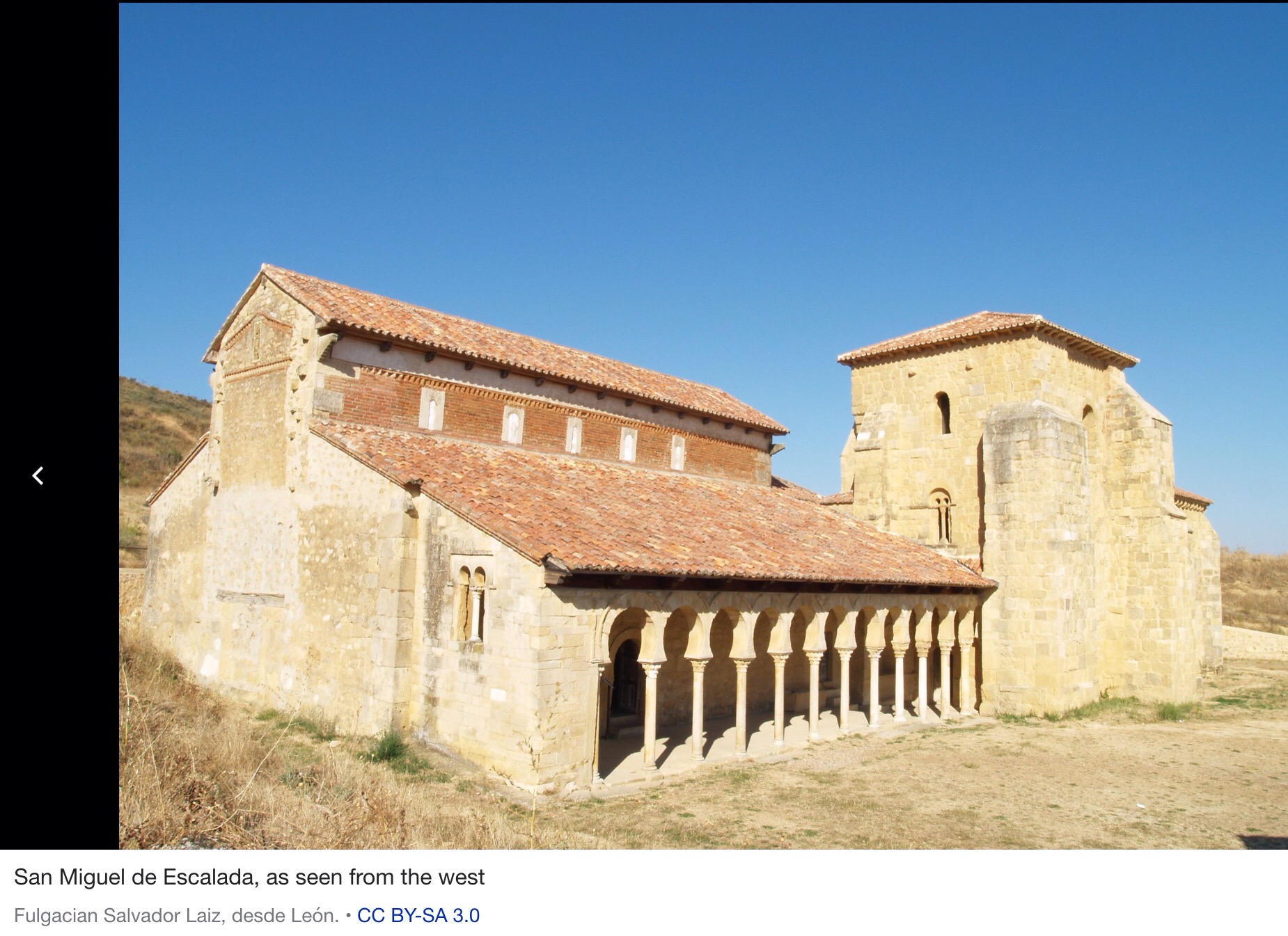
By the time of the Muslim Moorish Kings, there emerged Mozarabic, the Christian inhabitants of the Iberian Peninsula. They constructed small monasteries during the sixth and seventh centuries. Many of these buildings reflect the traditional style of Mozarabic. One example of such a building is San Miguel de Escalada in the province of León, Spain, located 10 km from the Way of St. James pilgrimage route to Santiago de Compostela. The building is an example of Mozarabic art and architecture or Repoblación art and architecture.


The second phase was developed with the arrival from France of the Benedictines of Cluny, during the Reconquista and several new orders developed at this time: Cistercian, military orders, Premonstratensian, Carthusians, Jeromes, Augustinians, Camaldolese and beggars.

The establishment of monasteries during the Middle Ages was paramount from a social and cultural standpoint, benefiting the arts and agriculture.

Monasteries are much less numerous in the south, Andalusia and the Canary Islands.

Posted in anthropocene | Leave a comment

Forceful Woman

Isabella of Portugal was married to King John II of Castile as his second wife, making her also Queen of Castille. Her stepson became Henry IV of Castille.

Isabella was 19 when she married John, who was 42. After a difficult birth of her daughter, born 1451, she developed a serious case of post natal depression and became mentally unstable. This led to her paranoia about the unwanted influence of a friend of her husband’s. She then conspired to incriminate him in a killing and he was executed for the crime. She believed she was haunted by the ghost of the dead man.

 She had a son, Alfonso in 1454, a few months after her husband John II died. Isabella’s stepson, Henry IV, only 3 years her elder, became king of Castille, and he banished his stepmother to the Castle of Arévalo. Here, Isabella and her small children struggled to live in austerity, which further damaged her mental state.

Isabella ensured her daughter and namesake observed practical piety and a deep reverence for religion. But she became more paranoid and ill, the children were removed from her around 1461, and young Isabella, who was to become the wife of Ferdinand, did not see her mother again until she was dying in 1496.  

When Henry IV’s wife, Joan of Portugal, was about to give birth to their daughter Joanna, Isabella and Alfonso were summoned to court (Segovia) to come under the direct supervision of the King and to finish their education. Alfonso was placed in the care of a tutor while Isabella became part of the Queen’s household. This meant a considerable improvement in living conditions for the children. Henry forbade Isabella from leaving Segovia or involving herself in local feuding. But she was well aware of what was going on around her.

Those making trouble for Henry were noblemen, anxious for power and demanding that Alfonso be named his successor. The nobles had gained control of Alfonso, and fought to make him heir at the Second Battle of Olmedo in 1467. The battle was a draw. Henry agreed to recognise Alfonso as heir presumptive, provided that he would marry his daughter, Joanna. Soon after he was named Prince of Asturias;  Alfonso died in July 1468, perhaps of the plague. 

One other version of what befell Alfonso was that he died in suspicious circumstances and perhaps Isabella suspected that he had been murdered. Isabella had no reason to trust her half brother, Henry. Although he knew she had made her debut in the matrimonial market at the tender age of six, with a betrothal to Ferdinand. Ferdinand was the favourite and the younger son of John II of Aragon (whose family was a cadet branch of the House of Trastámara). Henry he was always trying to marry his half sister off to other financially suitable prospects to bolster his plans for his future heirs. But she had made her decision her co monarch would be Ferdinand and John II of Aragon secretly negotiated the wedding to his son Ferdinand. It seems she did not tell Henry when she was going to Valladolid to marry Infante Ferdinand of Aragon. Instead, she eloped, saying she was going to see her brother’s tomb in Ávila.

The marriage of Isabella and Ferdinand took place on 18 October 1469.

Since 1295, the remaining Muslim presence was in Southern Spain,  Grenada. Isabella was determined to expel them and it took until 1492 for her to do so.  This will be covered in my blog, Forceful Woman, Part II.

Posted in anthropocene | 3 Comments

Coveted Gold

The motivation of humans to control others, destroy those who stand in their way, seems to spring from coveting that which belongs to others.

I have researched the hunger for gold prior to the desire of Columbus to set sail in 1492 to seek Asia.  Along with that research, I have found that the link to that desire to find Asia sprang from the knowledge of the African Moors. King Ferdinand and Queen  Isabella, in the name of the spreading of Catholicism, were to abolish the Muslim and Jewish faiths from Spain prior to Colombus setting sail.

I hereby share this with you and hope you find it relevant, as I do, to the troubles we have today in our unhappy world.

Flakes of gold have been found in Paleolithic caves, then appear in fourth millennium B.C. in Egypt, archaeologists found mostly beads and other modest items used for personal adornment. Gold jewelry intended for daily life or use in temple or funerary ritual continued to be produced throughout Egypt’s long history. Egypt was a land rich in gold, mined from the Eastern Desert with access to the riches of Nubia. Gold was found all over the world, but countries that dominate today are China (as of 2015, the world’s largest gold producer with 455 tonnes. China purchased a secret gold vault in London from Barclays). The second-largest producer, Australia, mined 270 tonnes in the same year, followed by Russia with 250 tonnes.

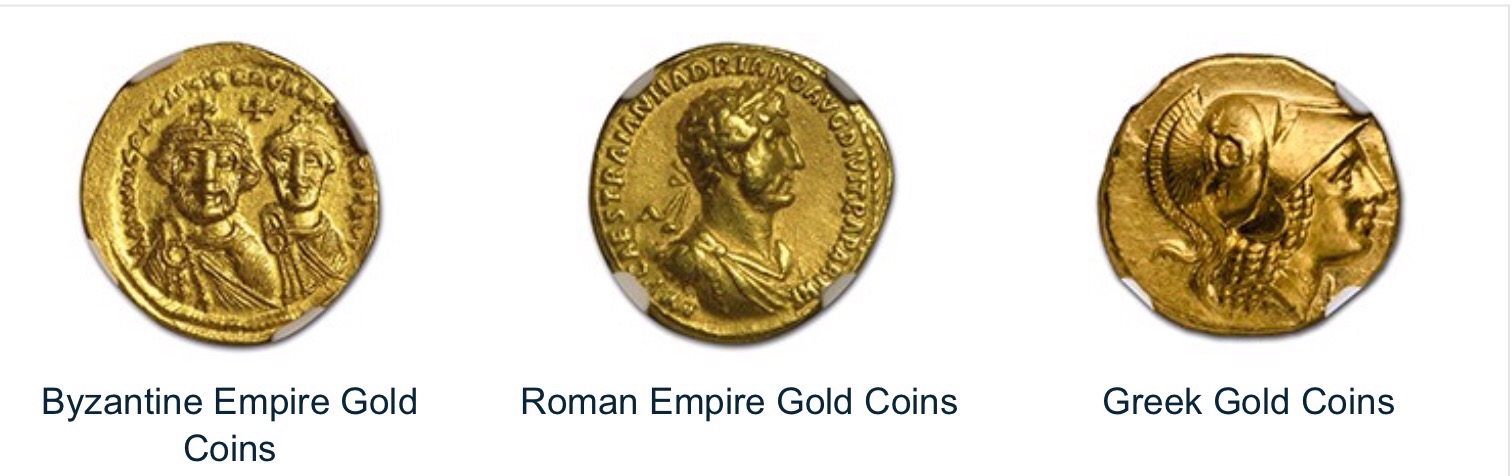
Gold has always been powerful stuff. The earliest history of human interaction with gold is long lost to us, but its association with the gods, with immortality, and with wealth itself are common to many cultures throughout the world.Gold was money in ancient Greece. The Greeks mined for gold throughout the Mediterranean and Middle East regions by 550 B.C., and both Plato and Aristotle wrote about gold and had theories about its origins.Gold gave rise to the concept of money itself: portable, private, and permanent. Gold (and silver) in standardized coins came to replace barter arrangements, and made trade in the Classic period much easier. The first money in the form of gold coins appeared about 700 B.C. The Greeks developed more efficient gold mining technology. 

The Roman Empire furthered the quest for gold. The Romans mined gold extensively throughout their empire, and advanced the science of gold-mining considerably. They diverted streams of water to mine hydraulically, and built sluices and the first ‘long toms.’ They mined underground, also, and introduced water-wheels and the ‘roasting’ of gold-bearing ores to separate the gold from rock. They were able to more efficiently exploit old mine-sites, and of course their chief laborers were prisoners of war, slaves, and convicts.

When the Visigoths migrated to the Western Roman Empire in the 370s they became significantly romanized. In 418 they were recognised as foederati, and were granted Aquitane by Honorius. This was the first centre of the Visigothic Kingdom, which over the course of the fifth century extended over the Pyrenees, including a significant portion of Hispania. In the first half of the seventh century, after the fall of the Kingdom of the Suebi (in c. 585) and the final abandonment of continental Spain by the Byzantine Empire, the Visigoths became sovereign rulers of most of the Iberian peninsula. The resulting state survived until the Islamic invasion of 711.

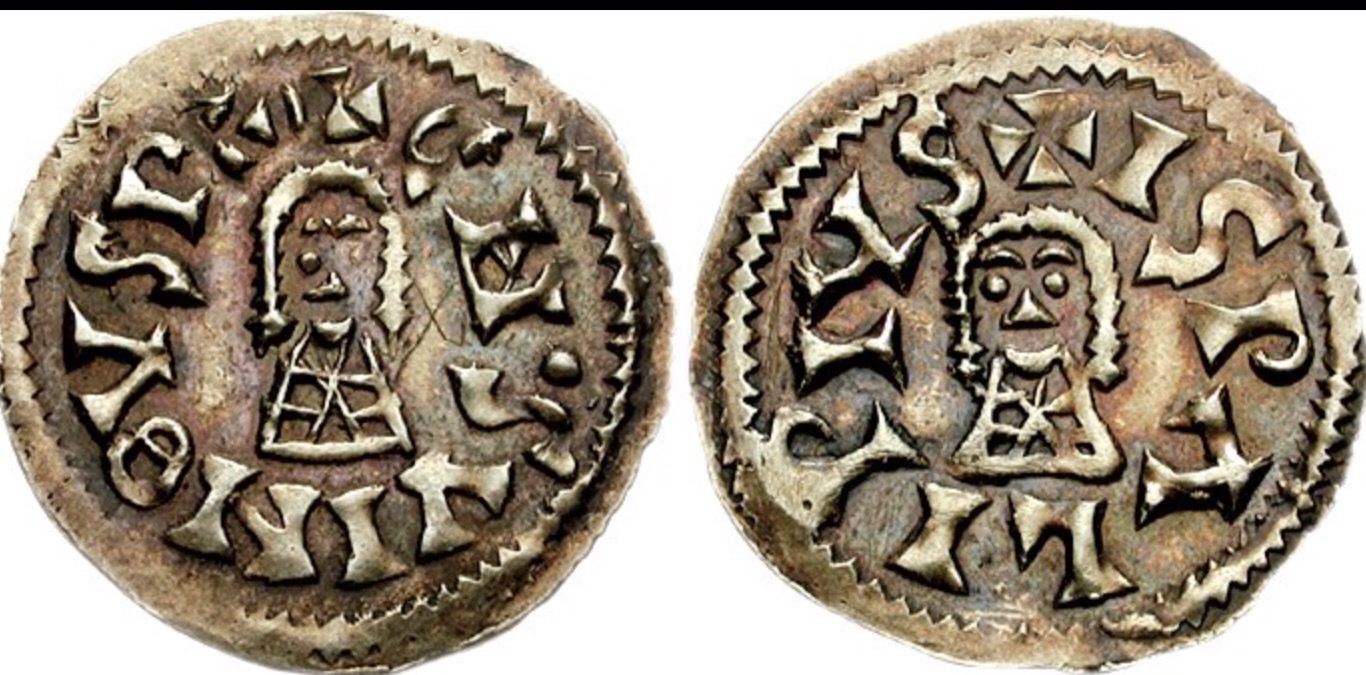
The Goths of Narbonne definitely had a mint during the reign of Liuvigild in the late 6th century, but minting likely already started in 507, when the city became the capital of the Visigothic Kingdom. The Visigothic coinage in Gaul were initially imitations of Western Roman coinage, which ended in around 481. After 509, imitations of Byzantine coinage follow, starting with those of Anastasius I Dicorus.


When the Moors became rulers after the Visigoths, they transformed Spain further. The gold coinage was named  maravedí comes from marabet or marabotin, a variety of the gold dinar struck in Spain by, and named after, the Moorish Almoravids (Arabic المرابطون al-Murābitũn, sing. مرابط Murābit). 

 The Moors, who ruled Spain for 800 years, introduced new scientific techniques to Europe, such as an astrolabe, a device for measuring the position of the stars and planets. Scientific progress in Astronomy, Chemistry, Physics, Mathematics, Geography and Philosophy flourished in Moorish Spain.

Education was universal in Moorish Spain, available to all, while in Christian Europe ninety-nine percent of the population were illiterate, and even kings could neither read nor write. At that time, Europe had only two universities, the Moors had seventeen great universities! These were located in Almeria, Cordova, Granada, Juen, Malaga, Seville, and Toledo.

The Moors introduced many new crops including the orange, lemon, peach, apricot, fig, sugar cane, dates, ginger and pomegranate as well as saffron, sugar cane, cotton, silk and rice which remain some of Spain’s main products today.

The Moorish rulers lived in sumptuous palaces, while the monarchs of Germany, France, and England dwelt in big barns, with no windows and no chimneys, and with only a hole in the roof for the exit of smoke. One such Moorish palace ‘Alhambra’ (literally “the red one”) in Granada is one of Spain’s architectural masterpieces. Alhambra was the seat of Muslim rulers from the 13th century to the end of the 15th century. The Alhambra is a UNESCO World Heritage Site

It was through Africa that the new knowledge of China, India, and Arabia reached Europe. The Moors brought the Compass from China into Europe. See http://www.blackhistorystudies.com/resources/resources/15-facts-on-the-moors-in-spain/

Posted in anthropocene | Tagged , , , , , , , , , , , , , | Leave a comment

Retaking the Iberian Peninsula (Reconquista)

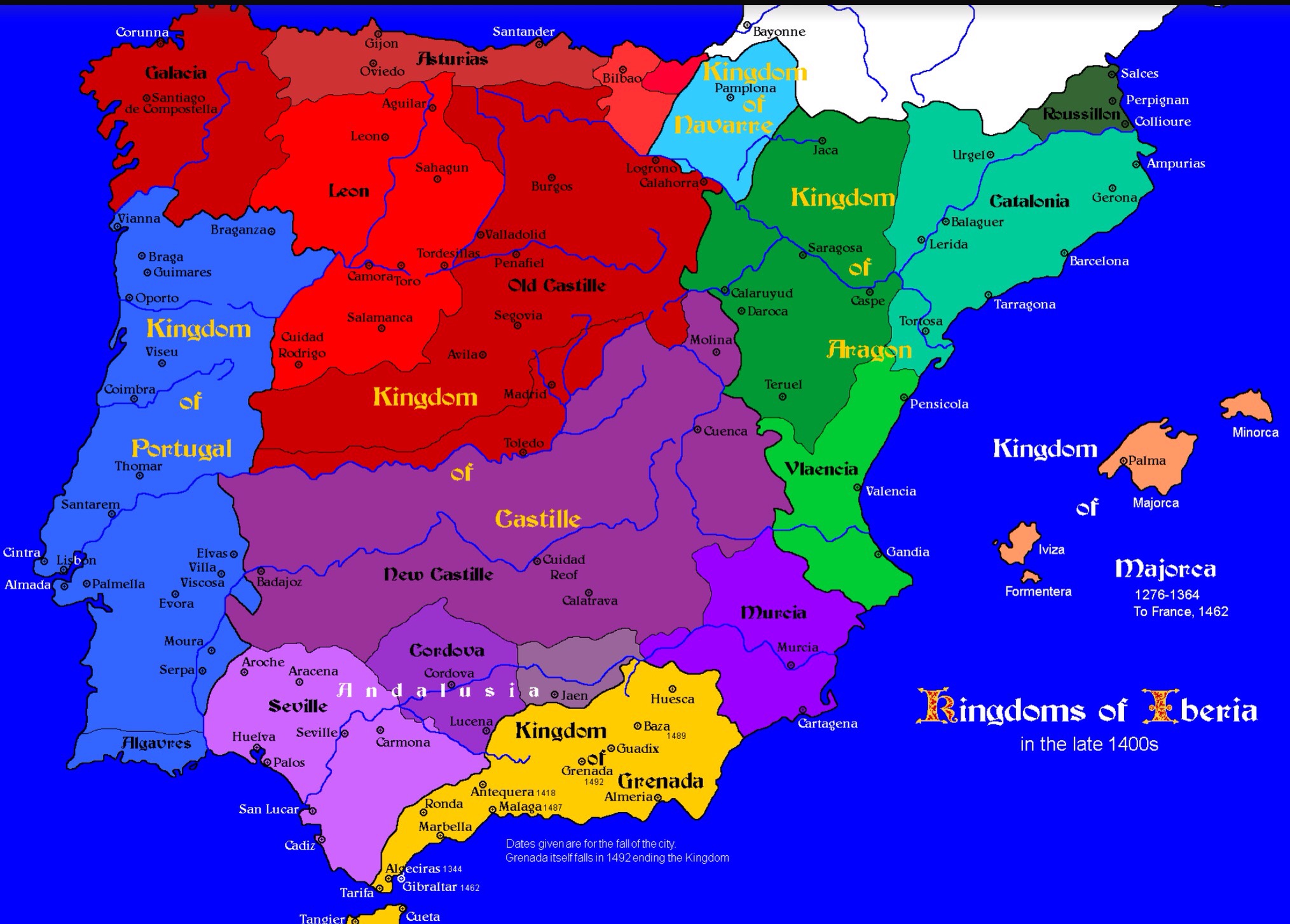
The MAPS of the 750 AD period to 1492 reveal how the 800 years of Muslim rule as a Caliphate was eventually overthrown by use of mercenaries (Conquistadors) of the Monarchy in 1492.  These are fascinating maps, interactive and highly illuminating to someone new to this unfolding significant part of history.  The power of a succession of Popes to influence the outcome of marriages between the various self created monarchy lines was vital. I recommend further reading on the subject of illegitimate, interbred aristocracy imposed on the peoples of a disunited landmass which eventually became known as a united Spain. The religious Catholic zeal grew out of the French Inquisition of the 12th century. Gradually it became a uniting belief to spread the faith and seek wealth through exploration of, as yet, unknown territory.

Coming to power in 1369, the House of Trastámara was a lineage of rulers of the Castilian and Aragonese thrones. The line of Trastámaran royalty in Castile ruled throughout a time period of military struggle with Aragon. Their family was sustained with large amounts of inbreeding, which led to a series of disputed struggles over rightful claims to the Castilian throne. This lineage ultimately ruled in Castile from the rise to power of Henry II in 1369 through the unification of the crowns under Ferdinand and Isabella.

Ferdinand was King of Sicily and heir to the Aragonese throne. He was the brother of Henry III and after his demise and that of Henry’s son, John II, who left a two year old son, Ferdinand, served as regent to the throne, along with John’s mother, Catalina of Lancaster. During his time as regent, Ferdinand was chosen as the ruler of Aragon, due to his maternal relation to the Aragonese throne, through the Compromise of Caspe in 1412. The Trastámaras now ruled in both the realms of Castile and Aragon.

Ferdinand was betrothed to Isabella when they were 6 years old.  It was a difficult process for them to finally achieve this marriage from which major changes in the world flowed.

Posted in anthropocene | Tagged , , , , , , , , , , , , , , | Leave a comment